ISS Slow Scan TV Pictures

RS0ISS SSTV 20130904 1125Z - Image credit Pete Sipple M0PSX

RS0ISS SSTV 20130904 1125Z – Image credit Pete Sipple M0PSX

Pete Sipple M0PSX received these Slow Scan TV images from the International Space Station on September 4-5, 2013.

RS0ISS SSTV 20130905 1228Z - Image credit Pete Sipple M0PSX

RS0ISS SSTV 20130905 1228Z – Image credit Pete Sipple M0PSX

Other images received by Pete during the two-day MAI-75 SSTV experiment on the ISS can be seen at:

04 Sept 2013 http://www.essexham.co.uk/news/iss-sending-sstv-04-sept-13.html

05 Sept 2013 http://www.essexham.co.uk/news/images-from-iss-05-sept-2013.html

Space Station Slow Scan TV Active https://amsat-uk.org/2013/09/04/space-station-slow-scan-tv-active/

Advanced notification of SSTV activity from the ISS is usually posted at http://ariss-sstv.blogspot.nl/

RS0ISS SSTV 20130905 1035Z - Image credit Pete Sipple M0PSX

RS0ISS SSTV 20130905 1035Z – Image credit Pete Sipple M0PSX

Space Station Slow Scan TV Active

RS0ISS SSTV Sept 4, 2013 0950Z - Image credit Dmitry Pashkov UB4UAD

RS0ISS SSTV Sept 4, 2013 0950Z – Image credit Dmitry Pashkov UB4UAD

Dmitry Pashkov UB4UAD has posted two images that he received on 145.800 MHz FM from the International Space Station (ISS) on Wednesday, September 4, 2013.

All you need to do to receive the SSTV pictures from the space station is to  connected the audio output of a scanner or amateur rig via a simple interface to the soundcard on a Windows PC or an Apple iOS device, and tune in to 145.800 MHz FM. You can even receive pictures by holding an iPhone next to the radio’s loudspeaker.

The ISS puts out a strong signal on 145.800 MHz FM and a 2m handheld with a 1/4 wave antenna will be enough to receive it. The FM transmission uses 5 kHz deviation which is standard in much of the world.

Many FM rigs in the UK can be switched been wide and narrow deviation FM filters so select the wider deviation. Handhelds all seem to have a single wide filter fitted as standard.

RS0ISS SSTV Sept 4, 2013 0953Z - Image credit Dmitry Pashkov UB4UAD

RS0ISS SSTV Sept 4, 2013 0953Z – Image credit Dmitry Pashkov UB4UAD

On Windows PC’s the free application MMSSTV can be used to decode the signal, on Apple iOS devices you can use the SSTV app. The ISS Fan Club website will show you when the space station is in range.

For more on Slow Scan Television SSTV, see this article SSTV – The Basics.

How to be successful with the ISS Slow Scan Television (SSTV) imaging system
http://www.marexmg.org/fileshtml/howtoisssstv.html

Information on the MAI-75 SSTV experiment
http://www.energia.ru/eng/iss/researches/education-26.html

IZ8BLY Vox Recoder, enables you to record the signals from the ISS on 145.800 MHz while you’re away at work http://antoninoporcino.xoom.it/VoxRecorder/

For the latest status of amateur radio activity on the ISS and real time tracking see http://www.issfanclub.com/

ARISS Slow Scan TV (SSTV) Blog and Gallery http://ariss-sstv.blogspot.co.uk/

Ham Video transmitter onboard ISS Columbus module

International Space Station ISS with shuttle Endeavour 2011-05-23

How a DATV transmitter on S-band is being added to the ARISS equipment onboard the International Space Station has been related in an announcement recently circulated and available at

http://www.ariss-eu.org/HamVideo.pdf
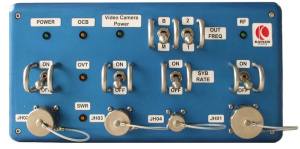
Front panel of the HamTV transmitter

Front panel of the HamTV transmitter

The ARISS Ham Video transmitter is presently onboard Columbus. The transmitter was delivered by Japanese cargo spacecraft HTV-4, which launched August 4 and docked 5 days later.

ESA astronaut Luca Parmitano KF5KDP / IR0ISS reported that the bags are stored in Columbus. There are two bags: one for the transmitter, the other for the power, camera and antenna cables.

Installation will be done by US astronaut Michael Hopkins KF5LJG who has been trained for the commissioning of the Ham Video equipment.The commissioning is planned later in the year, possibly end October when there are favourable passes over Italy. Indeed, the tests transmissions for the commissioning of the onboard equipment will be received by the ground station of the “Centro di Geodesia Spaziale” of the Italian Space Agency, located in Matera, Southern Italy.
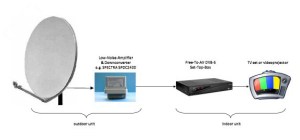
A basic amateur radio station that should be able to receive HamTV from ISS - Image AMSAT-Italia

A basic amateur radio station that should be able to receive HamTV from ISS – Image AMSAT-Italia

We will report in due time on the commissioning procedure which will involve a series of tests to be performed during 3 or 4 ISS passes.

Possibly, the Ham Video transmitter will transmit continuously between the commissioning steps offering amateur ground stations the opportunity to test and tune their receiving equipment. The transmissions will be performed in automatic mode, without requiring crew time. The camera, which runs on a battery, will not be used and the ground stations will receive a black image.

Meanwhile, commissioning is being prepared steadily. The kick-off meeting took place November 2012 at ESTEC, the European Space Research and Technology Centre, located in Noordwijk the Netherlands.  Detailed procedures are examined and finalized during weekly ESA/ARISS teleconferences. A preliminary EST (Experiment Sequence Test) is planned August 28-29. The test will involve the ARISS ground station IK1SLD, located in Casale Monferrato in Northern Italy.

One of the Columbus Module  2.4 / 1.2 GHz Antennas

One of the Columbus Module 2.4 / 1.2 GHz Antennas

IK1SLD, which is an ARISS telebridge station often used for educational ARISS school contacts on VHF, has been upgraded for S-band reception. Ham Video manufacturer Kayser Italia has delivered a 1.2 meter dish, a down converter and precision tracking motors, which are part of the ESA funded equipment. For the EST, the station will receive a DATV signal from a local low power S-band test transmitter. The decoded signal will be webstreamed to the BATC server. The British Amateur Television Club offers ARISS free access to their server. ESA examiners will connect to the BATC server and evaluate the reception. Test transmissions at IK1SLD will cover the different frequencies and symbol rates available on the Ham Video transmitter.

Web streaming will take advantage of the special software developed by Jean Pierre Courjaud, F6DZP. References are available in the HamVideo.pdf.

When the Ham Video transmitter will become operational, it will be used for ARISS educational school contacts. Video will be for downlink only. Uplink will be VHF FM audio. The Ericsson transceiver onboard Columbus will be used for reception onboard. This cross band and double mode operation is called Ham TV. Ham Video is the name of the DATV transmitter.

73,

Gaston Bertels – ON4WF
ARISS-Europe chairman
This Bulletin is available from the frontpage of http://www.ariss-eu.org/

Radio ham describes “nearly drowning” during space walk

Luca Parmitano KF5KDP / IR0ISS  on Expedition 36 EVA July 9, 2013 - Image credit ESA

Luca Parmitano KF5KDP / IR0ISS
on Expedition 36 EVA July 9, 2013 – Image credit ESA

“I can’t even be sure that the next time I breathe I will fill my lungs with air and not liquid”

These are the words of Luca Parmitano KF5KDP / IR0ISS describing his recent space walk during which his spacesuit leaked.

Read his blog – EVA 23: exploring the frontier
http://blogs.esa.int/luca-parmitano/2013/08/20/eva-23-exploring-the-frontier/

Radio Ham’s Leaky Spacesuit
https://amsat-uk.org/2013/07/31/radio-hams-leaky-spacesuit/

Astronaut Luca Parmitano KF5KDP talks about his ham radio contacts
https://amsat-uk.org/2013/08/14/astronaut-luca-parmitano-kf5kdp-talks-about-his-ham-radio-contacts/

Huffington Post – Astronaut Luca Parmitano Recounts Nearly Drowning During Spacewalk
http://www.huffingtonpost.com/2013/08/20/luca-parmitano-spacewalk-drowning_n_3786645.html

Radio ham VK3FADO in The Age newspaper

ArduSatThe Age newspaper reports on Jonathan Oxer VK3FADO who has been developing the ArduSat CubeSats which carry amateur radio payloads

The article, by Ben Grubb, says for the past 10 months, Jon VK3FADO has been involved in designing and building two crowd-funded micro-satellites that will allow anyone to conduct their own space experiments.

Named ArduSat-1 and ArduSat-X, the low-cost, miniature satellites are aboard the International Space Station ready to be put into orbit between October and March 2014.

Read the full article at
http://www.theage.com.au/technology/sci-tech/to-let-your-own-tiny-piece-of-space-young-einsteins-welcome-20130819-2s7bh.html

ArduSat Open Source Ham Radio CubeSats
https://amsat-uk.org/2013/08/09/ardusat-open-source-ham-radio-cubesats/

Astronaut Luca Parmitano KF5KDP talks about his ham radio contacts

Luca Parmitano KF5KDP on Expedition 36 EVA July 9, 2013 - Image credit ESA

Luca Parmitano KF5KDP on Expedition 36 EVA July 9, 2013 – Image credit ESA

On his ESA blog astronaut Luca Parmitano KF5KDP talks about his ham radio contacts from the International Space Station.

I set the radio to the ‘random’ contacts frequency, and without knowing what to expect, I put on the headphones. Physically, the International Space Station was still many kilometres away from the coastlines of Europe, but our horizon stretches out beneath us for thousands of kilometres and the various European ground stations could already see us. My ears were immediately overwhelmed by a cacophony of unidentifiable sounds and noises, voices, screeching and white noise. Then suddenly, a voice surfaced above the other sounds; it was a young man, in my mind barely more than a boy. He was calling the ISS American radio call sign (NA1SS) and repeating his own call sign. I was taken aback by the emotion that rose in me as I tried to reply to the call, using the Italian call sign (IR0ISS). But my excitement was nothing compared to the sheer astonishment and disbelief I heard in that voice, thousands of kilometres away. Speaking English with a beautiful Portuguese accent, the radio operator on the other side of the signal only managed to say a few words – “I don’t know what to say… This is a dream come true for me!” – before our conversation was interrupted and buried by swarms of other calls.

Read the blog at http://blogs.esa.int/luca-parmitano/2013/08/13/message-in-a-bottle/

Astronaut Luca Parmitano KF5KDP making ham radio contacts
https://amsat-uk.org/2013/08/12/astronaut-luca-parmitano-kf5kdp-making-ham-radio-contacts/