SSTV from Space for JOTA and Space Station Active

Serena Auñón-Chancellor KG5TMT

Serena Auñón-Chancellor KG5TMT

NASA astronaut Serena Auñón-Chancellor KG5TMT, who is currently on the International Space Station, was active on 145.800 MHz FM making contacts on Saturday, October 20 using the callsign NA1SS.
Watch a video at
twitter.com/supercazzola/status/1053659932292247552

The ISS packet radio digipeater on 145.825 MHz was active during Jamboree On The Air (JOTA) and Lauren 2E0HLR took advantage of this to demonstrate the reception of APRS packets from the Space Station to Scouts, see twitter.com/G0PEKand2E0HLR

Adil Namakoe YD3HNL has released a video of the Slow Scan TV pictures he received during Jamboree On The Air from the amateur radio satellite IO-86.

Watch IO-86 SSTV MODE #JOTA PASS 20102018

Adil Namakoe YD3HNL
https://twitter.com/adilnamakoe/
https://www.facebook.com/adil.namakoe

Four Russian satellites to be deployed during ISS spacewalk

SiriusSat-1 RS13S and SiriusSat-2 RS14S CubeSats

SiriusSat-1 (RS13S) and SiriusSat-2 (RS14S) CubeSats

Four Russian satellites with amateur radio payloads are expected be deployed from the International Space Station on Wednesday, August 15 during a spacewalk (EVA-45) by Sergei Prokopiev and Oleg Artemiev.

SiriusSat-1 (SXC1-181) RS13S beacon 435.570 MHz
(signal reported Aug 15 https://network.satnogs.org/observations/?norad=99970)
SiriusSat-2 (SXC1-182) RS14S beacon 435.670 MHz
(signal reported Aug 15 https://network.satnogs.org/observations/?norad=99971)

Tanyusha SWSU №3 RS-8 beacon 437.050 MHz 9k6 FSK or FM voice
(signal reported Aug 15 https://network.satnogs.org/observations/?norad=99974)
Tanyusha SWSU №4 RS-9 beacon 437.050 MHz 9k6 FSK or FM voice
(signal reported Aug 15 https://network.satnogs.org/observations/?norad=99973)

The Tanyushka SWSU CubeSats are also referred to as Tanyusha-YuZGU or Tanusha. The Cryillic spelling is Танюша-ЮЗГУ.

Was ТNS-0 №3 (Technologicesky Nanosputnik) deployed along with the four CubeSats?

Watch Reception of Tanyusha-3 RS-8 by the Chertsey Radio Club

Chertsey Radio Club
https://chertseyradioclub.blogspot.com/2018/08/tanusha-3-satellite.html
https://twitter.com/chertseyRC

BIRDS-2 CubeSats to deploy from ISS August 10

BIRDS CubeSat Project LogoMasa JN1GKZ reports JAXA has announced three BIRDS-2 CubeSats with APRS digipeaters will deploy from the International Space Station at about 0945 GMT on August 10, 2018.

BHUTAN-1, MAYA-1 and UiTMSat-1 will transmit 30 minutes after deployment. Initial mode looks CW on 70cm.

They use same frequency 437.375 MHz and transmit in the order of BHUTAN-1, MAYA-1 and UiTMSat-1. Each CubeSat also has an APRS digipeater on 145.825 MHz.

Watch BIRDS-2 deployment live broadcast at https://www.youtube.com/watch?v=pwS5uE5RStw

Satellite      Country      ID             Call Sign
BHUTAN-1  Bhutan       BIRD-BT   JG6YKL
MAYA-1      Philippines  BIRD-PH  JG6YKM
UiTMSat-1  Malaysia     BIRD-MY  JG6YKN

The live broadcast will open on 0915-1010z August 10. Deployment will be done around 0945z.

Initial operation plan is announced as following.
T=0  deployment form ISS
T+30  V/U antenna deployment
T+32  437.375MHz CW beacon start transmitting

So, CW beacon will start 1017z. The location is over Central Asia. Satellites go towards the east and pass through China, Japan, Pacific Ocean, South America, Africa and Europe. Check the orbit with ISS keps.

BIRDS Project http://birds2.birds-project.com/operation/

ISS SSTV activation July 30-31

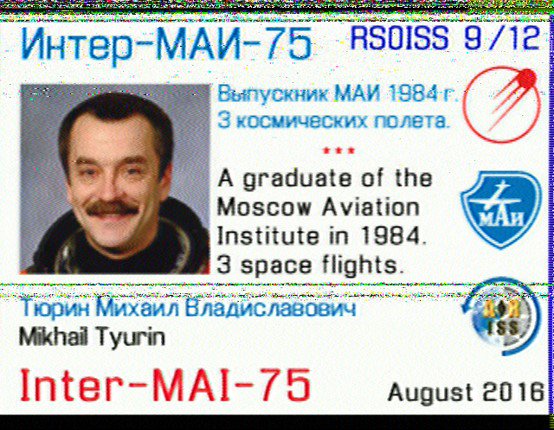
ISS SSTV MAI-75 image 9/12 received by Chertsey Radio Club on Baofeng handheld

ISS SSTV MAI-75 image 9/12 received by Chertsey Radio Club on Baofeng handheld

The Russian cosmonauts on the International Space Station are expected to activate amateur radio Slow Scan Television (SSTV) transmissions on 145.800 MHz FM during Monday and Tuesday, July 30-31.

The Inter-MAI-75 SSTV experiment should be active on:
• Monday, July 30 from 16:00-19:30 UT
• Tuesday, July 31 from 13:25-19:15 UT

The SSTV images will be transmitted on 145.800 MHz FM using the Kenwood TM-D710 transceiver located in the Russian ISS Service module. It is expected they will use the PD-120 SSTV format.

Note the ISS transmissions use the 5 kHz deviation FM standard rather than the narrow 2.5 kHz used in Europe. If your transceiver has selectable FM filters try using the wider filter. Handheld transceivers generally have a single wide filter fitted as standard and you should get good results outdoors using just a 1/4 wave whip antenna.

ISS SSTV links for tracking and decoding software
https://amsat-uk.org/beginners/iss-sstv/

You can receive the SSTV transmissions by using an Online Radio (WebSDR) and the MMSSTV software:
• Listen to the ISS when it is in range of London with the SUWS WebSDR http://farnham-sdr.com/
• Listen to the ISS when it is over Russia with the R4UAB WebSDR

CubeSats to deploy from ISS July 13

International Space Station – Image Credit NASA

Masa JN1GKZ reports JAXA has announced that nine CubeSats will deploy from the International Space Station on Friday, July 13.

The nine CubeSats are RainCube, Radix, CubeRRT, HaloSat, TEMPEST-D, EnduroSat AD, EQUISat, MemSat and RadSat-g.

EnduroSat AD, EQUISat and MemSat will operate in the amateur bands. The IARU Amateur Satellite Frequency Coordination Status pages show these frequencies:
• EnduroSat AD 437.050MHz CW, GFSK 9k6
• EQUISat 435.550MHz CW, FSK 9k6
• MemSat 437.350MHz BPSK 9k6

Happy chasing!
Masa JN1GKZ Tokyo Japan

Receive SSTV from Space in June and July

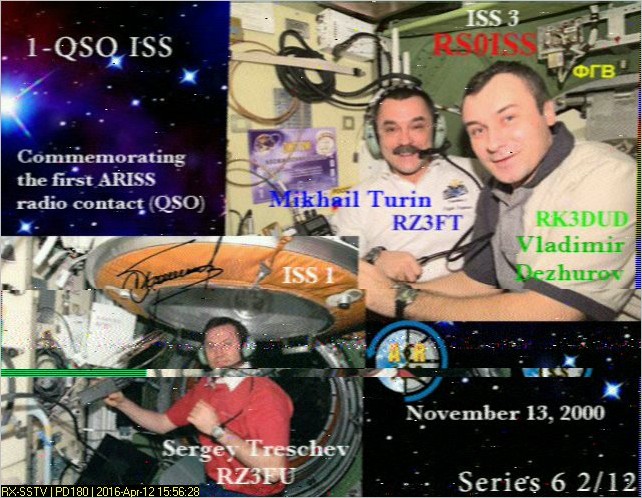
ISS SSTV image 2 received by Mike Rupprecht DK3WN April 12, 2016 at 1556 UT

ISS SSTV image received by Mike Rupprecht DK3WN April 12, 2016 at 1556 UT

ARISS Russia is planning a special Slow Scan Television (SSTV) event  from the International Space Station Station starting around 09:00 GMT on Friday, June 29.

It was originally planned to finish at 18:30 GMT on Sunday, July 1 but as of July 7 SSTV transmissions were continuing. The equipment will be required for a school contact on July 13 so SSTV transmission may continue until then.

Supporting this event is a computer on the ISS Russian Segment, which stores images that are then transmitted to Earth using amateur radio, specifically the onboard Kenwood TM-D710E transceiver.

These images will commemorate the various satellites that were hand-deployed from the ISS. These will include the first satellite deployment from ISS: Suitsat-1/Radioskaf-1 which was developed by ARISS and deployed in February 2006.

The transmissions will be made on 145.800 MHz FM using the PD-120 SSTV mode.

Note the ISS transmissions use the 5 kHz deviation FM standard rather than the narrow 2.5 kHz used in Europe. If your transceiver has selectable FM filters try using the wider filter. Handheld transceivers generally have a single wide filter fitted as standard and you should get good results outdoors using just a 1/4 wave whip antenna.

The ISS Fan Club site will show you when the space station is in range http://www.issfanclub.com/

ISS SSTV information and links at https://amsat-uk.org/beginners/iss-sstv/

Post your images on the ARISS-SSTV gallery at http://www.spaceflightsoftware.com/ARISS_SSTV/

If you don’t have an amateur radio receiver you can still listen to the ISS by using an Online Radio, also known as a WebSDR. Select a Frequency of 145800.0 kHz and Mode FM:
• Farnham WebSDR when ISS is in range of London http://farnham-sdr.com/
• R4UAB WebSDR when ISS is over Russia

Please note that the event is dependent on other activities, schedules and crew responsibilities on the ISS and subject to change at any time. You can check for updates regarding planned operation at:
ISS Ham https://twitter.com/RF2Space
ARISS Status https://twitter.com/ARISS_status
ARISS SSTV Blog https://ariss-sstv.blogspot.com/
AMSAT Bulletin Board http://www.amsat.org/mailman/listinfo/amsat-bb

If you receive a full or partial picture from the Space Station your Local Newspaper may like to know http://www.southgatearc.org/news/2016/july/now-is-a-great-time-to-get-ham-radio-publicity.htm

The RSGB produce a handy Media Guide and Template press release for anyone to download and adapt, see http://rsgb.org/main/clubs/media-guide-for-affiliated-societies/

An example of the publicity you can get for the hobby by telling your Local Newspaper
https://amsat-uk.org/2015/04/15/iss-sstv-in-the-press/