ISS Astronauts Link-Up with ITU WRC-15 in Geneva

ARISS contact between 4U1WRC and OR4ISS November 3, 2015

ARISS contact between 4U1WRC and OR4ISS November 3, 2015

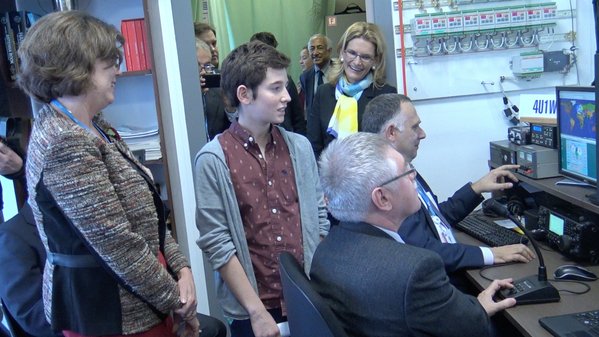
The ITU World Radiocommunication Conference 2015 (WRC-15) is taking place in Geneva from November 2-27. On Tuesday, November 3 at 1241 UT there was an amateur radio link-up between WRC-15 and two astronauts on the International Space Station (ISS).

The contact took place using the permanent amateur radio station at the ITU. The station’s normal call sign is 4U1ITU but during the conference the special call sign 4U1WRC is being used.

Students from Institut Florimont were able to use the ITU station to talk to astronauts Kjell Lindgren KO5MOS and Kimiya Yui KG5BPH who were using the  amateur radio station in the ISS Columbus module, call sign OR4ISS.

The Amateur Radio on the International Space Station (ARISS) program established the first permanent amateur radio presence in space 15 years ago. The inaugural ARISS contact took place on December 21, 2000, between a member of the ISS Expedition 1 crew and youngsters at Luther Burbank Elementary School near Chicago. Several pupils and a teacher got to chat using amateur radio with “Space Station Alpha” Commander William “Shep” Shepherd KD5GSL.

Watch ARISS contact with WRC-15 and Institut Florimont

The ARISS program lets students worldwide experience the excitement of talking directly with crew members of the International Space Station, inspiring them to pursue interests in careers in science, technology, engineering and math, and engaging them with radio science technology through amateur radio.

ARISS http://ariss-eu.org/

ARISS Celebrates 1000th Event, 15 Years of Permanent Ham Radio Presence in Space
http://www.arrl.org/news/view/ariss-celebrates-1000th-event-15-years-of-permanent-ham-radio-presence-in-space

RSGB WRC-15 information http://rsgb.org/wrc-15

Radio amateurs to help London children talk to ISS

International Space Station - Image Credit NASA

International Space Station – Image Credit NASA

On Wednesday, November 4 pupils at the Eleanor Palmer Primary School in Camden, London should have the opportunity to speak to an astronaut in space thanks to an Amateur Radio Telebridge link via Australia. The audio will be streamed via the web and Echolink.

ARISS LogoAn International Space Station school contact has been planned with participants at Eleanor Palmer School, London, United Kingdom on Wednesday, November 4. The event is scheduled to begin at approximately 09:51 GMT. It is recommended that you start listening approximately 10 minutes before this time. The duration of the contact is approximately 9 minutes and 30 seconds.

The contact will be a telebridge between astronaut Kjell Lindgren KO5MOS, using the callsign NA1SS from the amateur radio station in the ISS Columbus module, and Martin Diggens VK6MJ in Western Australia. The contact should be audible over portions of Australia and adjacent areas.  Interested participants are invited to listen in on the 145.800 MHz FM downlink.

Audio from this contact will be available via the amateur radio Echolink system on node *AMSAT* (101377) and via the IRLP Node 9010 Discovery Reflector.

Streaming Audio will be able on the web at https://sites.google.com/site/arissaudio/

Audio on Echolink and web stream is generally started around 20 minutes prior to the contact taking place so that you can hear some of the preparation that occurs. IRLP will begin just prior to the ground station call to the
ISS.

Contact times are approximate. If the ISS executes a reboost or other manoeuvre, the AOS (Acquisition Of Signal) time may alter by a few minutes

Eleanor Palmer Primary School, a non-selective community school, is located in central London in the United Kingdom. London is an exciting and dynamic capital city and its schools are the best in the country, attributed to the social and ethnic diversity, excellent local leadership and the quality of teaching.

Eleanor Palmer is a relatively small school of around 220 pupils with single classes of 30 children per year. The youngest pupils are 3 years old and the oldest 11 years old. Due to the central London location it is a highly diverse and inclusive school with staff and children from many different backgrounds.

The pupils achieve highly as judged by national benchmarks. One of the core aims of the school is to inspire in all pupils a love of learning and the desire to continue to learn and they therefore seek to provide a rich and broad curriculum opening minds and creating opportunities. The school hope that their contact with the ISS will inspire pupils to go on to learn more about space through the study of Science, Technology, Engineering and Math.

Participants will ask as many of the following questions as time allows:

1.  What have you seen that is more beautiful than earth?

2.  Who or what inspired you to choose this job?

3.  Does being in space make you feel differently about earth?

4.  What can you learn from the ISS that you cannot learn on earth?

5.  Will normal people who are not astronauts be able to visit space in the ISS one day?

6.  How do you sleep?

7.  Is it quiet up there in the ISS?

8.  When you get back to earth, do you have to re-train your muscles?

9.  Can you call home?

10.  Do you all have to be scientists?

11.  What do you think is the most important things children should know about space?

12.  What time zone do you use?

13.  Do you have plants on the ISS?

14.  What has been your favourite experiment?

15.  How does your brain respond to micro gravity?

16.  How do you wash your clothes?

17.  If you cry in space, with laughter, what happens to your tears?

18.  What do you want to do when you come back to earth?

19.  How do you get enough oxygen?

20.  Is it more scary taking off from earth or returning to earth?

21.  What is your energy source on the ISS?

22.  What does it feel like to be in space?

23.  Is it always dark in space?

Amateur Radio on the International Space Station (ARISS) lets students worldwide experience the excitement of talking directly with crew members of the International Space Station, inspiring them to pursue interests in careers in science, technology, engineering and math, and engaging them with radio science technology through amateur radio. http://www.ariss-eu.org/

A telebridge contact is where a dedicated ARISS amateur radio ground station, located somewhere in the world, establishes the radio link with the ISS. Voice communications between the students and the astronauts are then patched over regular telephone lines.
http://www.ariss-eu.org/ARISS%20Telebridge%20Guidelines.doc

What is Amateur Radio ? http://www.essexham.co.uk/what-is-amateur-radio

Eleanor Palmer Primary School
http://www.eleanorpalmer.camden.sch.uk/news/countdown-to-iss-link-up/
Twitter @eleanorpalmersc

Tim Peake KG5BVI and the ISS Astro Pi’s

Competition winner Hannah Belshaw with the Astro Pi flight unit. Hannah’s entry logs data from the Astro Pi sensors, and visualises it later using structures in a Minecraft world.

Competition winner Hannah Belshaw with the Astro Pi flight unit.
Hannah’s entry logs data from the Astro Pi sensors, and visualises it later using structures in a Minecraft world.

AMSAT-UK members are leading on the Amateur Radio on the ISS (ARISS) Schools contacts programme for the upcoming Tim Peake Principia mission to the ISS. A number of high profile school contacts are planned to be carried out and this activity is being coordinated with the UK Space Agency as part of the overall Principia Educational Outreach programme.

Two specially augmented Raspberry Pi’s called Astro Pi‘s are planned to fly on an Orbital Sciences’ Cygnus cargo freighter to the ISS in early December. They will be used by UK astronaut Tim Peake KG5BVI during his Principia mission on the Space Station which is expected to commence in mid-December.

The Astro Pi’s are planned to run experimental Python programs written by young people in schools across the country; the results will be returned back to Earth at the end of the mission. ARISS/AMSAT-UK members are actively involved in discussions with the UK Space Agency, ESA, the Raspberry Pi Foundation and others to establish the feasibility of re-purposing one of the Astro Pi units, either within or post Tim Peake’s mission, to provide an alternative video source for the amateur radio HamTV transmitter in the ISS Columbus module. Additional discussions are ongoing with all parties for joint educational activities into the future with the Astro Pi units being networked and potentially enhancing the capability of the amateur radio station on board Columbus.

The main mission of HamTV is to perform contacts between the astronauts on the ISS and school students, not only by voice as now, but also by unidirectional video from the ISS to the ground. ARISS has been working with Goonhilly and hope to provide a video download facility via one of their large dishes for the schools contacts as well as attempting to receive the video at each school as part of the contact.

Principia mission http://www.esa.int/Our_Activities/Human_Spaceflight/Principia

School Shortlist for Tim Peake Space Station Contact
https://amsat-uk.org/2015/07/14/school-shortlist-tim-peake-iss/

HamTV https://amsat-uk.org/satellites/hamtv-on-the-iss/

Astro Pi http://astro-pi.org/
Twitter https://twitter.com/astro_pi

Fort Worth students talk to ISS

Daggett Montessori Students - Credit Fort Worth ISD

Daggett Montessori Students – Credit Fort Worth ISD

Students at Daggett Montessori School in Fort Worth used amateur radio to talk to astronaut Kjell Lindgren KO5MOS, aboard the International Space Station.

Grace Jordan talks to the ISS

Grace Jordan talks to the ISS

Before the contact Cowtown Amateur Radio Club member Keith Pugh W5IU explained to the students how they are able to talk to the ISS.

The contact, which took place on Thursday, October 29, gave the students the opportunity to ask questions about life in space. The Star-Telegram newspaper reports Grace Jordan, a seventh-grader, wondered about the effects of microgravity on food digestion.

Kjell used the amateur radio station in the ESA ISS Columbus module callsign NA1SS, while the students used the station K5COW set up by Cowtown Amateur Radio Club in the school auditorium.

Amateur Radio on the International Space Station (ARISS) lets students worldwide experience the excitement of talking directly with crew members of the International Space Station, inspiring them to pursue interests in careers in science, technology, engineering and math, and engaging them with radio science technology through amateur radio.

Watch Daggett Montessori MS Talk to Space Station 2015

Read the Star-Telegram story at
http://www.star-telegram.com/news/local/community/fort-worth/article41837055.html

ARISS http://ariss.org/

Young people build antennas at Goonhilly

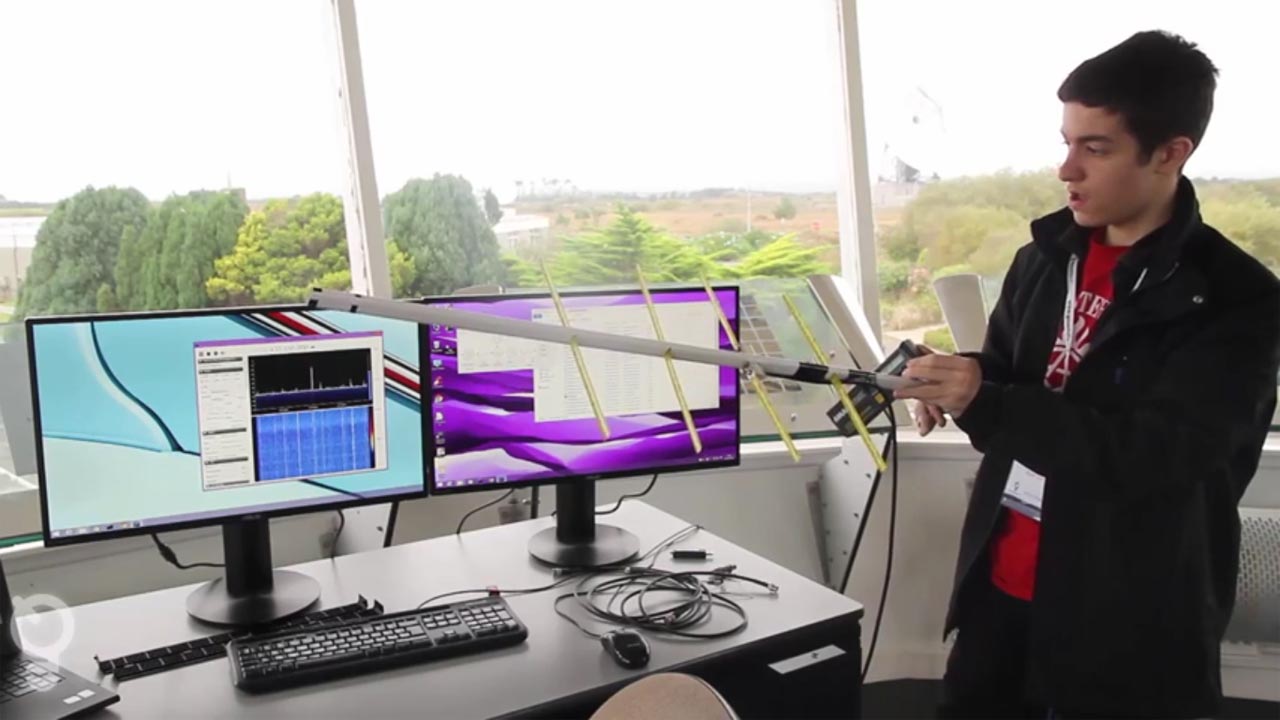
Young people build antennas at GoonhillyYear 11 students have been spending a week’s work experience at Goonhilly Earth Station learning about radio and satellite receivers. They researched and built a low-cost receiver using the FUNcube Dongle Pro+ Software Defined Radio.

Watch the video How to listen to the International Space Station

Goonhilly Earth Station http://www.goonhilly.org/

FUNcube Dongle Pro+ SDR http://FUNcubeDongle.com/

Astro Pi launch changed

Astro Pi LogoTwo specially augmented Raspberry Pi’s called Astro Pi‘s were planned to fly with UK astronaut Tim Peake KG5BVI to the International Space Station (ISS) on December 15.

On the ISS the Astro Pi’s are planned to run experimental Python programs written by school-age students; the results will be downloaded back to Earth and made available online for all to see. It is hoped that subsequently one of them will be used to provide a video source for the amateur radio HamTV transmitter in the ISS Columbus module.

It appears the amount of cargo on Tim’s Soyuz flight was overbooked so the Astro Pi’s will instead fly to the ISS on an Orbital Sciences’ Cygnus cargo freighter. The launch is currently planned for December 3 at 22:48 UT.

Read the full story on the Raspberry Pi site
https://www.raspberrypi.org/blog/astro-pi-mission-update-7-launch-vehicle-changed/

HamTV https://amsat-uk.org/satellites/hamtv-on-the-iss/