Radio ham over the moon at decoding space message

International Space Station - Image Credit NASA

International Space Station – Image Credit NASA

The Kent and Sussex Courier newspaper reports a picture from space has been decoded by an over-the-moon radio amateur from Tunbridge Wells.

Colin Bowman M0NLP spoke to his local newspaper after receiving a Slow Scan TV (SSTV) picture from the International Space Station (ISS) and in doing so gained some good publicity for the hobby.

He told the Courier: “I went mad when I realised I had decoded an entire picture.”

“I had to e-mail my children straight away, though, as they are both licensed amateurs as well and my daughter has just started a new job in the space industry in Turin.”

Read the full story at
http://www.courier.co.uk/Tunbridge-Wells-radio-man-moon-decoding-space/story-26160562-detail/story.html

ISS images received by radio amateurs world-wide are at http://www.spaceflightsoftware.com/ARISS_SSTV/

Find out more about ISS SSTV and links to decoding software at
https://amsat-uk.org/2015/02/11/more-iss-slow-scan-tv/


Sarah Brightman’s fellow astronaut gets ham license

Danish Astronuat Andreas Mogensen KG5GCZ and Murray Niman G6JYB

Danish astronaut Andreas Mogensen KG5GCZ with Murray Niman G6JYB

Danish astronaut Andreas Mogensen completed his amateur radio license class on February 23 and passed his exam on February 25. He has been assigned the callsign KG5GCZ.

Andreas was selected as an ESA astronaut in May 2009 and completed the astronaut basic training programme at the European Astronaut Centre in Cologne, Germany in November 2010. Since completing the astronaut basic training programme, Andreas has been trained and certified as a private pilot by the Lufthansa flight school and is trained and qualified for spacewalks using both the American EMU suit and the Russian Orlan suit.

In July  2009 he attended the AMSAT-UK International Space Colloquium in Guildford where he described to delegates the astronaut selection process. This year it was announced he would be on the same 10-day mission to the International Space Station (ISS) as the UK’s Sarah Brightman.

He will be the first astronaut of Danish nationality to go to space and will launch with Sarah on a Soyuz TMA-18M spacecraft in September 2015.

UK’s Sarah Brightman starts space flight training
https://amsat-uk.org/2015/01/13/uks-sarah-brightman-starts-space-flight-training/

Sarah Brightman ISS Mission Patch

Sarah Brightman ISS Mission Patch

ISS SSTV in a Brazilian School

Paulo PV8DX of AMSAT-BR turned the recent Slow Scan TV transmissions from the International Space Station (ISS) into an education outreach opportunity for amateur radio.

On Monday, February 23, 2015 at the Gonçalves Dias school he explained amateur radio to the students and demonstrated receiving an ISS SSTV picture on 145.800 MHz FM.

The ISS pass he received did not produce a strong signal and only part of the picture was captured but as can be seen from the video the students were enthusiastic and excited to be receiving a signal from space.

Paulo expressed the hope that the ISS will send images on school days more often.

Watch ISS – SSTV , By PV8DX

AMSAT-BR https://sites.google.com/site/amsatbr/

Information on receiving ISS SSTV https://amsat-uk.org/2015/02/11/more-iss-slow-scan-tv/

Space Station SSTV and Packet Radio via SUWS WebSDR

ISS SSTV and Packet Radio signals on the SUWS WebSDR

ISS SSTV and Packet Radio signals on the SUWS WebSDR

Martin Ehrenfried G8JNJ reports excellent SSTV and Packet Radio signals from the International Space Station (ISS) using the online SUWS WebSDR.

144 MHz prototype helix antenna

144 MHz prototype helix antenna

The omni-direction helix antennas at the WebSDR were designed with high elevation satellites in mind. Conventional antennas concentrate the radiation pattern towards the horizon resulting in weaker signals when a satellite is above 15 degrees elevation. Comparisons with other WebSDRs show the SUWS antennas provide a 6 to 10dB better signal to noise ratio on similar passes.

Martin says: “I had been experimenting with single turn ‘twisted halo’ design, and decided to try stacking them to see if I could achieve more gain. Modelling suggested that a stretched 3 turn helix with a helix circumference of approx 1/2 wave length and an overall length of 1/2 wave at 70cm, and fed with a gamma match at the centre would offer reasonable gain, an omni-directional pattern and mixed polarisation.”

You can use the free online SUWS Web Software Defined Radio from your PC or Laptop to receive the ISS and the many amateur radio satellites transmitting in the 144-146 MHz or 435-438 MHz bands. It also provides reception of High Altitude Balloons in the 434 MHz band and coverage of the microwave 10368-10370 MHz band.

The SUWS WebSDR is located at Farnham not far from London, 51.3 N 1.15 W, listen to it at http://websdr.suws.org.uk/

Full details of the antennas are available at http://g8jnj.webs.com/currentprojects.htm

Brazilian radio amateur uses SUWS WebSDR to receive ISS SSTV
https://amsat-uk.org/2014/09/06/iss-sstv-on-suws-websdr/

ISS SSTV image 9/12 received by Martin Ehrenfried G8JNJ using the SUWS WebSDR on Dec 18, 2014

ISS SSTV image 9/12 received by Martin Ehrenfried G8JNJ using the SUWS WebSDR on Dec 18, 2014

Stunning Results from ISS SSTV

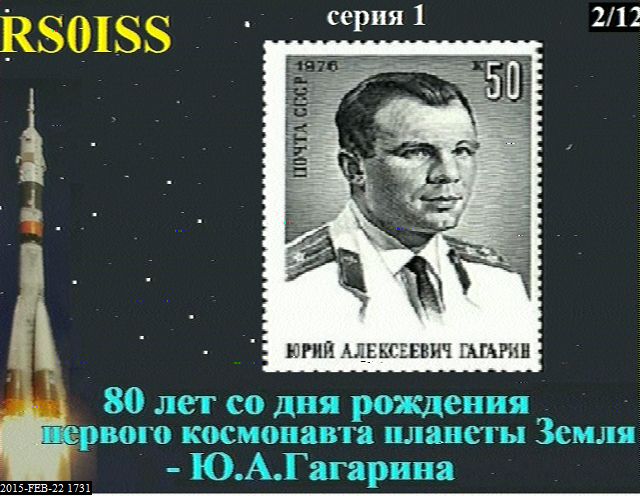
ISS SSTV image 2 received by Andrew Garratt M0NRD Feb 22, 2015

ISS SSTV image 2 received by Andrew Garratt M0NRD February 22, 2015

The ISS Slow Scan television Transmissions have already produced some great pictures, more will be sent Monday, February 23 on 145.800 MHz FM until 2130 UT.

On the AMSAT Bulletin Board (AMSAT-BB) Clint Bradford K6LCS posted:

Receiving SSTV from the ISS really CAN be simple: For my first time ever, I simply fired up a $3 iOS app, and held my iPod touch near my Yaesu FT-60R’s speaker, and downloaded one of the images from the ISS.

I didn’t think there was too much left in the hobby to excite me – but I was WRONG!!!

Greg KO6TH said “I’ve never received a clearer SSTV picture from anywhere, let alone outer space!”

Twelve different images depicting space pioneer Yuri Gagarin – the first human to orbit Earth – are being sent on 145.800 MHz using the SSTV mode PD180, with a 3-minute off time between transmissions.

The transmitter on the ISS uses 5 kHz deviation FM. If your rig has selectable FM filters (most mobiles do) make sure you choose the wider setting designed for 20 or 25 kHz channel spacing, usually marked FM or FMW.

Images received so far by radio amateurs world-wide are at
http://www.spaceflightsoftware.com/ARISS_SSTV/

Find out more about receiving these transmissions and links to decoding software at
https://amsat-uk.org/2015/02/11/more-iss-slow-scan-tv/

Advert Features Ham Radio and ISS

International Space Station - Image Credit NASA

International Space Station – Image Credit NASA

The latest advert from Internet Services provider MTN Global features amateur radio and the International Space Station (ISS).

MTN Global’s latest brand commercial tells the story of a little boy who discovers, via the internet, that it is very simple to build a homemade radio that will allow him to actually speak to an astronaut in space. He tries and fails and tries again, using the internet to embark on a journey of discovery that takes a rather unexpected turn. Because that’s the thing about discovery, there’s always more to discover.

Watch MTN: ‘Space’

My first radio contact with an Astronaut
http://www.southgatearc.org/news/december2005/qso_with_an_astronaut.htm

Check the status of the ISS amateur radio stations at http://issfanclub.com/

How to hear the ISS https://amsat-uk.org/beginners/how-to-hear-the-iss/

How to use the ISS APRS Packet Radio Digipeater
https://amsat-uk.org/beginners/how-to-work-the-iss-on-aprs-packet-radio/

More ISS Slow Scan TV Activity https://amsat-uk.org/2015/02/11/more-iss-slow-scan-tv/

What is Amateur Radio ? http://www.essexham.co.uk/what-is-amateur-radio