ISS SSTV success – More transmissions Saturday, December 20

ISS SSTV image 9/12 received by Frank Heritage M0AEU at 19:21 UT on Dec 18, 2014

ISS SSTV image 4/12 received by Frank Heritage M0AEU at 19:21 UT on Dec 18, 2014

During Thursday, December 18 the Russian ARISS team members successfully activated the amateur radio Slow Scan TV (SSTV) experiment from the International Space Station (ISS) on 145.800 MHz FM. Further transmissions using the callsign RS0ISS are planned for Saturday, December 20, 2014.

ISS SSTV image 9/12 received by Martin Ehrenfried G8JNJ using the SUWS WebSDR on Dec 18, 2014

ISS SSTV image 9/12 received by Martin Ehrenfried G8JNJ using the SUWS WebSDR on Dec 18, 2014

Among the many radio amateurs receiving the pictures was Frank Heritage M0AEU. His station comprised a 5 element crossed Yagi on a Yaesu 5600B Az/Ele rotator, about 4 metres above the ground, interfaced with a LVB Tracker. Frank used the Ham Radio Deluxe satellite program (v5) for the tracking and a Yaesu FT736R feeding audio to the free MMSSTV software on a Dell laptop.

Martin Ehrenfried G8JNJ used the online SUWS Web-based Software Defined Radio (WebSDR) located near London to receive a number of images during the day. Martin made the 144 and 430 MHz helix antennas for the WebSDR which are optimized for satellite reception. The SUWS WebSDR is available for anyone to use.

Other images received by amateurs world-wide can be seen at http://www.spaceflightsoftware.com/ARISS_SSTV/

The next ISS SSTV transmissions on 145.800 MHz should start around 12:40 UT on Saturday, December 20 and end at 21:30 UT. It is expected the SSTV mode will be PD180 with 3 minute off periods between transmissions. A total of 12 different photos will be sent, each celebrating the 80th anniversary of the birth of Yuri Gagarin, the first human to orbit Earth.

The transmission will be mode using the Kenwood D710 transceiver located in the Russian Service Module. It is thought the equipment may be producing about 25 watts output which should provide a very strong signal.

International Space Station - Image Credit NASA

International Space Station – Image Credit NASA

All you need to do to receive SSTV pictures direct from the space station is to connect the audio output of a scanner or amateur radio transceiver via a simple interface to the soundcard on a Windows PC or an Apple iOS device, and tune in to 145.800 MHz FM. You can even receive pictures by holding an iPhone next to the radio’s loudspeaker.

The ISS puts out a strong signal on 145.800 MHz FM and a 2m handheld with a 1/4 wave antenna will be enough to receive it. The FM transmission uses the 5 kHz deviation which is standard in much of the world.

Many FM rigs in the UK can be switched been wide and narrow deviation FM filters. For best results you should select the wider deviation filters. Handhelds all seem to have a single wide filter fitted as standard.

On Windows PC’s the free application MMSSTV can be used to decode the signal, on Apple iOS devices you can use the SSTV app for compatible modes. The ISS Fan Club website will show you when the space station is in range.
ISS SSTV image 12/12 received by Martin Ehrenfried G8JNJ using the SUWS WebSDR Dec 18, 2014

ISS SSTV image 12/12 received by Martin Ehrenfried G8JNJ using the SUWS WebSDR Dec 18, 2014

Paul Turner G4IJE, co-developer of the SSTV PD modes, says regarding the MMSSTV PD180 mode: “Don’t forget to either enable “Always show RX viewer” or use the “Picture viewer” (magnifying glass icon) to show the picture at its real resolution of 640 x 496. If you just view as normal you will only see 320 x 248 resolution, which kind of defeats the object of using a high resolution mode.”

On the AMSAT-BB Rick W2JAZ and Alan WA4SCA comment on the need to set the MMSSTV sound card setting to 48 kHz instead of the default 44.100 kHz
• Options
• Setup
• Misc
• Then the Clock section at the bottom of the page

The MMSSTV default setting may need to be set to 24000 (exactly half of the sound card setting). You then should get good clean images.

The sound card adjustments will vary slightly depending on the version of the OS you are running, but usually will be under the advanced properties for the device. You can probably use a higher sampling rate for the sound card so long as it is a power of 2 multiple (2,4,8, etc)  of the value in MMSSTV. For instance, 192k (8x) has no issues. The same applies to most similar software.

You can receive the SSTV transmissions online using the SUWS WebSDR remote receiver located near London along with the MMSSTV software https://amsat-uk.org/2014/08/15/suws-websdr-moves-to-new-site/

For more on Slow Scan Television SSTV, see this article SSTV – The Basics
http://www.essexham.co.uk/sstv-the-basics

How to be successful with the ISS Slow Scan Television (SSTV) imaging system
http://www.marexmg.org/fileshtml/howtoisssstv.html

Free MMSSTV Slow Scan TV software http://hamsoft.ca/pages/mmsstv.php

iOS SSTV App https://itunes.apple.com/gb/app/sstv/id387910013

IZ8BLY Vox Recoder, enables you to record the signals from the ISS on 145.800 MHz while you’re away at work http://antoninoporcino.xoom.it/VoxRecorder/

ARISS Slow Scan TV (SSTV) Blog and Gallery http://ariss-sstv.blogspot.co.uk/

Information on the MAI-75 SSTV experiment
http://www.energia.ru/eng/iss/researches/education-26.html

Video showing reception of SSTV using the FUNcube Dongle Pro SDR and SDR-RADIO going into Virtual Audio Cable (VAC) then to MMSSTV software https://www.youtube.com/watch?v=K6MOrX9iZCk

ISS SSTV received online with SUWS WebSDR
https://amsat-uk.org/2014/09/06/iss-sstv-on-suws-websdr/

ISS SSTV 1/12 received by Martin Ehrenfried G8JNJ using the SUWS WebSDR Dec 18, 2014

ISS SSTV 1/12 received by Martin Ehrenfried G8JNJ using the SUWS WebSDR Dec 18, 2014

Astronaut’s first school contact from ISS

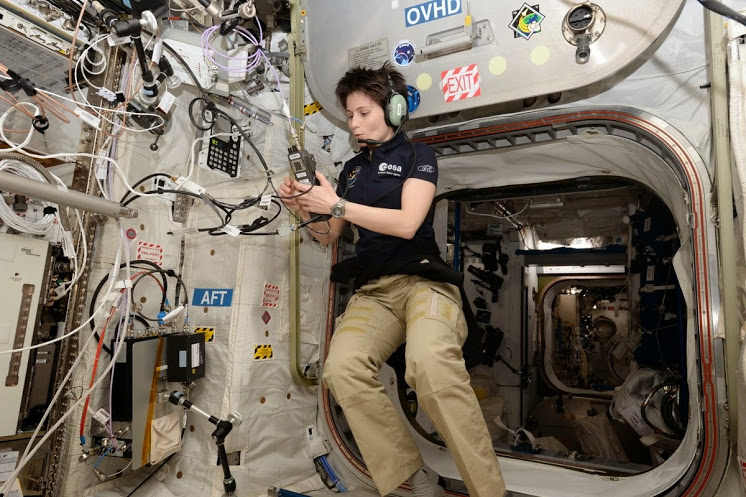
Samantha Cristoforetti IZ0UDF using the amateur radio station in the ISS Columbus module

Samantha Cristoforetti IZ0UDF using the amateur radio station in the ISS Columbus module

Samantha Cristoforetti IZ0UDF has written about her first amateur radio school contact from the International Space Station.

20 students from “Elena di Savoia” in Bari and “Alessandro Volta” in Bitonto were able to ask her questions about space and the ISS.

Read her post at https://plus.google.com/+SamanthaCristoforetti/posts/do2vfeVgAw7

ARISS contact planned for two Italian schools
http://www.southgatearc.org/news/2014/december/ariss_event_1512.htm

Send your code into space with astronaut Tim Peake KG5BVI

Students programming the Astro Pi computers Credit: UK Space Agency (Max Alexander)

Students programming the Astro Pi computers Credit: UK Space Agency (Max Alexander)

Leading UK space organisations have joined forces with UK Astronaut Tim Peake KG5BVI and Raspberry Pi to offer students a chance to devise and code their own apps or experiment to run in space. Two Raspberry Pi computers are planned to be flown to the International Space Station (ISS) as part of Tim’s 6 month mission and both will be connected to a new “Astro Pi” board, loaded with a host of sensors and gadgets.

Launched December 10 at an event held by the UK Space Agency, the Astro Pi competition will be officially opened at the BETT conference (January 21-24) and will be open to all primary and secondary school aged children who are resident in the United Kingdom. The competition will be supported by a comprehensive suite of teaching resources that are being developed by ESERO-UK and Raspberry Pi.

Astro Pi Logo

Astro Pi Logo

During his mission to the ISS, Tim Peake KG5BVI plans to deploy the Astro Pi computers in a number of different locations on board the ISS. He will then load up the winning code whilst in orbit, set them running, collect the data generated and then download this to Earth where it will be distributed to the winning teams.

Speaking at the Astro Pi launch event, Dr David Parker, Chief Executive of the UK Space Agency, also revealed that the UK Space Agency has been given a £2 million programme, as part of the Chancellor’s Autumn Statement, to support further outreach activities around Tim’s mission, particularly to help inspire interest in STEM subjects.

Tim Peake KG5BVI said I’m really excited about this project, born out of the cooperation among UK industries and institutions. There is huge scope for fun science and useful data gathering using the Astro Pi sensors on board the International Space Station. This competition offers a unique chance for young people to learn core computing skills that will be extremely useful in their future. It’s going to be a lot of fun!

To help students on their way in developing their code, five inspirational themes have been devised to stimulate creativity and scientific thinking. The themes are Spacecraft Sensors, Satellite Imaging, Space Measurements, Data Fusion and Space Radiation.

A Raspberry Pi computer. Credit: UK Space Agency (Max Alexander).

A Raspberry Pi computer. Credit: UK Space Agency (Max Alexander).

In the primary school age category, teams will be asked to devise and describe an original idea for an experiment or application which can be conducted on the Astro Pi by Tim during his mission. The two best submissions will get the opportunity to work with the Astro Pi team to interpret their ideas and the team at the Raspberry Pi Foundation will then code them ready for flight on the ISS.

In the secondary school age group, the competition will be run across three age categories, one for each of Key Stages 3, 4 and 5 (in England and Wales, and their equivalent ages in Scotland and Northern Ireland). In the first phase, competitors can submit their ideas for experiments and applications. At least the best 50 submissions in each age category will win a Raspberry Pi computer and an Astro Pi board on which to code their idea. In phase 2, all teams will develop code based on their original concept and two winning teams will be selected in each age category. The winning teams’ code will be readied for flight by the Raspberry Pi Foundation and CGI.

As well as having their code uploaded to the ISS, all winning teams will each receive a class set of Raspberry Pi and Astro Pi boards, meet the Astro Pi team and participate in a winners event during Tim’s flight.

In addition to the main prizes, each of the UK space companies supporting the project have offered a prize. These prizes will be awarded to the best submission associated with each of the themes, across the age ranges.

Major Tim Peake KG5BVI

Major Tim Peake KG5BVI

ESERO-UK and Raspberry Pi are developing a comprehensive suite of teaching resources to link to the curriculum and assist teachers of STEM subjects in engaging their students in the competition. As well as explaining how to use and write code for the Astro Pi and its sensors, the resources will provide a context for the Astro Pi in the curriculum and link to teaching subjects and areas.

The first two resources of the series are available now in the National STEM Centre eLibrary and the rest will follow.

Launching the Astro Pi computers, and consequently the successful implementation and completion of this competition is subject to nominal progress through the ESA integration programme and operations on-board the ISS.

BBC TV News: Astronaut Tim Peake KG5BVI invites Raspberry Pi challenge
http://www.bbc.co.uk/news/technology-30415207

Astro Pi: Your code in space http://astro-pi.org/

Source: UK Space Agency press release https://www.gov.uk/government/news/send-your-computer-code-into-space-with-astronaut-tim-peake

SSTV transmissions from the ISS

International Space Station - Image Credit NASA

International Space Station – Image Credit NASA

The Russian ARISS team members plan to activate SSTV from the International Space Station on Thursday, December 18 and Saturday, December 20, 2014 .

ISS SSTV received by Jan van Gils PE0SAT Sept 26. 2014 at 14:02 GMT

ISS SSTV received by Jan van Gils PE0SAT Sept 26. 2014 at 14:02 GMT

Expected SSTV mode will be PD180 on 145.800 MHz with 3 minute off periods between transmissions. A total of 12 different photos will be sent during the operational period.

The transmission will be mode using the Kenwood D710 transceiver located in the Russian Service Module. It is thought the equipment will be producing about 5 watts output which should provide a very strong signal.

Start time would be around 14:20 UT on December 18 and 12:40 UT on December 20. The transmissions should terminate around 21:30 UT each day.

SpaceX was launching to the ISS this week and any delays could change SSTV operational times.

All you need to do to receive SSTV pictures direct from the space station is to connect the audio output of a scanner or amateur radio transceiver via a simple interface to the soundcard on a Windows PC or an Apple iOS device, and tune in to 145.800 MHz FM. You can even receive pictures by holding an iPhone next to the radio’s loudspeaker.

ISS SSTV received by Fabiano Moser CT7ABD on Sept 6, 2014 at 0910 GMT

ISS SSTV received by Fabiano Moser CT7ABD on Sept 6, 2014 at 0910 GMT

The ISS puts out a strong signal on 145.800 MHz FM and a 2m handheld with a 1/4 wave antenna will be enough to receive it. The FM transmission uses the 5 kHz deviation which is standard in much of the world.

Many FM rigs in the UK can be switched been wide and narrow deviation FM filters. For best results you should select the wider deviation filters. Handhelds all seem to have a single wide filter fitted as standard.

On Windows PC’s the free application MMSSTV can be used to decode the signal, on Apple iOS devices you can use the SSTV app. The ISS Fan Club website will show you when the space station is in range.

You can receive the SSTV transmissions online using the SUWS WebSDR remote receiver located near London along with the MMSSTV software https://amsat-uk.org/2014/08/15/suws-websdr-moves-to-new-site/ In the days before the SSTV starts why not practice listening to the ISS packet radio transmissions on 145.825 MHz FM.

For more on Slow Scan Television SSTV, see this article SSTV – The Basics
http://www.essexham.co.uk/sstv-the-basics

How to be successful with the ISS Slow Scan Television (SSTV) imaging system
http://www.marexmg.org/fileshtml/howtoisssstv.html

Free MMSSTV Slow Scan TV software http://hamsoft.ca/pages/mmsstv.php

iOS SSTV App https://itunes.apple.com/gb/app/sstv/id387910013

IZ8BLY Vox Recoder, enables you to record the signals from the ISS on 145.800 MHz while you’re away at work http://antoninoporcino.xoom.it/VoxRecorder/

ARISS Slow Scan TV (SSTV) Blog and Gallery http://ariss-sstv.blogspot.co.uk/

Information on the MAI-75 SSTV experiment
http://www.energia.ru/eng/iss/researches/education-26.html

Video showing reception of SSTV using the FUNcube Dongle Pro SDR and SDR-RADIO going into Virtual Audio Cable (VAC) then to MMSSTV software https://www.youtube.com/watch?v=K6MOrX9iZCk

ISS SSTV received online with SUWS WebSDR
https://amsat-uk.org/2014/09/06/iss-sstv-on-suws-websdr/

Principia Mission Patch

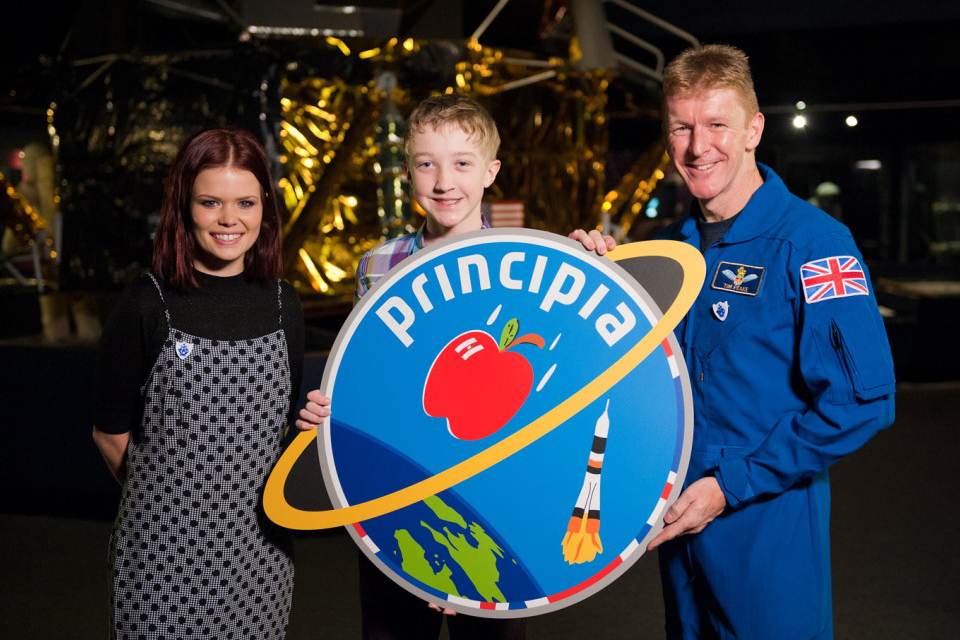
Blue Peter presenter Lindsey, competition winner Troy and UK astronaut Tim Peake KG5BVI with mission patch

Blue Peter presenter Lindsey, competition winner Troy and UK astronaut Tim Peake KG5BVI with mission patch

In partnership with the UK Space Agency, BBC TV’s Blue Peter show asked young people to design a mission patch for UK astronaut Tim Peake KG5BVI and received more than 3000 entries.

Principia Mission Patch

Principia Mission Patch

The judges from the UK Space Agency, Blue Peter and ESA together chose their two favorites in each of the three age groups of 6–8, 9–11 and 12–15 years. Important considerations for deciding on the final six were how a design would look as a patch, the colors used and whether the children drew everything on their own. The selection of the winning design out of the six came down to Tim himself.

The mission name Principia comes from Isaac Newton’s world-changing three-part text on physics, Naturalis Principia Mathematica, describing the principal laws of motion and gravity.

The winning entry was by 13-year-old Troy who used an apple to signify Newton’s law of gravity. Fittingly a stylized International Space Station (ISS) glints in the apple. The Soyuz rocket taking Tim into space flies over the UK as the colors of the Union Flag run along the border.

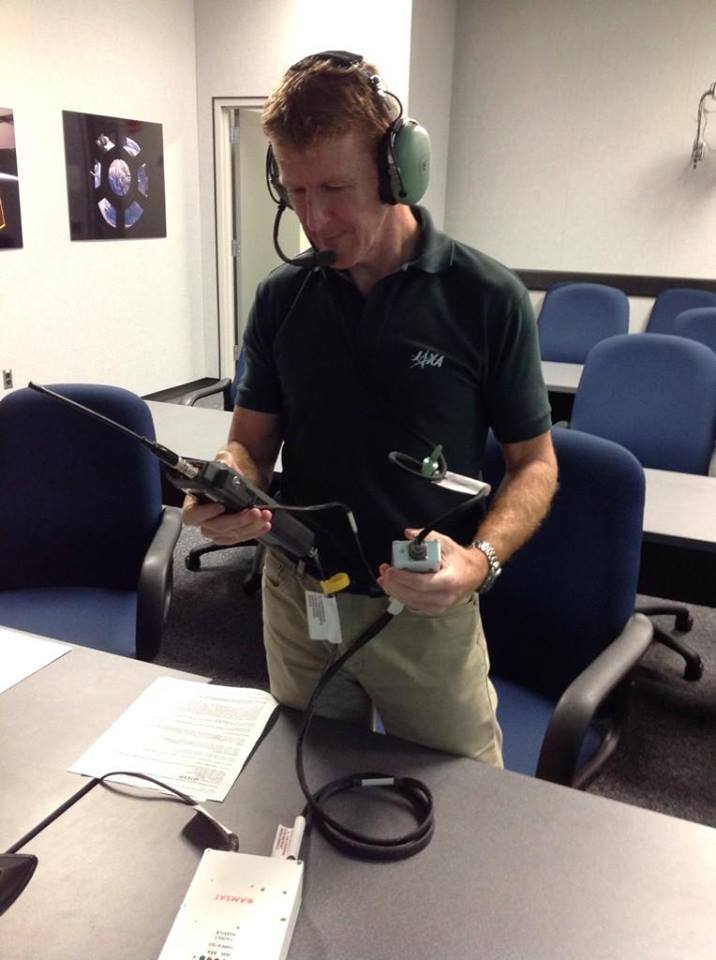
In September Tim Peake KG5BVI learned how to use the Ericsson 144 MHz handheld radio which is installed in the Columbus module of the ISS. On September 18 Tim said “Will be great to chat with schools next year from space using this ham radio on board the ISS.”

UK Space Agency announcement
https://www.gov.uk/government/news/tim-peakes-principia-mission-logo

GB1SS callsign for International Space Station
https://amsat-uk.org/2014/10/22/gb1ss-callsign-for-international-space-station/

Tim Peake KG5BVI training on ISS Amateur Radio Station Equipment

Tim Peake KG5BVI training on ISS Amateur Radio Station Equipment

SpinSat Deployment from ISS

SpinSat extended from airlock

SpinSat extended from airlock

SpinSat was launched to the International Space Station (ISS) on September 21 in preparation for a subsequent deployment from the Japanese Experiment Module (JEM).

SpinSat - Credit Naval Research Laboratory

SpinSat – Credit Naval Research Laboratory

Masahiro Arai JN1GKZ reported that SpinSat would be deployed, using the Cyclops deployment system, from the airlock of the JEM. Successful deployment took place on Friday, November 28 at 14:30 UT into a 406 x 417 km x 51.65 deg orbit. SpinSat is cataloged as object number 40314.

Developed by the Naval Research Laboratory (NRL) SpinSat is a 56 cm sphere weighing 57 kg that has 12 Electronically-controlled Solid Propellant (ESP) thrusters spread in pairs throughout the surface of the satellite. They will be fired in pairs to spin the spacecraft. With just primary batteries and only 4.8 grams of fuel this phase may last between three to six months.

The spacecraft will be used to calibrate the space surveillance network. Lasers will be fired at SpinSat from the ground, the light reflected back will be measured to determine where in time and space the satellite is passing overhead. SpinSat will also model the density of the atmosphere.

The IARU Satellite Frequency Coordination Panel report that SpinSat carries a 2 watt RF output 9600 bps AX.25 packet radio store and forward system on 437.230 MHz.

SpinSat just before deployment

SpinSat just before deployment

Listen for SpinSat on 437.230 MHz with the SUWS WebSDR located near London
https://amsat-uk.org/2014/08/15/suws-websdr-moves-to-new-site/

In the first few days after deployment SpinSat’s orbit will be similar to that of the International Space Station. To see when it’s in range use the ISS real-time tracker at http://issfanclub.com/

Read all about SpinSat at
http://www.nrl.navy.mil/media/news-releases/2014/with-spinsat-mission-nrl-will-spin-small-satellite-in-space-with-new-thruster-technology

SpinSat after deployment

SpinSat after deployment

NASA – SpinSat
http://www.nasa.gov/mission_pages/station/research/experiments/1019.html

Space Station Integrated Kinetic Launcher for Orbital Payload Systems (SSIKLOPS) – Cyclops
http://digitalcommons.usu.edu/smallsat/2013/all2013/76/

IARU Satellite Frequency Coordination Panel http://amsat.org.uk/iaru

SpinSat in orbit

SpinSat in orbit