Ham radio CubeSat deployment postponed

Koichi Wakata KC5ZTA installs ISS CubeSat Deployer

Koichi Wakata KC5ZTA installs ISS CubeSat Deployer

The deployment of amateur radio CubeSats from the International Space Station (ISS) planned for Thursday, February 6 has been postponed.

Kibo Robot Arm CubeSat Deployment

Kibo Robot Arm CubeSat Deployment

NASA say:

Flight Engineer Koichi Wakata KC5ZTA spent his morning working in the Japanese Kibo module to install a deployer mechanism that will be used in concert with the Kibo robotic arm to “launch” the first set of NanoRacks CubeSats. Wakata, who ran into some difficulty last week installing an electronics box that would help control the deployment of the mini-satellites, successfully installed that box after troubleshooting an alignment issue.  The deployment of the first batch of CubeSats, which had originally been scheduled for this week before being postponed following last week’s installation issue, has been postponed further to make sure that the CubeSats do not fall into the intended orbit of the Global Precipitation Measurement satellite launching later this month. The exact date of the CubeSat deployment is still being evaluated.

NASA http://www.nasa.gov/content/crew-conducts-science-begins-unloading-russian-cargo-craft/

Video: Deploying CubeSats from the Space Station
https://amsat-uk.org/2014/01/31/video-deploying-cubesats-from-the-space-station/

ISS CubeSats https://amsat-uk.org/2014/02/04/ham-radio-cubesats-to-deploy-thursday/

Ham radio CubeSats to deploy Thursday

Koichi Wakata KC5ZTA installs ISS CubeSat Deployer

Koichi Wakata KC5ZTA installs ISS CubeSat Deployer

Several amateur radio CubeSats will be deployed from the International Space Station on Thursday, February 6, 2014.

LY2013SAT QSL card received by Andy Thomas G0SFJOn Thursday, January 9 at 1807 UT an Antares rocket launched the Cygnus freighter carrying a cargo of CubeSats to the International Space Station. Since then the CubeSats have been stored on the ISS awaiting deployment using the Japanese Kibo Robot Arm.

The first of these CubeSats LituanicaSat-1, LitSat-1, ArduSat-2, UAPSat-1 and the 915 MHz SkyCube should be deployed on Thursday, February 6, 2014. They will be followed later in the month by twenty eight commercial 3U CubeSats from Planet Labs.

LituanicaSat-1 carries a 145/435 MHz FM transponder while LitSat-1 is thought to carry a 435/145  MHz linear transponder for SSB/CW communications.

Kibo Robot Arm CubeSat Deployment

Kibo Robot Arm CubeSat Deployment

The IARU coordinated frequencies are listed as:

LituanicaSAT-1
• FM Transponder Uplink 145.950 MHz Downlink 435.180 MHz
• AX25 Uplink 145.850 MHz AX25 Downlink 437.550 MHz
• CW Beacon 437.275 MHz
https://www.facebook.com/Lituanicasat1

LitSat-1
• SSB Transponder Uplink 435.180 MHz Downlink 145.950 MHz
• AX25 Uplink 437.550 MHz Downlink 145.850 MHz
https://www.facebook.com/palydovas

ArduSat-2
•  9k6 MSK CCSDS data format downlink 437.? MHz
http://www.kickstarter.com/projects/575960623/ardusat-your-arduino-experiment-in-space

UAPSAT
• AX.25 Packet Radio uplink 145.980 MHz downlink 437.385 MHz
http://www.uap.edu.pe/

Video: Deploying CubeSats from the Space Station
https://amsat-uk.org/2014/01/31/video-deploying-cubesats-from-the-space-station/

Details of other amateur radio satellites due to launch this month are at
https://amsat-uk.org/2014/02/01/japanese-amateur-radio-satellite-depoyments/

Video: Deploying CubeSats from the Space Station

LituanicaSAT-1

LituanicaSAT-1

Four amateur radio CubeSats, LituanicaSat-1, LitSat-1, ArduSat-2 and UAPSat-1 are on the International Space Station (ISS) awaiting deployment currently planned for February 6, 2014.

Additionally there is SkyCube-1 which transmits on 915 MHz which is an amateur band in many countries and a license exempt allocation elsewhere.

In this video NASA PAO Officer Amiko Kauderer talks to Michael Johnson, NanoRacks Chief Technology Officer, about the installation of the CubeSat deployer in the Japanese Experiment Module Airlock. The installation work is in preparation for the upcoming deployment of several tiny satellites.

Watch Space Station Live: Deploying Cubesats from the Station

ISS Ham Video Commissioning – Blank Transmissions

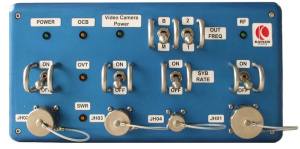
Front panel of the HamTV transmitter

Front panel of the HamTV transmitter

As announced December 22, 2013 the Ham Video transmitter is onboard the International Space Station (ISS) and stored in the Columbus module. It is slated to be installed February 5, 2014 by Michael Hopkins KF5LJG. Hopkins will also install the camera and the supporting Bogen arm.

The Ham Video transmitter will be connected to the ARISS 41 antenna and to the KuPS power supply. The installation procedure comprises a check of the electrical connections. The transmitter will be powered on and will transmit a signal on 2.422 GHz. This check will be very limited in time, just enough to verify that the control LEDs are nominal. Then Ham Video will be powered off, ready for the first Commissioning Step.
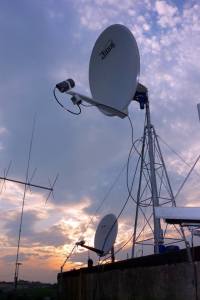
New HamTV Antennas for ARISS Telebridge Station IK1SLD at Casale Monferrato, Italy

New HamTV Antennas for ARISS Telebridge Station IK1SLD

January 23 and 24, Commissioning Simulations were again performed by ESA, in collaboration with ARISS. The ARISS Team, in charge of receiving the signals during the Commissioning, worked with B.USOC, simulating the four scheduled Commissioning Steps. The procedure was an update of the Simulations performed 5-6 September 2013, as reported in HamTV Bulletin #2.
( All HamTV Bulletins are archived at http://www.ariss-eu.org/ ).

The four Commissioning steps are scheduled February 8, 15 and 16 and March 5. These dates are still to be confirmed and this depends on the signature of the Flight Rules relative to Ham Video (see HamTV Bulletin #4).

Blank Transmissions will start immediately at the conclusion of Commissioning Step 1 and will continue till Commissioning Step 4. This means that the Ham Video transmitter will operate continuously during 25 days.

The DATV signal parameters will be:
* Downlink frequency: 2.395 GHz
* DVB-S standard (QPSK modulation)
* Symbol rate: 1.3 Ms/s
* FEC : ½
* Video PID = 256
* Audio PID = 257
* RF radiated power : approximately 10 W EIRP
Ham Video will operate with a Canon XF-305 camera, but the camera will be turned off during the Blank Transmissions.
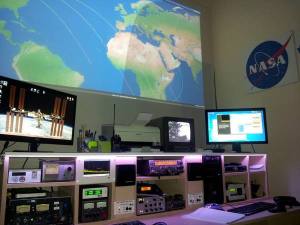
ARISS Telebridge Station IK1SLD at Casale Monferrato, Italy

ARISS Telebridge Station IK1SLD at Casale Monferrato, Italy

Blank Transmissions

A « blank » DVB-S signal contains all the data of normal DVB-S. The information tables describing the content and the content itself, i.e. the video (black) and the audio (silence), are the same as for the image and the sound produced by a camera.
Receiving a black image and silent sound may seem uninteresting but, from a technical perspective, the digital signal offers an important source of information.

The decoded signal provides many data :
* the video stream can be measured (Tutioune + TS reader)
* the audio stream can be measured (Tutioune + TS reader)
* the DVB tables can be decoded (satellite receiver (Set Top Box) or Tutioune or TS reader or VLC …)

The DVB tables mention the PIDs (content identification numbers) as well as the SDT (Service Description Table) with the TV channel name, which will be « HAMTV »

Even without decoding, several measurements of the received signal provide valuable information:
* analogic HF signal strength  (dBm)
* analogic Signal/Noise ratio (dB)
* digital Signal/Noise ratio = MER (dB)
* error/correction ratio = Vber, Cber …
* validation of the received transport stream = TS

Reception Reports

Ground stations with S-band capability can provide valuable information, which will be much appreciated. Basic data such as:
* noise level without signal
* AOS time (UTC)
* maximum signal level during pass
* LOS time (UTC)
can be reported by ground stations without the need of special DATV hardware and software.

ARISS is preparing a Ham Video Internet Reporting Program for collecting reception data from volunteering ground stations. These most needed reception reports will be gratefully accepted.

Basic DATV receiver

A “Set Top Box” or a Television receiver with satellite tuner can be used for receiving Ham Video signals during a pass of the ISS.

When scanning the 2.395 GHz frequency, the DVB stream can be decoded. When this is successful, the channel name « HAMTV » will appear on the TV screen.

Windows computer with TechnoTrend TT S2-1600 card and Tutioune software

A Windows computer with TT S2-1600 receiver card can be used for Ham Video reception. See appended Block Diagram of N6IZW Station.

The Tutioune software, developed by Jean Pierre Courjaud F6DZP, measures and records the Ham Video signals second by second:
* HF signal level
* digital Signal/Noise level = MER (dB)
* error/correction = Vber
* validation of the received transport stream = TS

The recorded file can be examined and forwarded to ARISS.

Better even, the data can be forwarded during an ISS pass to the TiouneMonitor on the http://www.vivadatv.org/ website. In other words, the data can be observed worldwide, real time.

Tutioune also shows the constellations during signal reception (see HamTV Bulletin #4). The TS stream can be recorded, but this is less interesting since richer information is already available.

Tutioune also decodes the DVB tables and provides the PIDs and the channel name  (« HAMTV ») recovered from the SDT table.

73,

Gaston Bertels, ON4WF
ARISS-Europe chair

Annex: http://www.ariss-eu.org/N6IZW_Station.pdf

ARISS minutes regarding ISS HAMTV frequencies http://www.ariss.org/1/post/2013/05/may-18-2013.html

ARISS-Europe http://www.ariss-eu.org/

Space Station orbit live on Channel 4 TV

International Space Station ISS 2011

International Space Station – Image credit NASA

BBC News reports that Channel 4 TV is to screen a live broadcast featuring a complete orbit of the International Space Station (ISS), later this year.

Luca Parmitano KF5KDP / IR0ISS  on Expedition 36 EVA July 9, 2013 - Image credit ESA

Luca Parmitano KF5KDP / IR0ISS
on Expedition 36 EVA July 9, 2013 – Image credit ESA

The show, hosted by Dermot O’Leary, will link live to the astronauts from mission control in Houston as they make a 90-minute circuit of the Earth.

The ISS, which orbits 400 km above the Earth, will send back High Definition live images of the planet.

The show Lap of the Planet screens in March as part of a space season.

It will also feature contributions from Professor Stephen Hawking and UK astronaut Tim Peake, who is due to join the crew of the ISS next year.

Read the full BBC story at http://www.bbc.co.uk/news/entertainment-arts-25680706

Channel 4 TV streams its shows live to the web but overseas viewers may need to use a Proxy Server / VPN to get around geographic blocking. Watch Channel 4 at http://watchlive.channel4.com/C4

ExpatShield http://download.cnet.com/Expat-Shield/3000-2092_4-75211377.html

Our thanks to Peter M0PWW for spotting this item.

ISS Ham Video Commissioning

Front panel of the HamTV transmitter

Front panel of the HamTV transmitter

As announced August 21,  2013 the Ham Video transmitter is onboard the International Space Station and stored in the Columbus module.

September 10, 2013 we informed about the Experiment Sequences Test (EST) and the Simulations performed by the European Space Agency in collaboration with ARISS.

September 20, 2013 we announced the Ham Video Launch Campaign and described a simple station for Ham Video reception.

New HamTV Antennas for ARISS Telebridge Station IK1SLD at Casale Monferrato, Italy

New HamTV Antennas for ARISS Telebridge Station IK1SLD at Casale Monferrato, Italy

The Commissioning of the Ham Video transmitter needs to cover different configurations involving 2 antennas, 4 frequencies and 2 symbol rates. As announced earlier, the signals transmitted during the Commissioning steps will be received by the Matera ground station, located in south Italy (see HamTV Bulletin #2).

Moreover, during the Commissioning period, the Ham Video transmitter will transmit permanently for several days (weeks). This will allow ground stations to test their equipment and to provide useful information concerning the efficiency of the transmitter.

For these transmissions, no camera will be used. The so-called “blank” transmissions will nevertheless provide a complete DVB-S signal, as described hereafter.

We hoped that the Commissioning of the Ham Video transmitter would be planned October 2013. It appeared that the “Flight Rules” regarding ARISS activities, which cover VHF and UHF transmissions, needed to be updated for S-band.

One of the Columbus Module  2.4 / 1.2 GHz Antennas

One of the Columbus Module 2.4 / 1.2 GHz Antennas

Writing Flight Rules and having them verified, accepted and signed by all parties involved is a process that takes time. ARISS matters have low priority among the countless activities that populate the International Space Station. Unforeseen events, such as the recent failing of a cooling system, evidently cause further delay.

Finally, the January – February 2014 time frame seems a reasonable guess for the Ham Video Commissioning.

Merry Christmas and a Happy New Year !

73

Gaston Bertels, ON4WF
ARISS-Europe chairman
December 22, 2013

Facebook https://www.facebook.com/Hamtvproject

HamTV Bulletins are available at www.ariss-eu.org
See left side column : HamTV Bulletin 4 (with annexes)