RSGB LoRa Repeater Balloon Launch September 20

RSGB LoRa High-Altitude Balloon Repeater GB1HABThe launch of the RSGB High-altitude balloon carrying the LoRa Repeater GB1HAB will take place around 11am BST (10:00 GMT) on Saturday, September 20.

As part of the RSGB’s National Coding Week activities this year, the RSGB Outreach Team has been working closely with Hi-Impact to launch a hot air balloon equipped with a LoRa digipeater.

The LoRa Repeater uses Spreading Factor (SF) 12, and Coding Rate (CR) 5 with a bandwidth of 125 kHz. The frequencies are:
Uplink 439.850 MHz use no more than 200 mW EIRP
Downlink 433.850 MHz

Further information at https://rsgb.org/main/coding-and-amateur-radio/lora-balloon-project/

Watch the launch on YouTube from 10am BST (09:00 GMT) https://www.youtube.com/watch?v=iGIYx5oamkE

Real-time tracking of amateur high-altitude balloons https://amateur.sondehub.org/

Follow Mark Harper MW1MDH on X https://x.com/HiImpactMarkH

Follow Hi-Impact Tech on X https://x.com/hiimpacttech

Follow AMSAT-UK on X https://x.com/AmsatUK
Unicorn-2a PocketQube Satellite

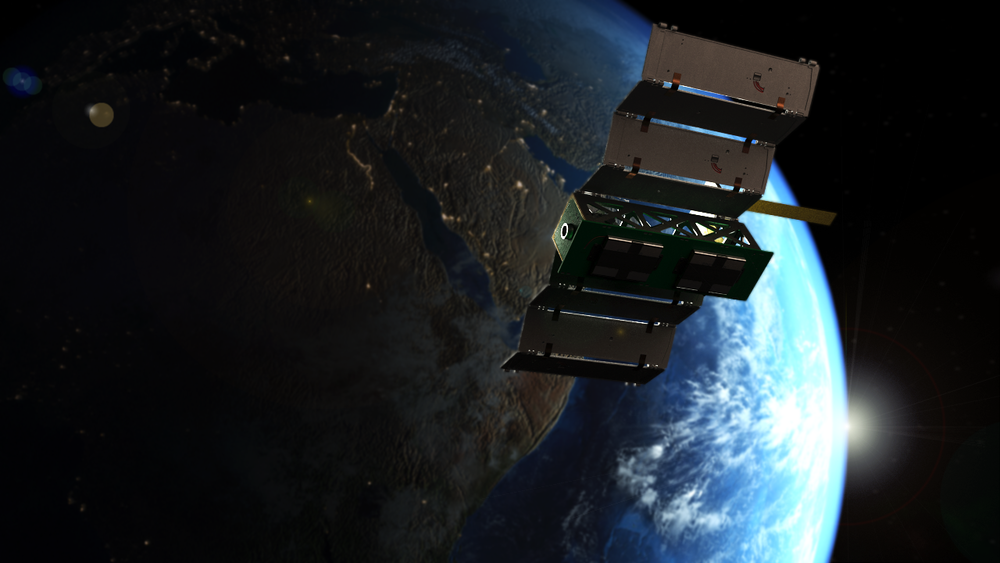
Unicorn-2a in Space - image credit Alba Orbital

Unicorn-2a in Space – image credit Alba Orbital

Glasgow-based Alba Orbital plan to launch a 3p PocketQube Unicorn-2a built by several radio amateurs including Constantin Constantinides MM6XOM, Sajimon Chacko 2M0DSY and Alejandro González Garrido EA7KDU. A 3rd quarter 2018 launch is planned on a Vector Launch Inc. rocket from Kodiak, Alaska into a 350 x 350 km 98 degree orbit. The mission will last about 45 days and Delfi-PQ is expected to be a fellow passenger on the launch.

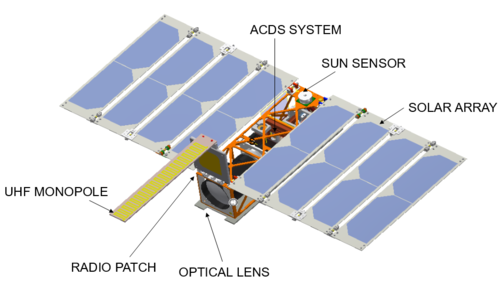
Unicorn-2a PocketQube Structure

Unicorn-2a PocketQube structure

The mission of Unicorn-2a is primarily a technological demonstration of an Optical payload with a 16m GSD (Ground Sample Distance).

When the satellite is in orbit it is planned to run challenges with the amateur radio community such as:
– 1st download of an image from the satellite
– 1st reception of text based/extended beacon
– 1st reception of the satellite in the southern hemisphere

An open source GUI for the satellite will be available to all from Alba Orbital’s web site. This GUI allows for monitoring the health status of the satellite once the beacon has been received.

Alba Orbital are collaborating with the University of Aachen and their amateur radio group DL0FHA to trial Unicorn-2a operations and act as a backup. This helps students learn about communicating with a real mission.

The team are proposing a UHF downlink using 9k6 bps GFSK and at 2.4 GHz using 200 kbps GMSK and LoRa at 38 kbps.

Watch the talk on the Unicorn-2a structure by Andrew Dunn given at PocketQube Workshop in Delft

Unicorn-2 http://www.albaorbital.com/unicorn2/

Unicorn-2 on IARU satellite frequency coordination site http://www.amsat.org.uk/iaru/

Vector to launch Unicorn-2a and Delfi-PQ PocketQube satellites on first orbital attempt
https://www.prnewswire.com/news-releases/vector-to-conduct-dedicated-launch-of-alba-orbital-pocketqube-satellites-on-first-orbital-attempt-300610673.html