Interns build a CubeSat

NASA Interns CubeSat

This video, released by NASA, shows a  group of interns who built a CubeSat.

Interns building a CubeSatInterns:
Anthony Yee, Christopher Erb, Jeffrey Sherwood, Tanzim Imam, Clayton Jacobs, Tiara Johnson, Liz Sauerbrunn, Alex Petrov, Marvin Cosare, Matthew Davis, Megan Robbett

Co-mentors:
Pat Kilroy, Joe Howard, Gary Crum, David Kim, Anisa Jamil, Eric Young, Pete Rossoni, Peter Ancosta, Victor Sank, Mark Steiner, Frank Kirchman, Jeff Didion, Franklin L. Robinson, Kenneth E. Li, Porfy Beltran, Dan Solomon, Leigh Janes, Gerardo Cruz-Ortiz

Watch NASA | Interns Build CubeSat

Interns Group Picture

7-year-old UK boy writes to NASA

Late Spring on MarsDexter, a 7-year-old from Derby in England, wrote to NASA saying he wanted to be an astronaut and go to Mars.

The Huffington Post reports that to the surprise of his mother, Katrina Anderson, NASA responded encouraging Dexter to explore space camp, get good grades and continue “reaching for the stars” and sent a parcel of photos and stickers.

Read Dexters original letter and NASA’s response on his mother’s Imgur account at http://imgur.com/a/6MqlY

Huffington Post article http://www.huffingtonpost.com/2013/07/08/dexter-nasa-letter_n_3561386.html

National Public Radio (NPR) story http://www.npr.org/blogs/thetwo-way/2013/07/08/200053973/boy-writes-to-nasa-nasa-writes-back

NASA Seeks Academic Partners for Smallsat Technology Collaboration

Image NASA - Franklin image credit to Paul D. Stewart

Image NASA – Franklin image credit to Paul D. Stewart

NASA is seeking small spacecraft technology project proposals from U.S. colleges and universities that would like to collaborate with agency researchers.

Small spacecraft, or smallsats, represent a growing field of space research and operations in which universities often have led the way in technology development. Smallsats, some of which are as small as a four-inch cube, are not expected to replace conventional spacecraft, but sometimes can provide an alternative to larger, more costly spacecraft. Smallsats can serve as platforms for rapid technology testing or specialized scientific research and exploration not otherwise possible. Smallsats also can be developed relatively quickly and inexpensively, and can share a ride to orbit with larger spacecraft.

Continue reading

NASA EDGE – CubeSat Launch Initiative

NASA EDGE talks to NASA about how they’re helping students and professionals launch their own mini satellites known as CubeSats. The CubeSat Launch Initiative provides new opportunities for Science, Technology, Engineering and Mathematics by helping people design, launch and collect data.

Watch NASA EDGE CubeSat Launch Initiative

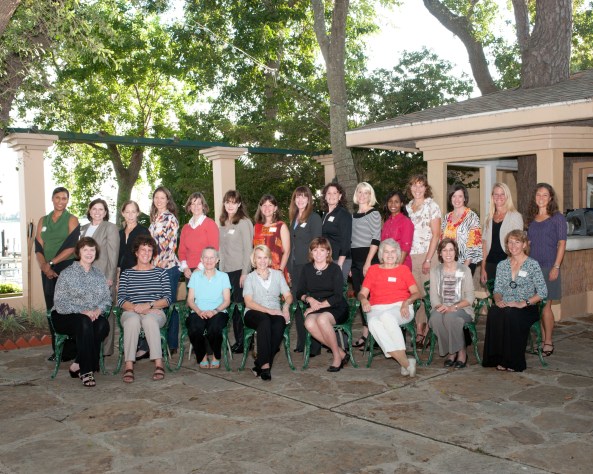
Gathering of Female Astronauts and Former Johnson Space Center Director

Gathering of some Female Astronauts in memory of Sally Ride

Gathering of some Female Astronauts in memory of Sally Ride. Image credit NASA
Seated (from left): Carolyn Huntoon, Ellen Baker KB5SIX, Mary Cleave, Rhea Seddon, Anna Fisher, Shannon Lucid R0MIR, Ellen Ochoa KB5TZZ, Sandy Magnus KE5FYE.
Standing (from left): Jeanette Epps, Mary Ellen Weber, Marsha Ivins, Tracy Caldwell Dyson KF5DBF, Bonnie Dunbar KD5DCB, Tammy Jernigan KC5MGF, Cady Coleman KC5ZTH, Janet Kavandi, Serena Aunon, Kate Rubins, Stephanie Wilson KD5DZE, Dottie Metcalf-Lindenburger KE5DAT, Megan McArthur, Karen Nyberg, Lisa Nowak KC5ZTB
Photographer: Lauren Harnett

On September 17, 2012, 22 female astronauts, a number of them radio amateurs, along with Johnson Space Center’s first female director, Carolyn Huntoon, met to honor Sally Ride and her legacy.
Sally Ride - Image Credit NASA

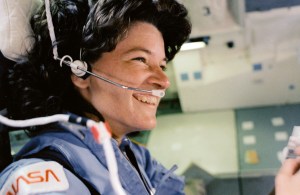
Sally Ride – Image Credit NASA

Sally Kristen Ride was one of 8,000 people to answer an advertisement in a newspaper seeking applicants for the space program. As a result, she joined NASA in 1978. On June 18, 1983, she became the first American woman in space as a crew member on Space Shuttle Challenger for STS-7.

She was the president and CEO of Sally Ride Science, a company she co-founded in 2001 that creates entertaining science programs and publications for upper elementary and middle school students, with a particular focus on young women. The science books, student programs and professional development programs place a strong emphasis on gender and racial equality in the classroom and provide role models of working scientists, engineers and mathematicians who exemplify this diversity in their respective fields

Sally Ride wrote or co-wrote five books on space aimed at children, with the goal of encouraging children to study science.

She died on July 23, 2012, aged 61, seventeen months after being diagnosed with pancreatic cancer.

Wiki – Sally Ride http://en.wikipedia.org/wiki/Sally_Ride

Astronuat Sally Ride - Image Credit NASA

Astronuat Sally Ride – Image Credit NASA

Appointment of Frank Bauer, KA3HDO as AMSAT VP-Human Spaceflight Programs

AMSAT-NA President Barry Baines is pleased to announce that effective August 1, 2012, Frank Bauer, KA3HDO, will be returning as AMSAT’s Vice President for Human Spaceflight Programs. This role will include AMSAT’s leadership on the Amateur Radio on the International Space Station (ARISS) Program and amateur radio operations pursuits on other Human Spaceflight vehicles proposed by NASA, International Space Agencies and domestic and international commercial spaceflight organizations.

Bauer made the following comment regarding his reappointment: “I look forward to working again with AMSAT as we bring the excitement of human space exploration pursuits and amateur radio communications into the communities of the world, inspiring youth to pursue Science, Technology, Engineering and Math (STEM) careers”. Continue reading