NASA Flight Engineer Joe Acaba, KE5DAR, and his two Russian crewmates, Soyuz Commander Gennady Padalka, RN3DT, and Flight Engineer Sergei Revin, RN3BS, arrived on the International Space Station (ISS) this week.
They joined the three other radio amateurs on the ISS – Expedition 31 Commander Oleg Kononenko, RN3DX, of the Russian Federal Space Agency, Flight Engineer Don Pettit, KD5MDT, of NASA and Flight Engineer Andrei Kuipers, PI9ISS, of the European Space Agency.
A status report video released by NASA for May 14-18 notes that Joe Acaba, KE5DAR, powered on the ham radio in the ESA Columbus module. The ham radio reference occurs 09:05 into the video.
Watch ISS Update: Weekly Recap for May 14-18, 2012
Classroom preperation for the student spaceflight experiments program SSEP
On Tuesday, May 22 at 07:44 UT SpaceX’s Dragon hopes to transport the student payload Aquarius on SSEP Mission 1 to the International Space Station (ISS).
The set of SSEP Mission 1 experiments, called Aquarius, was originally slated to fly aboard the Soyuz 30. But in an interesting twist of fate, the experiments were re-manifested on the maiden voyage of the SpaceX Dragon to the ISS. Aquarius not only becomes part of a historic first but also allows the space station to remain an out-of-this-world platform to engage students in STEM — science, technology, engineering and mathematics.
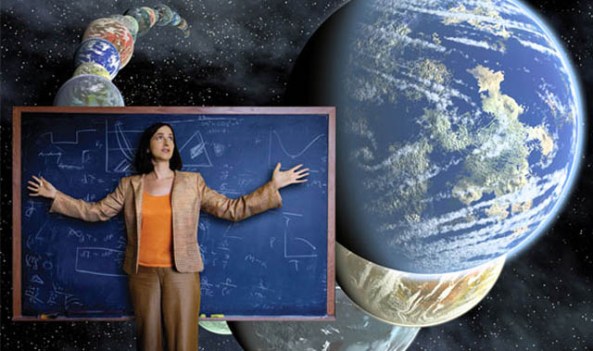
Radio Amateur Sara Seager KB1WTW - Image Credit PlanetQuest
Time Magazine reports that unlike the massive NASA Kepler probe the next mission to search for new planets will be a tiny CubeSat called ExoplanetSat.
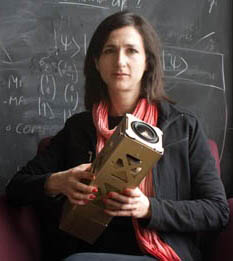
Sara Seager KB1WTW with model of ExoplanetSat - Image Credit MIT
Time says: What makes ExoplanetSat even more un-NASA-like is that it began as a class project — although admittedly, the class was at MIT. It was a design-and-build course, which the university’s engineering students have to take in order to graduate. In a recent semester, the class was co-taught by Sara Seager [KB1WTW] an astrophysicist who has done groundbreaking research studying how the atmospheres of planets orbiting distant stars might look like from earthly telescopes. Seager recruited five science undergrads to join her engineers, on the theory that out in the real world, they’d eventually have to work with engineers anyway.
The group lead by Sara KB1WTW is developing a prototype ExoplanetSat capable of monitoring a single, bright, sun-like star for two years. Planned to launch late 2012 or 2013 it is hoped it will open the gates for ExoplanetSat interest and funding. Once the funding doors are opened, then the fleet of ExoplanetSats can be launched. The fleet may contain as many as a hundred of these small satellites, each focused on its own star.
In a 2011 visit to Cambridge, UK, Sara said “The reason why we’re excited is because we think that this is a really huge thing. Hundreds and thousands of years from now, people will look back and ask, what are the significant accomplishments of our society in the early twenty-first century? One of them will be that we were the first to discover other worlds and other worlds that might be like Earth. When you think back four hundred years, what do you remember? You think about Christopher Columbus and Lewis and Clark. It’s the exploration—finding things that were new to our culture. And that’s why we’re excited.”
Global voting started yesterday, May 9, for the International Space Apps Challenge! The Space Apps Challenge fosters innovation by providing a platform for citizens from around the world to work together to solve current challenges relevant to both space exploration and social need. The Innovation Endeavors and Talenthouse community of investors, entrepreneurs and advisors are here to support and celebrate these teams and their innovations to the fifty challenges – and invite you to vote for your favorite App. The final winners will be determined with your votes and along with an internationally recognized jury of investors and entrepreneurs from Innovation Endeavors.
Among the many Apps is one that visualizes near-real time aurora data, a solution to visualize Kepler data, such as changing star intensity, using an Arduino and a prototype web app aimed at school children that makes the Kepler exoplanet data more accessible by displayingᅠit in a visual and fun way, making comparisons with each planetᅠto our own.
The six radio hams comprising the ISS Expedition 31 crew. In the front row are Russian cosmonauts Oleg Kononenko RN3DX (right), commander; and Gennady Padalka RN3DT, flight engineer. Pictured from the left (back row) are NASA astronaut Joe Acaba KE5DAR, Russian cosmonaut Sergei Revin RN3BS, European Space Agency astronaut Andre Kuipers PI9ISS and NASA astronaut Don Pettit KD5MDT, all flight engineers. Photo credit: NASA
The ARRL report that NASA will televise the launch and docking of the next mission, carrying three radio amateurs to the International Space Station (ISS), scheduled for May 14.
NASA Flight Engineer Joseph Acaba, KE5DAR, and his two Russian crewmates, Soyuz Commander Gennady Padalka, RN3DT, and Flight Engineer Sergei Revin, RN3BS, are completing their training as they undergo Soyuz spacecraft fit.
Live NASA TV coverage of the Soyuz TMA-04M spacecraft launch from the Baikonur Cosmodrome in Kazakhstan begins at 9 PM CDT on Monday, May 14 (0200 UTC May 15), with the launch scheduled for 10:01 PM CDT (0301 UTC).
The trio will arrive at the station May 16, joining Expedition 31 Commander Oleg Kononenko, RN3DX, of the Russian Federal Space Agency, Flight Engineer Don Pettit, KD5MDT, of NASA and Flight Engineer Andrei Kuipers, PI9ISS, of the European Space Agency, who have been aboard the ISS since December 2011. Padalka, Acaba and Revin will transition to the Expedition 32 crew in July and return to Earth in mid-September.
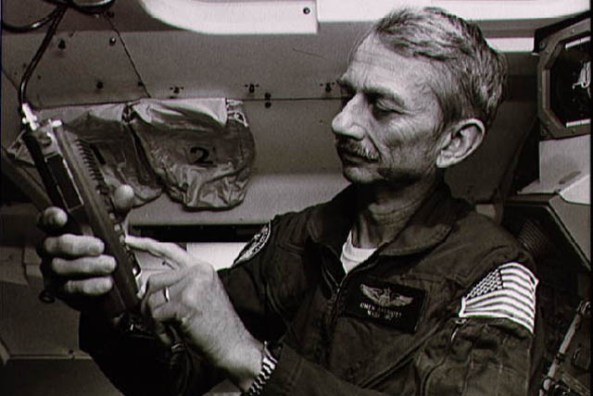
Owen Garriott W5LFL with Motorola two meter FM ham radio on STS-9 Columbia
The first ham radio transmissions by an amateur radio operator in space were made by Owen K. Garriott W5LFL during the STS-9 Columbia mission in 1983. This led to many further space flights incorporating amateur radio as an educational and back-up communications tool.
Watch ARRL – Amateur Radio’s Newest Frontier (STS-9 Columbia) narrated by Roy Neal K6DUE
Narrated by the Commander and crew, the following video contains footage selected by the astronauts, as well as their comments on the mission. Footage includes launch, onboard crew activities, and landing.
Watch Space Shuttle STS-9 Columbia-Spacelab 1 pt1-2 Post Flight Press Conference Film 1983 NASA
Watch Space Shuttle STS-9 Columbia-Spacelab 1 pt2-2 Post Flight Press Conference Film 1983 NASA
STS-9 (also known as STS-41A and Spacelab 1) was a NASA Space Shuttle mission which carried the first Spacelab module into orbit to conduct space-based scientific experiments. It was the sixth mission of the Space Shuttle Columbia, and was Columbia’s last flight until STS-61-C in January 1986. It was also the last time the old STS numbering was used until STS-26 (in the aftermath of the Challenger disaster of STS-51-L). Under the new system, STS-9 would have been designated as STS-41-A.
STS-9 launched successfully from Kennedy Space Center at 11 am EST on 28 November 1983.
The shuttle’s crew was divided into two teams, each working 12-hour shifts for the duration of the mission. Young, Parker and Merbold formed the Red Team, while Shaw, Garriott and Lichtenberg made up the Blue Team. Usually, the commander and the pilot team members were assigned to the flight deck, while the mission and payload specialists worked inside the Spacelab.
Over the course of the mission, seventy-two scientific experiments were carried out, spanning the fields of atmospheric and plasma physics, astronomy, solar physics, material sciences, technology, life sciences and Earth observations. The Spacelab effort went so well that the mission was extended an additional day to 10 days, making it the longest-duration shuttle flight at that time.
The Spacelab 1 mission was highly successful, proving the feasibility of the concept of carrying out complex experiments in space using non-NASA persons trained as payload specialists in collaboration with a POCC. Moreover, the Tracking and Data Relay Satellite, now fully operational, was able to relay vasts amounts of data through its ground terminal to the POCC.
During orbiter orientation, four hours before re-entry, one of the flight control computers crashed when the RCS thrusters were fired. A few minutes later, a second crashed in a similar fashion, but was successfully rebooted. Young delayed the landing, letting the orbiter drift. He later testified: “Had we then activated the Backup Flight Software, loss of vehicle and crew would have resulted.” Post-flight analysis revealed the GPCs failed when the RCS thruster motion knocked a piece of solder loose and shorted out the CPU board.
Columbia landed on Runway 17 at Edwards Air Force Base on 8 December 1983, at 3:47 pm PST, having completed 166 orbits and travelled 4.3 million miles (6.9×10⁶ km) over the course of its mission. Right before landing, two of the orbiter’s three auxiliary power units caught fire due to a hydrazine leak, but the orbiter nonetheless landed successfully. Columbia was ferried back to KSC on 15 December. The leak was later discovered after it had burned itself out and caused major damage to the compartment…
Commander: John W. Young
Pilot: Brewster H. Shaw, Jr.
Mission Specialists: Owen K. Garriott, Robert A. R. Parker
Payload Specialists: Byron K. Lichtenberg (MIT), Ulf Merbold (Germany)
Dates: November 28 to December 8, 1983
Vehicle: Columbia OV-102
Payloads: Spacelab-1
Landing site: Runway 17 dry lakebed at Edwards AFB, CASpace Shuttle




 AMSAT-UK
You must be logged in to post a comment.