PhoneSat team thank Radio Amateurs

Phonesat ConstructionThe Team behind the three PhoneSats, deployed April 21, have thanked radio amateurs for their response so far and they request further telemetry reports.

They say:

Since the successful deployment of our three PhoneSats on Sunday, we have already received over 200 packets from Amateur Radio operators around the world! We are sincerely grateful for all of your support and would like to thank you for your key contributions in making this technology demonstration a success. The received packets are being processed right now and will be published soon. Please keep sending packets so we can follow the status of the satellites for the complete duration of the technology demonstration.

The three PhoneSats carry amateur radio payloads on 437.425 MHz. The callsign of all three satellites is KJ6KRW and they transmit using AFSK (1200 bps) modulation, AX.25 packet radio. The two PhoneSat 1.0 satellites, Graham and Bell, transmit with a periodicity of respectively 28 seconds and 30 seconds. The PhoneSat 2.0 beta satellite, Alexandre, transmits with a periodicity of 25 seconds.

Register your amateur radio satellite station on the PhoneSat Dashboard at
http://www.phonesat.org/dashboard.php

PhoneSat CubeSats with Ham Radio Payloads Launched
https://amsat-uk.org/2013/04/22/phonesat-cubesats-launched/

PhoneSat CubeSats with Ham Radio Payloads Launched

Antares Rocket Tuesday, April 16, 2013

Antares Rocket Tuesday, April 16, 2013

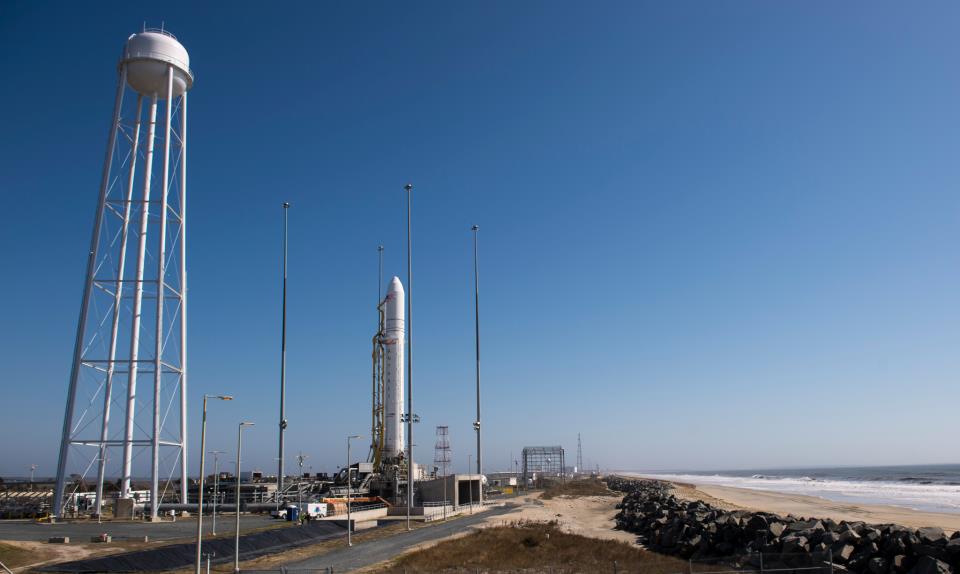
Three PhoneSat CubeSats with amateur radio payloads were launched on an Orbital Sciences Corporation Antares(TM) rocket from NASA’s Wallops Flight Facility (WFF) in eastern Virginia on Sunday, April 21.

The three PhoneSats carry amateur radio payloads on 437.425 MHz, each transmits at intervals so all three are receivable during a pass. Roland Zurmely PY4ZBZ received them on the second orbit on April 21 at 22:52 UT, see http://www.qsl.net/py4zbz/phs.htm and Mike Rupprecht DK3WN reported receiving all three on Monday April 22, see http://www.dk3wn.info/p/?p=32755

The callsign of all three satellites is KJ6KRW and they transmit using AFSK (1200 bps) modulation, AX.25 packet coding. The two PhoneSat 1.0 satellites, Graham and Bell, transmit with a periodicity of respectively 28 seconds and 30 seconds. The PhoneSat 2.0 beta satellite, Alexandre, transmits with a periodicity of 25 seconds.

Watch PhoneSat: Small Satellites Use Smart Phones For Brains

PhoneSat was chosen as one of the winners in the Aerospace category for the Popular Science magazine “Best of What’s New 2012″ awards. The PhoneSat is a technology demonstration mission consisting of three 1U CubeSats intended to prove that a smartphone can be used to perform many of the functions required of a spacecraft bus.

The satellite is built around the Nexus smartphone which will be running the Android operating system and will be enclosed in a standard 1U CubeSat structure. The main function of the phone is to act as the Onboard Computer, but the mission will also utilize the phone’s SD card for data storage, 5MP camera for Earth Observation, and 3-axis accelerometer and 3-axis magnetometer for attitude determination.

One of the nanosatellites, powered by the HTC Nexus One smartphone, will send back pictures of Earth. The other two, running on the Samsung Nexus S, will have two-way S-band radio allowing them to be controlled from Earth.

The satellites have no solar cells and operate on battery only so will only have a lifetime of about a week,

An updated website with telemetry info is now available.
http://www.phonesat.org/packets.php

The Antares launch included the commercial DOVE-1 satellite, a technology development experiment that is believed to be using 2420 MHz.

PhoneSat http://www.phonesat.org/

Preliminary TLEs / ‘Keps’ are at http://phonesat.org/phonesat.txt
TLEs / ‘Keps’ for recent launches http://celestrak.com/NORAD/elements/tle-new.txt

Check the AMSAT Bulletin Board (AMSAT-BB) for the latest information http://www.amsat.org/amsat-new/tools/maillist/

Thanks to AMSAT News Service (ANS), AMSAT-NA, AMSAT-UK and Samudra Haque N3RDX / S21X for the above information.

Antares CubeSat Launch

Antares Rocket Tuesday, April 16, 2013

Antares Rocket Tuesday, April 16, 2013

The launch of Antares carrying three CubeSats with amateur radio payloads is expected to take place on Wednesday, April 17.

ANS reports that three PhoneSat cubesats will be aboard the Orbital Sciences Corporation Antares(TM) rocket from NASA’s Wallops Flight Facility (WFF) in eastern Virginia scheduled for April 17 at approximately 5:00 p.m. (EDT). The launch will be shown live on NASA TV at http://www.nasa.gov/ntv and also at http://www.nasa.gov/orbital

The three PhoneSats carry amateur radio payloads on 437.425 MHz, each transmits at intervals so all three should be receivable during a pass.

The callsign will be KJ6KRW all three satellites will transmit using AFSK (1200 bps) modulation, AX.25 packet coding. The two PhoneSat 1.0 satellites, Graham and Bell, transmit with a periodicity of respectively 28 seconds and 30 seconds. The PhoneSat 2.0 beta satellite, Alexandre, transmits with a periodicity of 25 seconds.

PhoneSat was chosen as one of the winners in the Aerospace category for the Popular Science magazine “Best of What’s New 2012″ awards. The PhoneSat is a technology demonstration mission consisting of three 1U CubeSats intended to prove that a smartphone can be used to perform many of the functions required of a spacecraft bus.

The satellite is built around the Nexus smartphone which will be running the Android operating system and will be enclosed in a standard 1U CubeSat structure. The main function of the phone is to act as the Onboard Computer, but the mission will also utilize the phone’s SD card for data storage, 5MP camera for Earth Observation, and 3-axis accelerometer and 3-axis magnetometer for attitude determination.

One of the nanosatellites, powered by the HTC Nexus One smartphone, will send back pictures of Earth. The other two, running on the Samsung Nexus S, will have two-way S-band radio allowing them to be controlled from Earth.

With a short lifetime of only about one week, the satellites have no solar cells and operate on battery only.

An updated website with telemetry info is now available. Please note the launch date/time may change.
http://www.phonesat.org/packets.php

The Antares launch includes the commercial DOVE-1 satellite, a technology development experiment. The satellite had requested IARU coordination for a 1 watt transmitter on 145.825 MHz to downlink a 1200 baud AFSK AX.25 beacon with telemetry and health data. The AMSAT News Service reported in ANS-027 that according to the IARU DOVE-1 will no longer be using frequencies in the amateur radio bands.

It appears the USA FCC granted the experimental callsign WF9XKA for the use by Dove 1, it is believed it may use a downlink on 2420 MHz. Search for Cosmogia at https://apps.fcc.gov/oetcf/els/reports/GenericSearch.cfm
Dove-1  information https://apps.fcc.gov/els/GetAtt.html?id=121393
Dove 2 is slated to launch from Baikonur in Kazakhstan on April 19 on a Soyuz-2-1a,

PhoneSat http://www.phonesat.org/

TLEs / ‘Keps’ for recent launches http://celestrak.com/NORAD/elements/tle-new.txt

Check the AMSAT Bulletin Board (AMSAT-BB) for the latest information http://www.amsat.org/amsat-new/tools/maillist/

Thanks to AMSAT News Service (ANS), AMSAT-NA, AMSAT-UK and Samudra Haque N3RDX / S21X for the above information.

Decoding the STRaND-1 amateur radio telemetry beacon

STRaND-1 PSLV-C20 Launch - Image credit ISRO

STRaND-1 PSLV-C20 Launch – Image credit ISRO

STRaND-1 carries an amateur radio AX.25 packet radio downlink on 437.568 MHz using 9600 bps FSK modulated data with HDLC frame, NRZI encoding.

Dr Chris Bridges would be delighted to receive all available telemetry files by email to C.P.Bridges@surrey.ac.uk

Excel Spreadsheet of STRaND-1 Telemetry Format_20130327

On the AMSAT Bulletin Board Mark Hammond N8MH has provided these tips to decode STRaND-1:

(1) Sprint-2 TNC set at 9600 baud in KISS mode (or any 9600 in KISS mode probably)

(2) Using this software to capture:
http://www.dk3wn.info/files/online_kiss_plus.zip

(3) And using this software to decode the captured KISS files:
http://www.dk3wn.info/files/kissdump.zip

Thanks to Mike Rupprecht DK3WN for the excellent software.

Jan PE0SAT describes how he used the free TNC emulator software AGWPE and SDR# to decode the telemetry. This approach means you don’t have to buy a dedicated hardware TNC it simply uses your existing PC and radio that supports 9600 bps data:

(1) Record a pass using SDR# and a FUNcube Dongle Pro+ and save the IQ wav file so you can work with it after the pass.
(2) Configure AGW Packet Engine (AGWPE) as a 9600 baud modem using your audio mixer as input. If you don’t have an audio mixer, use audio VAC to route the received audio to the AGW audio input.
(3) When the AGW packet engine is running use AGW-Online-KISS from DK3WN to connect to the packet engine and decode the telemetry.
(4) Open the IQ wav file within SDR# and playback the recorded file and tune to the correct receive frequency, now you can see decoded data within Online-Kiss.
(5) Feed the files captured to KISS-Dump

STRaND-1 Ground Station Antennas

STRaND-1 Ground Station Antennas

Descriptions of ONLINE KISS +, AGW ONLINE KISS and KISS Dump + are at http://tinyurl.com/SatSoftwareDK3WN/

The free AGWPE soundcard packet software AGWPE.zip is available at http://www.sv2agw.com/downloads/

Guide on how to use AGWPE http://www.soundcardpacket.org/

Tracking Information

Free satellite tracking software:
• SimpleSat Look Down http://www.tomdoyle.org/SimpleSatLookDown/
• Gpredict http://gpredict.oz9aec.net/
• Orbitron http://www.amsat-uk.org/?p=9051

Keplerian Two Line Elements (TLE’s) ‘Keps’

ISRO plans SARAL and Amateur Radio satellites launch for February 25

AAUSAT3 Flight Model and Engineering Model - Image credit Aalborg University

AAUSAT3 Flight Model and Engineering Model – Image credit Aalborg University

The Hindu newspaper reports that the first launch of the year by the Indian Space Research Organisation (ISRO) will be the PSLV-CA (PSLV-C20). It will carry the ocean study spacecraft SARAL as well as satellites carrying amateur radio payloads. The launch into a 785 km orbit is currently planned to take place on February 25.

Continue reading

ISS Plasma Thrust Shadow-Beacon Experiment Feb 1-3 and 8-10

International Space Station ISS with shuttle Endeavour 2011-05-23It is understood that the ISS amateur radio SpEx Shadow-Beacon experiment is planned to take place February 1-3 and 8-10. The timetable is here.

The Central Research Institute of Machine Building (TSNIIMASH) in Russia is conducting a series of space plasma experiments in order to evaluate the shape of previously observed “dead” zone, or shadowing due to the firing of an onboard arcjet plasma source.

Radio Amateurs are invited to participate in the Space plasma experiment “Shadow” onboard the International Space Station (ISS).

Continue reading