 In this HamRadioNow video AMSAT President, Barry Baines WD4ASW, gives an update on what AMSAT is up to now and planning for the future.
Tag Archives: Packet Radio
ISS Packet Radio Active Again on 145.825 MHz
Watch ISS AX.25 packets on 145.825 MHz FM at approx 7:21pm on August 24, 2012
QRP APRS Packet Radio to the ISS http://www.uk.amsat.org/?p=3838
Real time tracking and status information for the amateur radio stations on the ISS can be found on the ISS Fan Club site http://www.issfanclub.com/
SPROUT amateur radio SSTV satellite to launch in 2014
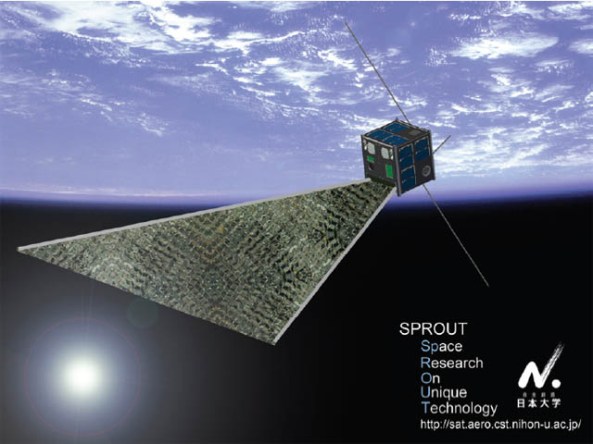
SPROUT Amateur Radio SSTV Satellite
SPROUT, a 20 x 20 x 22 cm amateur radio nano-satellite with a mass of 7.1 kg, plans to launch with the L-band (1236.5 MHz/1257.5 MHz/1278.5 MHz) Synthetic Aperture Radar (SAR) satellite ALOS-2 on May 24, 2014. [Updated May 19, 2014]
SPROUT (Space Research On Unique Technology) was built by students from Nihon University and its objectives are:
1. Operation of satellite by radio amateurs. SPROUT downlinks the digi-talker sound recorded preliminary in the satellite, the digi-peater voice and packet uploaded by radio amateurs, Slow Scan TV (SSTV) and FM packet of the picture of the Earth taken by the satellite camera, which can be received by radio amateurs. SPROUT has two downlink frequencies and two uplink frequencies, and one uplink frequency and one downlink frequency will be open for radio amateurs. They can use the digipeater and packet and use one camera mounted on SPROUT and take the pictures by themselves, and downlink the pictures by SSTV.
2. Demonstration of the deployment of the combined membrane structure and verification of the design method of the structure SPROUT has a triangular membrane supported by two tubes like framework. They are folded and stored in the satellite before the launch. After the launch, the nitrogen gas is injected into the tubes in space, and they extend, so that the membrane deploys (called “combined membrane structure”).
3. Demonstration of attitude determination and control of a nanosatellite Will conduct the attitude determination experiment on orbit by using the sun sensors, gyros, and geomagnetic sensor, and conduct the attitude control experiment by using the magnetic torquers.
It carries two UHF/VHF radio systems – one for Telemetry, Tracking & Control (TTC) using CW, 1200 bps AFSK and 9600 bps GMSK AX.25 packet and one for amateur operations using 1200 bps AFSK AX.25 packet.
SPROUT plans to launch from the Tanegashima Space Center into a 628 km Sun Synchronous Orbit (SSO) on May 24, 2014.
Callsign: JQ1ZJQ
Size: 214x210x220 mm
Weight: 7.1 kg
Mode: 1200bps AFSK, 9600bps GMSK
CW downlink 437.525 MHz
FM packet downlink 437.525 MHz
Digi-peater uplink 437.600 MHz
Digi-talker downlink 437.600 MHz
SSTV downlink 437.600 MHz
Sprout Satellite English website http://sat.aero.cst.nihon-u.ac.jp/sprout-e/
Sprout Satellite Japanese website http://sat.aero.cst.nihon-u.ac.jp/sprout/
Nihon-Univ. Miyazaki Laboratory on Facebook
https://www.facebook.com/pages/Nihon-Univ-Miyazaki-Laboratory/406566642818860
JE9PEL website http://www.ne.jp/asahi/hamradio/je9pel/jaxalos2.htm
Read the Overview of the L-band SAR Onboard ALOS-2 here.
SwampSat on TV News

Dr Norman Fitz-Coy with the SwampSat CubeSat
The amateur radio SwampSat satellite, built by students at the University of Florida (UF), featured in a TV news report.
SwampSat’s primary objective is to demonstrate a compact three-axis attitude control system that permits rapid retargeting and precision pointing (R2P2) capabilities for pico and nano satellites.
Its downlink will use 1200 bps AX25 packet radio on 437.385 MHz with 1 watt of RF.
The team are planning on a December 2012 launch on the SpaceX Falcon 9 into a 450 km orbit with an inclination of 45 degrees.
Watch SwampSat Video.mp4
Watch SwampSat – UF Research Report.mp4
SwampSat – Florida’s small satellite programs brings STEM jobs
https://www.facebook.com/media/set/?set=a.10150734814267248.435445.121264742247&type=3
UF shows off its small satellite http://www.gainesville.com/article/20120406/articles/120409715
Gator Amateur Radio Club http://www.gatorradio.org/
University of Florida Small Satellite Design Club (SSDC) http://www.ufsmallsat.com/
Status of ISS Ham Radio Operations

ISS Amateur Radio Project Engineer Kenneth Ransom, N5VHO reports the ARISS AX.25 digipeater has changed frequency from 145.825 MHz (up/down) to 437.550 MHz (up/down). The same digi alias ARISS is still used.
This change was started with the docking of the ESA Automated Transfer Vehicle (ATV). The ATV is an expendable, unmanned resupply spacecraft delivering propellant, water, air, payloads and experimental supplies to the International Space Station (ISS).

International Space Station
Packet radio operations were moved to the Columbus Module UHF radio when the Kenwood D700 radio was recently powered off due to needing an additional air purifier to support the ATV. Normally the air purifier is located in the ATV but recent power support issues related to the ATV and ISS necessitated the system be relocated to the Service Module.
The purifier is now using the power outlet that the Kenwood radio normally uses. The Russian team has agreed to briefly power the purifier off for the scheduled ARISS school events but then will re-activate the purifier right afterwards. This appears to be a long term impact as ATV is currently scheduled to depart from ISS in September.
ARISS and Ham Radio Opportunities Video http://www.uk.amsat.org/8099
Amateur Radio on the International Space Station ARISS http://ariss.rac.ca/
PrintSat – An Amateur Radio 3D Printer CubeSat

The image shows the building of a CubeSat with Additive Manufacturing with the WINDFORM XT. Image Credit Windform
Students at Montana Sate University (MSU) are planning to build their new amateur radio satellite PrintSat with nano-carbon-impregnated plastic using a 3D printer.
David Klumpar KD7MFJ of MSU said 3D printing “will further lower the costs and speed the development of very small satellites, enabling future scientific missions comprised of dozens of satellites flying in formation.”
Jim White WD0E, president of Colorado Satellite Services, explained that “Additive manufacturing (also called 3-D printing) has evolved in the past few years to be a very inexpensive and fast way to make mechanical parts. With PrintSat, the entire structure of the small satellite will be printed. As the first use of additive manufacturing for a satellite, we plan to show it’s not only cheaper and faster, but that we can make parts that cannot be made in traditional ways.”
When in orbit PrintSat will measure and report on the characteristics of the Windform XT2.0 printed material and plating during its mission life in order to verify the utility of additive manufacturing for spacecraft structures and mechanisms.
PrintSat plans to use the same frequencies as RAMPART and use GMSK 9k6 Ax.25 packet radio. It is aiming for a May 2103 launch from the Wallops Flight Facility into a 500km 40 degree inclination orbit.
Other satellites planning to fly on the same launch include Blacknight-1, Spa-1 Trailblazer, Phonesat, Kysat- II, Rampart, NPS-SCAT, Copper, TJSat, Tethersat, Lunar orbiter/lander CubeSat, Swampsat, Cape-2, Dragonsat-1 and Ethersat.
Montana State University Space Science and Engineering Laboratory https://ssel.montana.edu/
Windform XT2.0 http://www.windform.it/windform-xt-2-0-en.html
IARU Amateur Satellite Frequency Coordination Status Pages http://www.amsat.org.uk/iaru
 AMSAT-UK
You must be logged in to post a comment.