MO-76 $50sat is Rev-Ed project of the month

Yaesu handheld and $50SAT 1.5U PocketQube

Yaesu handheld and $50SAT 1.5U PocketQube

The MO-76 $50sat amateur radio satellite team is pleased to announce that the PICAXE based $50sat was chosen as Project of the Month by Bath based Revolution Education who supply PICAXE microcontroller development systems.

$50SAT is one of the smallest amateur radio satellites ever launched at 5x5x7.5 cm and weighs only 210 grams. Transmitter power is just 100 mW on 437.505 MHz (+/-9 kHz Doppler shift) FM CW/RTTY. It uses the low cost Hope RFM22B single chip radio and PICAXE 40X2 processor.

$50SAT was a collaborative education project between Professor Bob Twiggs, KE6QMD, Morehead State University and three other radio amateurs, Howie DeFelice, AB2S, Michael Kirkhart, KD8QBA, and Stuart Robinson, GW7HPW.

PICAXE $50sat http://www.picaxe.com/Project-Gallery/50SAT/

Bath based Revolution Education http://www.rev-ed.co.uk/

$50SAT PocketQube Amateur Radio Challenge
https://amsat-uk.org/2014/02/21/50sat-amateur-radio-challenge/

Further information in the $50SAT Dropbox https://www.dropbox.com/sh/l3919wtfiywk2gf/-HxyXNsIr8

$50SAT – Eagle2 – Communications – Release Version V1_1.pdf
http://tinyurl.com/50DollarSatCommunicationsV1-1

Hope RFM22B single chip radio http://www.hoperf.com/rf/fsk_module/RFM22B.htm

There is a discussion group for $50SAT http://groups.yahoo.com/groups/50dollarsat/

50DollarSat http://www.50dollarsat.info/

$50SAT designated Morehead-OSCAR-76

Yaesu handheld and $50SAT 1.5U PocketQube

Yaesu handheld and $50SAT 1.5U PocketQube

The $50SAT team have applied for and been designated an OSCAR number for their PocketQube satellite – Morehead-OSCAR-76, or MO-76.

$50SAT is one of the smallest amateur radio satellites ever launched at 5x5x7.5 cm and weighs only 210 grams. Transmitter power is just 100 mW on 437.505 MHz (+/-9 kHz Doppler shift) FM CW/RTTY. It uses the low cost Hope RFM22B single chip radio and PICaxe 40X2 processor.

$50SAT has been a collaborative education project between Professor Bob Twiggs, KE6QMD, Morehead State University and three other radio amateurs, Howie DeFelice, AB2S, Michael Kirkhart, KD8QBA, and Stuart Robinson, GW7HPW.

$50SAT PocketQube Amateur Radio Challenge
https://amsat-uk.org/2014/02/21/50sat-amateur-radio-challenge/

Further information in the $50SAT Dropbox https://www.dropbox.com/sh/l3919wtfiywk2gf/-HxyXNsIr8

$50SAT – Eagle2 – Communications – Release Version V1_1.pdf
http://tinyurl.com/50DollarSatCommunicationsV1-1

Hope RFM22B single chip radio http://www.hoperf.com/rf/fsk_module/RFM22B.htm

There is a discussion group for $50SAT http://groups.yahoo.com/groups/50dollarsat/

50DollarSat http://www.50dollarsat.info/

Information on obtaining an OSCAR number for your satellite can be found on the OSCAR Numbers Policy page at http://www.amsat.org/?page_id=2478

$50SAT PocketQube Amateur Radio Challenge

Yaesu handheld and $50SAT 1.5U PocketQube

Yaesu handheld and $50SAT 1.5U PocketQube

The $50sat PocketQube satellite team, AB2S, KD8QBA and GW7HPW, are celebrating 90 days in orbit by proposing a technical challenge to all interested radio amateurs.

$50sat is capable of responding to uplink command packets. There are three open packets:

• Test packet – $50SAT responds by sending the RSSI of the received packet in slow FM Morse.

• Request data packet – the normal data packet is sent.

• Request RTTY – The RTTY is sent.

In addition all received packets result in two copies of the ack packet being sent, that contains the RSSI of the received packet.

All the required information to accomplish this is available on the Dropbox location available through the $50sat web page. See the document $50SAT – Eagle2 – Communications – Release Version V1_1.pdf

Anyone that can demonstrate a successful command uplink by submitting a recording of the response packet along with the date, time and location of of the contact will receive a Certificate of Technical Accomplishment signed by all three builders of $50sat.  Submissions can be made to the $50sat email address; 50dollarsat at yahoo.com

This is a significant challenge because there is no magic black box that you can buy to do this.

$50SAT Boards

$50SAT Boards

After 90 days of operation, the Kodak KLIC-7002 camera battery that powers the satellite has fallen off about 100mV, but operations still seem normal.

We have also programmed a special 5th Morse beacon to thank our launch sponsor and mentor Prof. Bob Twiggs. Please give a listen for  the message TNX KE6QMD on the FM Morse beacon.

QSL cards are still available to anyone that posts telemetry, either hand copied CW or RTTY captures, to the 50dollarsat yahoo group.

73 and good luck to all from the $50sat team

$50SAT is one of the smallest amateur radio satellites ever launched at 5x5x7.5 cm and weighs only 210 grams. Transmitter power is just 100 mW on 437.505 MHz (+/-9 kHz Doppler shift) FM CW/RTTY. It uses the low cost Hope RFM22B single chip radio and PICaxe 40X2 processor.

$50SAT has been a collaborative education project between Professor Bob Twiggs, KE6QMD, Morehead State University and three other radio amateurs, Howie DeFelice, AB2S, Michael Kirkhart, KD8QBA, and Stuart Robinson, GW7HPW.

Further information in the $50SAT Dropbox https://www.dropbox.com/sh/l3919wtfiywk2gf/-HxyXNsIr8

$50SAT – Eagle2 – Communications – Release Version V1_1.pdf
http://tinyurl.com/50DollarSatCommunicationsV1-1

Hope RFM22B single chip radio http://www.hoperf.com/rf/fsk_module/RFM22B.htm

There is a discussion group for $50SAT http://groups.yahoo.com/groups/50dollarsat/

50DollarSat http://www.50dollarsat.info/

$50SAT PocketQube Update

Yaesu handheld and $50SAT 1.5U PocketQube

Yaesu handheld and $50SAT 1.5U PocketQube

Michael Kirkhart KD8QBA provides this update on the $50SAT PocketQube which transmits on 437.505 MHz (+/-9 kHz Doppler shift).

The TLEs on the Dropbox have been updated to reflect the latest element set available from Celestrak. This probably is not necessary, as many (if not all) of you are probably pulling them down into your satellite prediction programs straight from Celestrak’s WWW site.

Construction of the replacement engineering model (engineering model 1 was promoted to flight model 1 and is what is in orbit) has been completed, and preliminary tests show it to be operating correctly. I posted a few photos of the build up on the Dropbox in the Pictures/Engineering-Model-2 folder. Final mass is 202.1 g, which is about 4 to 5 grams lighter than the flight model. This is in line with expectations, as it only has 1 fully populated solar panel, and the missing solar cells (18 of the 24 used on the flight model) would add about 4 to 5 g.

The RTTY reports file has been updated to include all telemetry posted/collected as of 2014-02-11. This file has nearly doubled in size from the last update, which was only 16 days ago. Thanks to everyone who has been feeding the data beast by posting their telemetry; please keep doing so. QSL cards for those who have been posting telemetry should start appear in your mailbox in the next few weeks (or sooner).

$50SAT Boards

$50SAT Boards

While it is still quite cold (and snowy) here in EN82, I have been going out with my FT-60 to listen for at least one pass per day. As the terminator continues to move north (not fast enough for some of us who would like to get past winter), I have noticed the point where the FM Morse beacon transitions to slow code speed (indicating it is now warm enough to turn on the solar power) has been occurring earlier in the pass. As soon as it warms up a bit, I will gather some telemetry just to see how much solar power is being generated.

I have a bit more analysis to do, but thanks to some telemetry captured by Kristaps, we believe the low temperature of $50SAT to be about -24 degrees C.

73
Michael Kirkhart KD8QBA
$50SAT team

$50SAT is one of the smallest amateur radio satellites ever launched at 5x5x7.5 cm and weighs only 210 grams. Transmitter power is just 100 mW on 437.505 MHz (+/-9 kHz Doppler shift) FM CW/RTTY. It uses the low cost Hope RFM22B single chip radio and PICaxe 40X2 processor.

$50SAT has been a collaborative education project between Professor Bob Twiggs, KE6QMD, Morehead State University and three other radio amateurs, Howie DeFelice, AB2S, Michael Kirkhart, KD8QBA, and Stuart Robinson, GW7HPW.

Further information in the $50SAT Dropbox https://www.dropbox.com/sh/l3919wtfiywk2gf/-HxyXNsIr8

There is a discussion group for $50SAT http://groups.yahoo.com/groups/50dollarsat/

50DollarSat http://www.50dollarsat.info/

$50SAT Effect of temperature on battery

Yaesu handheld and $50SAT 1.5U PocketQube

Yaesu handheld and $50SAT 1.5U PocketQube

The following information was posted to the $50SAT (437.505 MHz) PocketQube Yahoo Group:

This is the data from a pass a couple of weeks ago. By noting the audio frequency of the Morse audio, you know what the battery voltage is, so this can be used together with the RTTY to monitor the change in battery voltage as the temperature rises.

The temperature sensor in on the radio\processor PCB, not the battery, so its likely the battery temperature is lagging behind a bit.

The seconds are the time since $50SAT came out of Eclipse and should have therefore started warming up.

Pass Starting 10:55:04 10/01/2014
Time out of Eclipse in Seconds Mode Temp mVolts
463 RTTY -22 3662
534 Morse 3662
568 RTTY -19 3662
642 Morse 3683
725 Morse 3683
744 RTTY -13 3683
850 Morse 3683
915 Morse 3702
945 RTTY -8 3702
995 Morse 3702
1024 RTTY -3 3702

$50SAT is one of the smallest amateur radio satellites ever launched at 5x5x7.5 cm and weighs only 210 grams. Transmitter power is just 100 mW on 437.505 MHz (+/-9 kHz Doppler shift) FM CW/RTTY. It uses the low cost Hope RFM22B single chip radio and PICaxe 40X2 processor.

The electronics of the $50SAT PocketQube cost about $50 which is where the name came from. It also required solar panels which cost a further $150.

$50SAT has been a collaborative education project between Professor Bob Twiggs, KE6QMD, Morehead State University and three other radio amateurs, Howie DeFelice, AB2S, Michael Kirkhart, KD8QBA, and Stuart Robinson, GW7HPW.

Further information in the $50SAT Dropbox https://www.dropbox.com/sh/l3919wtfiywk2gf/-HxyXNsIr8

There is a discussion group for $50SAT http://groups.yahoo.com/groups/50dollarsat/

50DollarSat http://www.50dollarsat.info/

$50SAT PocketQube two months after launch
https://amsat-uk.org/2014/01/22/50sat-pocketqube-two-months-after-launch/

$50SAT PocketQube two months after launch

Yaesu handheld and $50SAT 1.5U PocketQube

Yaesu handheld and $50SAT 1.5U PocketQube

Michael Kirkhart KD8QBA reminds us that the PocketQube $50SAT has now been operating for two months. He writes:

It has now been 2 months since the launch of $50SAT into its 625 km (approximate) sun-synchronous orbit, and as of this morning [Tuesday January 21], it is still operating.

It is getting cold again in EN82 land, so it is not likely I will be able to gather RTTY telemetry during the next few days, as my trusty netbook will not likely be able to deal with the cold for very long. Hopefully, everyone else can “pick up the slack” for me. I will still go out and monitor passes, provided it does not get too cold.
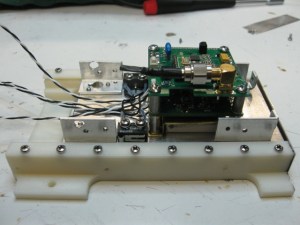
$50SAT Boards

$50SAT Boards

Since it was pretty cold this morning (about -12 to -13 degrees C), I chose not to record the pass at 15:24 UTC (10:28 AM local time). Instead, I monitored it using my FT-60. At about 15:36 UTC, I heard the codespeed on the FM Morse beacon drop, which indicates the availability of solar power. Using gpredict, I estimated the latitude of the satellite sub-point (the point on the Earth directly underneath the satellite) to be about 24 degrees N. Today, the sun is directly over 20.4 degrees south latitude (23.5 degrees * sin(270 + 30), as it has been about 30 days since the winter solstice). At the time I heard the beacon, the angle of $50SAT normal to the sun (assuming the passive magnetic stabilization is working) would be about 24 – (-20.4), or about 44.4 degrees. This means the solar radiation intensity is about 70% of its maximum value, which means the solar power generating capacity will be anywhere from 50% to 70% of its maximum, depending on whether one or two panels are facing the sun. But since I did not collect telemetry, I have no values for comparison.

I was able to collect RTTY telemetry on Sunday and Monday, and here it is:

2014-01-19,16:34,$$$$50jAT,128,,467,,,52,3,,21,142,82,,102,305,3662,*43
2014-01-19,16:36,b50SAT.128,,467,,,54,3,,21,139,82,,102,305,3683,*46
2014-01-19,16:39,$50SAT,128,,467,,,59,3,,21,132,83,1223cr}

2014-01-20,16:55,50SAT,128,,471,,,60,3,,21,132,83,,122,309,3683,*42

Michael Kirkhart KD8QBA
$50SAT team

$50SAT is one of the smallest amateur radio satellites ever launched at 5x5x7.5 cm and weighs only 210 grams. Transmitter power is just 100 mW on 437.505 MHz (+/-9 kHz Doppler shift) FM CW/RTTY. It uses the low cost Hope RFM22B single chip radio and PICaxe 40X2 processor.

$50SAT has been a collaborative education project between Professor Bob Twiggs, KE6QMD, Morehead State University and three other radio amateurs, Howie DeFelice, AB2S, Michael Kirkhart, KD8QBA, and Stuart Robinson, GW7HPW.

Further information in the $50SAT Dropbox https://www.dropbox.com/sh/l3919wtfiywk2gf/-HxyXNsIr8

There is a discussion group for $50SAT http://groups.yahoo.com/groups/50dollarsat/

50DollarSat http://www.50dollarsat.info/