OSCAR Satellite QSO Party 1 Aug – 22 Sept

Fun in space with Amateur RadioThe objective of the AMSAT-UK OSCAR Satellite QSO Party is to encourage all radio amateurs around the world to get on the air and make contacts via satellites during northern hemisphere summer. We would like to attract both seasoned die-hard operators as well as all newcomers who are just getting involved.

While points are given per QSO this isn’t a contest, but we hope it will encourage people to get on the air and enjoy the excitement of making contacts through satellites.

The AMSAT-UK OSCAR Satellite QSO Party will be supported by an online leaderboard which will be available from the start of the event which runs from 00:00 GMT on 1st August until 23:59 GMT on 22nd September.

Prizes will be awarded to those from first to thirteenth place and are open to both AMSAT-UK and non-members around the world.
● First Place £250 Amazon Voucher
● Second Place £150 Amazon Voucher
● Third Place £50 Amazon Voucher
● Fourth to Thirteenth Place One Year AMSAT-UK Membership

Download the rules for the AMSAT-UK OSCAR QSO Party

Leaderboard https://leaderboard.amsat-uk.org/

Unauthorized transmissions in 144 MHz satellite allocation

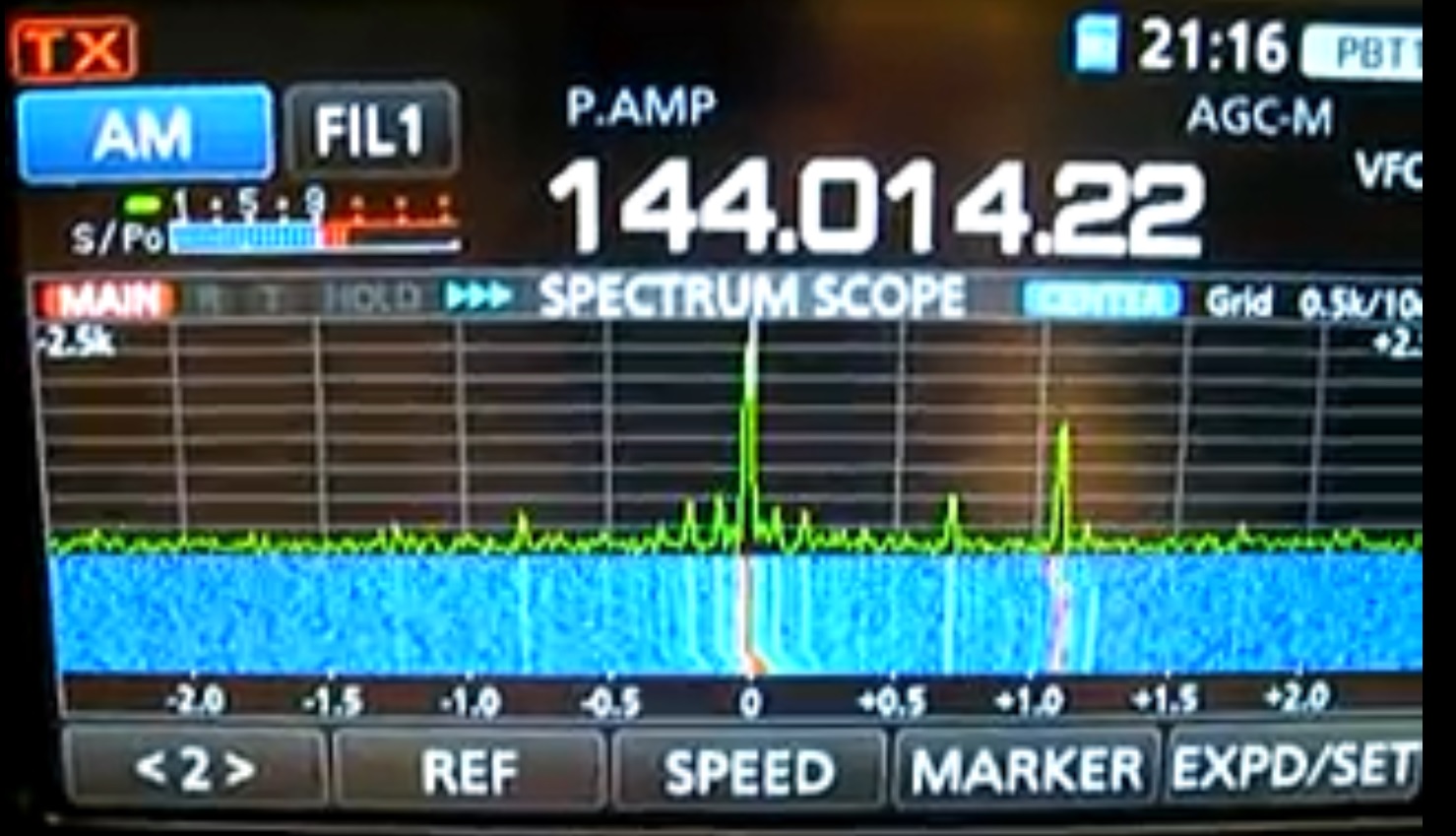
Water Vitalizer Interference - DC4CX

Water Vitalizer Interference – DC4CX

The DARC reports unauthorized transmissions are taking place in the 144 MHz satellite segment of the 2m amateur radio primary allocation.

A translation of the DARC post reads:

In the 144.010 MHz to 144.020 MHz range, illegally operated transmitters are increasingly being operated as “water vitalizers” or “water energizers”. The manufacturer specifies 144.015 MHz as the transmission frequency in its product description.

The DARC EMC department asks for further information with location information about conspicuous signals in this frequency range, in preparation for collective complaints.

The devices apparently generate fields with considerable field strength and a long range. The signals appear increasingly in the morning or in the evening. The illegal transmitters are typically in operation for 5 to 60 minutes (integer multiples of 5 minutes). The signal is generally very stable in frequency, but occasionally shows short-term fluctuations of up to a few 100 Hz. Otherwise the carrier is not further modulated.

The frequency range 144.000 MHz to 146.000 MHz is assigned to the amateur radio service in Germany as the primary exclusive user.

A video of the interference caused by these devices and a map showing some of the cases so far detected in Germany can be seen at https://www.darc.de/der-club/referate/emv/

LO-94 Amateur Radio in Lunar Orbit

Longjiang-2 / LO-94 in Lunar Orbit

Longjiang-2 / LO-94 in Lunar Orbit

Nature carries an article about the spacecraft Longjiang-2 / Lunar-OSCAR 94 (LO-94), built by students at the Harbin Institute of Technology, that carried the first Amateur Radio communication system to operate in lunar orbit.

As a part of China’s Chang’e-4 lunar far side mission, two lunar microsatellites for low frequency radio astronomy, amateur radio and education, Longjiang-1 and Longjiang-2, were launched as secondary payloads on 20 May 2018 together with the Queqiao L2 relay satellite.

On 25 May, 2018, Longjiang-2 successfully inserted itself into a lunar elliptical orbit of 357 km × 13,704 km, and became the smallest spacecraft which entered lunar orbit with its own propulsion system. The satellite carried the first amateur radio communication system operating in lunar orbit, which is a VHF/UHF software defined radio (SDR) designed for operation with small ground stations.

This article describes and evaluates the design of the VHF/UHF radio and the waveforms used. Flight results of the VHF/UHF radio are also presented, including operation of the radio, performance analysis of downlink signals and the first lunar orbit UHF very-long-baseline interferometry (VLBI) experiment.

Read the article at https://www.nature.com/articles/s41467-020-17272-8

Cartoon movie – Longjiang-2 / LO-94: Journey to the Moon
https://amsat-uk.org/2020/06/06/longjiang-2-lo-94-journey-to-the-moon/

Summer issue of OSCAR News now available

OSCAR News Issue 230 June 2020 Front CoverE-members of AMSAT-UK can now download the June 2020 edition of OSCAR News, issue 230, here.

The paper edition edition will be sent to postal members and should arrive in the next 2-3 weeks.

In this issue:
• From the Secretary’s Keyboard
• Meetings & Events
• Filtered 2400 MHz Driver Amplifier Kits Now Available
• AMSAT-UK Shop Update
• AREx – Gateway Amateur Radio Exploration
• AMSAT-UK Sunday Morning Nets
• Schedule released for E2STAYHOME satellite operation
• A Filtered S-Band Driver Amplifier for Software Defined Radios
• FUNcube-1 in continuous transponder mode
• The “Ekran” Heli-yag, a hybrid antenna for circular polarisation
• Huskysat-1 Transponder is Open
• Raspberry Pi FUNcube satellite telemetry decoder now available
• SMOG-P: A Successful Space Project
• Report from the IARU Region 1 Satellite Coordinator – July 2020

AMSAT-UK FUNcube Mission Patch

AMSAT-UK FUNcube Mission Patch

Membership of AMSAT-UK is open to anyone who has an interest in amateur radio satellites or space activities, including the International Space Station (ISS).

E-members of AMSAT-UK are able to download the quarterly publication OSCAR News as a convenient PDF that can be read on laptops, tablets or smartphones anytime, anyplace, anywhere. Join as an E-member at Electronic (PDF) E-membership

PDF sample copy of “Oscar News” here.

Join AMSAT-UK using PayPal, Debit or Credit card at
http://shop.amsat-uk.org/

E-members can download their copies of OSCAR News here.

CAS-6 antenna deployed, transponder activated

CAS-6 Satellite

CAS-6 Satellite

The CAMSAT CAS-6 satellite was launched December 20, 2019. Alan Kung BA1DU reports the V/UHF antenna was deployed on Saturday, June 20, 2020 and the linear transponder activated.

Due to some OBC failures, CW beacon and GMSK telemetry are not working properly. At present, only the carriers are transmitted on the two frequencies, the linear transponder has been put into operation. We will then try to diagnose and then determine whether the CW and telemetry data stream transmission can be recovered.

Frequencies:

• CW Telemetry Beacon: 145.910 MHz

• AX.25 4.8kbps GMSK Telemetry: 145.890 MHz

• U/V Linear Transponder Downlink: 145.925 MHz, 20 kHz bandwidth, Inverted

• U/V Linear Transponder Uplink: 435.280 MHz

TLE:

CAS-6(2019-093C)
1 44881U 19093C 20170.81187924 -.00001118 00000-0 -13581-3 0 9991
2 44881 97.9575 246.8556 0015830 36.2280 323.9959 14.81412013 26893

73!
Alan Kung, BA1DU

Further information on the 35 kg micro-satellite is at
https://amsat-uk.org/2019/12/19/camsat-cas-6-satellite/

Raspberry Pi FUNcube satellite telemetry decoder now available

RPi decoder receiving telemetry from JY1Sat in Interactive mode

RPi decoder receiving telemetry from JY1Sat in Interactive mode

The FUNcube Team has announced the availability of FUNcube CubeSat satellite telemetry decoder software for the popular Raspberry Pi computer board.

The original FUNcube telemetry decoder and Dashboard was designed to run on Windows devices and the FUNcube team did publish the telemetry format in accordance with the Amateur Satellite Service traditions and requirements. The Team had planned to opensource the Telemetry Decoder and provide an implementation on Linux, but several new missions after the original FUNcube-1 delayed their plans somewhat.

Late 2019, the Team had the opportunity to develop a low power/low impact ground station, based on Docker containers, for use at the Neumayer III Antarctic base at DP0GVN. This led us to evolve the code such that it would run on a Raspberry Pi.

The Linux implementation is suitable for use on Raspberry Pi versions from 2B+ to 4 and with a FUNcube dongle (Pro or Pro+). The software will tune a dongle to search for and track all three FUNcube compatible spacecraft currently operational. The Telemetry Decoder is configured with five active decoders operating concurrently so it can deal with situations where more than one of the spacecraft are overhead at the same time.
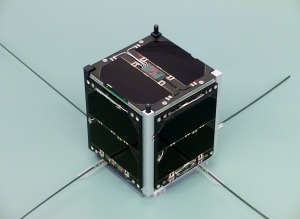
AO-73 (FUNcube-1) - Image credit Wouter Weggelaar PA3WEG

AO-73 (FUNcube-1) – Image credit Wouter Weggelaar PA3WEG

The decoder and warehouse uploader run as a Docker container for convenience shell scripts have been provided to launch the container in one of two modes:

• “Interactive Mode” is when the Telemetry Decoder operates in the foreground , when FUNcube compatible telemetry is received, the corresponding hex data is displayed on the terminal screen.

• “Background Mode” allows the telemetry decoder to run as a Docker image in the background where it operates much like any other background service on Linux. This mode allows for the automatic restarting of the telemetry decoder after a shutdown or reboot of the Raspberry Pi, therefore making it suitable for a remote deployment situation.

*Both modes, when connected to the internet, will upload the received data to the FUNcube Data Warehouse and the totals displayed on the Ranking Page in the normal manner.

*Uploading to the warehouse requires online registration with the FUNcube Data Warehouse.

All the code for the telemetry decoder, and the scripts to build the Docker images, are now published online under a GPL Open Source License at the FUNcube-Dev GitHub account
https://github.com/funcube-dev

Alternatively, it possible to buy a pre-formatted microSD card for the Pi from the AMSAT-UK shop at https://shop.amsat-uk.org/

Full instructions PDF can be downloaded from https://tinyurl.com/RPi-FUNcube-Decoder

FUNcube Data Warehouse http://warehouse.funcube.org.uk/missions