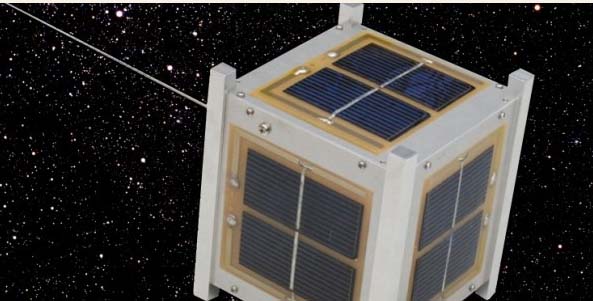
ITF-1 CubeSat – Imagine The Future

University of Tsukuba ITF-1 (YUI) CubeSat

University of Tsukuba ITF-1 (YUI) CubeSat

Students at the University of Tsukuba are working on the ITF-1 (YUI) CubeSat project that is planned to be launched on a H-IIA rocket in the fiscal year 2013. The orbit will be 400 by 350km with an inclination of 65 degrees.

The formal name ITF-1 comes from the initial letter of the university slogan “Imagine The Future”.  The satellite also has a popular name YUI which means “bond” in Japanese, it came from the project’s concept‚ “Creating the Worldwide Human Community”.

The 435MHz satellite beacon will send telemetry by a Morse Code audio tone on an FM transmitter running 300 milliwats output. It should be possible to receive it using simple equipment such as a handheld transceiver or scanner. Telemetry information will be first compressed into binary data  and then cut into 5 bits and converted into 10 – 15 Morse codes.

Ayano Okamura ITF-1 Project Manager

Reception reports will be acknowledged with a certificate and the telemetry will be made available on the web.

The UTF-1 Project Manager is Ayano Okamura and you can read her blog at http://tinyurl.com/ITF-1-ProjectManagerBlog

The Chief Tech blog by Asai Eisuke is at http://tinyurl.com/ITF-1-TechBlog

ITF-1 (YUI) on the IARU Amateur Satellite Frequency Coordination pages http://www.amsatuk.me.uk/iaru/formal_detail.php?serialnum=226

ITF-1 website in Google English http://tinyurl.com/CubeSat-ITF-1

Vega rocket ready for first flight


Vega VV01 liftoff
Flight VV01

Vega rocket ready for first flight

19 January 2012
Final checkout of Europe’s new Vega launcher was completed last Friday, marking another milestone towards its maiden flight from Europe’s Spaceport in Kourou, French Guiana.

The first Vega launch campaign began in November with the installation of the P80 first stage on the launch pad. The two solid-propellant second and third stages were added to the vehicle, followed by the AVUM – Attitude & Vernier Upper Module – liquid-propellant fourth stage.  

AVUM pressurisation
AVUM pressurisation

All four stages have undergone final acceptance, including the testing of the avionics, guidance, telemetry, propulsion, separation pyrotechnics and safety systems.These steps culminated on 13 January with Vega’s ‘synthesis control checks’, where all systems were put into launch mode for the vehicle’s final acceptance. This included pressurising the AVUM propulsion systems that actuate the thruster valves.

The rocket’s elements were switched on from the control bench to simulate the launch countdown. The onboard software then took over and simulated the different stages of a flight. The interfaces between the vehicle and the control bench were also tested.

The test review confirmed that everything ran as expected and that the launcher is ready for flight.

AVUM in mobile gantry
AVUM

What’s next?

The ‘upper composite’ – the fairing and payload – will be integrated, followed by final checkout of the fully assembled launcher and the countdown rehearsal.

The first launch, VV01, is targeted for 9 February. It will carry nine satellites into orbit: the Italian space agency’s LARES and ALMASat-1, together with seven CubeSats from European universities.

This mission aims to qualify the Vega launch system, including the vehicle, its launch infrastructure and operations, from the launch campaign to payload separation and disposal of the upper module.

Artist's impression of Vega
Vehicle VV01

A flexible system

Vega is designed to cope with a wide range of missions and payload configurations in order to respond to different market opportunities and provide great flexibility.

In particular, it offers configurations able to handle payloads ranging from a single satellite up to one main satellite plus six microsatellites.

Vega is compatible with payload masses ranging from 300 kg to 2500 kg, depending on the type and altitude of the orbit required by the customers. The benchmark is for 1500 kg into a 700 km-altitude polar orbit.

More information on Vega and updates are now available on the new launch website here.

QRP APRS Packet Radio to the ISS

International Space Station

International Space Station

Doug Cook KD5PDN’s article about contacting the International Space Station with a few watts and a shoestring budget antenna is now available.

The article “QRP to the ISS” appeared in the February, 2012 issue of QST magazine and, with permission from the ARRL, can be downloaded from Clint Bradford K6LCS’s website.

Doug walks the reader through building a simple tape measure beam, and how to successfully work the ISS with it and a handheld radio.

Read the article at http://www.work-sat.com/Work-Sat/Misc_files/QRP-ISS.pdf

A video by author Doug Cook KD5PDN shows the tape rule antenna and how to set up a Yaesu VX-8R for ISS APRS packet data sending and receiving and other aspects to make a digital contact with the International Space Station. You can also learn how to interpret the audio prompts when packet data is being received.

Watch ISS APRS Contact with a Yaesu VX-8R WB5BSA

There is lots of other information on the Work Satellites website at http://www.work-sat.com/

Student D-STAR Satellite to Launch in 2012

Students at workStudents at the University of Liege are hoping their D-Star GMSK satellite OUFTI-1 will be launched towards the end of this year.

An update on the satellite is published in the January 2012  issue of the OUFTI-1 newsletter at
http://www.leodium.ulg.ac.be/cmsms/uploads/OUFTI-1%20Newsletter%204.pdf

The satellite will have uplinks in the 145 MHz band and downlinks on 435.015 and 435.045 MHz.

OUFTI-1 http://www.leodium.ulg.ac.be/cmsms/

Professor Jacques Verly ON9CWD (Montefiore Institute) and Amandine Denis ON4EYA, Head of Project OUFTI (LTAS) with the flight model (structure) of OUFTI-1 - Image credit ESA

Professor Jacques Verly ON9CWD (Montefiore Institute) and Amandine Denis ON4EYA, Head of Project OUFTI (LTAS) with the flight model (structure) of OUFTI-1 – Image credit ESA

Sounds From Space website looking for additional sounds

 Matthias, DD1US, would like to draw your attention to a collection of audio recordings, the ‘Sounds From Space‘ collection on his website at http://www.dd1us.de. This features a collection which has also a section dedicated to recordings of amateur radio satellite signals.

Please have a look at it. The idea is to give older radio amateurs the chance, to listen to signals of satellites which are already gone and the might have worked in the past, and to younger people interested in ham radio, to get them more excited in satellite communication.

In spite of the fact that the collection now has close to 1000 recordings he is still missing recordings from some amateur radio satellites.
If anyone of you would be willing to contribute recordings to these satellite he would highly appreciate it. He has and always will give full credit to the source of the recordings. Please have a look in your older tapes and recordings!

Here is a list of the most wanted missing satellites:
Amsat Oscar 8
RS-1
RS-2
ISKRA-1
RS-3
RS-4
RS-5
RS-6
RS-8
ISKRA-3
Fuji-OSCAR-12
UOSAT OSCAR 15
WEBER OSCAR 18
UOSAT OSCAR 22
POSAT OSCAR 28
TMSAT OSCAR 31
PANSAT OSCAR 34
UOSAT OSCAR 36
ASUSAT OSCAR 37
WEBER OSCAR 39
SAUDI OSCAR 42
STARSHINE OSCAR 43
MYSAT OSCAR 46
KAGAYAKI (SORUNSAT-1)
ANUSAT
BEVO-1
WASEDA-SAT2
StudSAT

Source: Amsat, Matthias, DD1US and The Sounds From Space website

FUNcube in Electronics Weekly

FUNcube_Graphic_Large

Artists impression of FUNcube in space

The FUNcube amateur radio satellite project is featured on the website of Electronics Weekly.  The printed version of the publication (circulation 36,400) is due out on Wednesday, January 18.

Read the article ‘Radio hams seal launch deal for FUNcube satellite’ http://www.electronicsweekly.com/Articles/13/01/2012/52712/radio-hams-seal-launch-deal-for-funcube-satellite.htm

A free subscription to the digital version of the publication is available via the Electronics Weekly website http://www.electronicsweekly.com/ On the lef-hand side under “SIGN UP TO” click on “Digital Magazine”.