1240-1300 MHz – ITU-R WP5A fails to achieve consensus

ITU LogoThe Chair of IARU Region 1 Spectrum and Regulatory Liaison Committee, Barry Lewis G4SJH, writes on the IARU-R1 site that ITU‑R WP5A meeting #30 could not achieve consensus on the measures needed to protect the RNSS in the amateur 23cm band (1240-1300 MHz), (Relating to WRC-23 AI 9.1b)

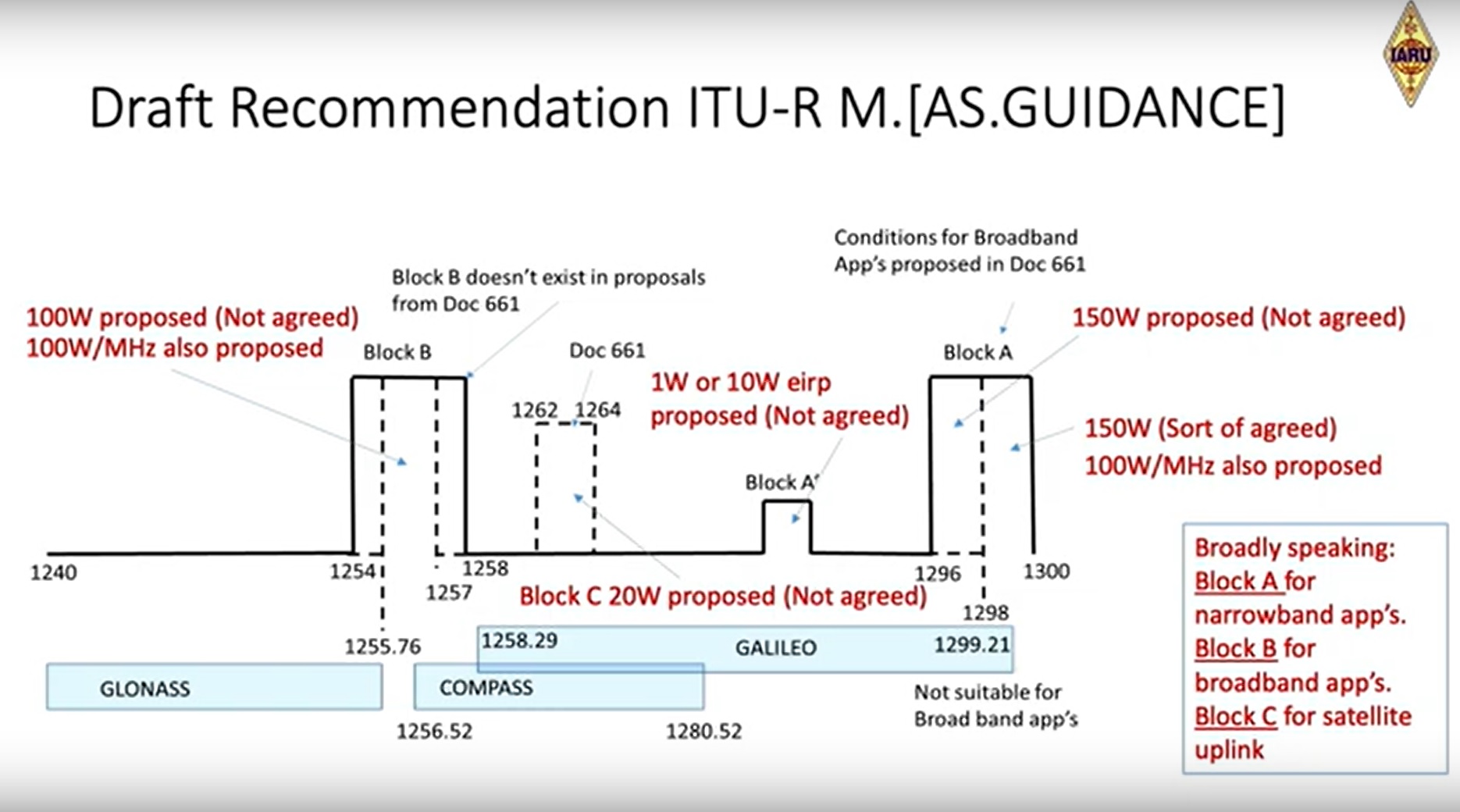
Working Party 5A meeting #30 met over the period 13th to 22nd September 2023 and despite extra meeting time allocated specifically to the development of the ITU‑R Recommendation M.[AS_GUIDANCE] the meeting did not reach a consensus on the technical and operational measures required to ensure the protection of the RNSS (radio navigation satellite service) in the amateur 23cm band. The measures aim to identify parts of the frequency band with associated amateur transmitter power limits that can help protect the RNSS operations. By the close of the meeting three alternative solutions remained unresolved in the draft document.

This outcome was reported to the WP5A plenary meeting and the subsequent parent Study Group 5 meeting but despite further efforts still no outcome could be achieved. Since the recommendation will be important for WRC-23 discussions it is expected that further efforts will continue to try to find a solution.

On a positive note the Draft New Report ITU‑R M. [AS_CHARACTERISTICS] was finalised by WP5A an approved in Study Group 5.

The IARU report from the WP5A meeting can be downloaded here
https://www.iaru.org/wp-content/uploads/2023/10/Report-from-WP5A_Sept-2023.pdf

The ITU-R WP5A Meeting Report can be downloaded from
https://itu.int/md/R19-WP5A/new/en
Word Doc https://www.itu.int/dms_pub/itu-r/md/19/wp5a/c/R19-WP5A-C-0837!!MSW-E.docx

IARU Region 1 2023 conference information paper ZL23_C5_19 from RSGB ZL23_C5_19 1300MHz INFO

BATC to Webstream AMSAT-UK Colloquium

Kents Hill Park Conference Centre Milton Keynes MK7 6BZVolunteers from the British Amateur Radio Club (BATC) will be providing a live stream of the presentations from the AMSAT-UK International Space Colloquium which takes place as part of the RSGB Convention on October 14-15.

BATC volunteers have been recording and streaming the Colloquium for over 11 years.

Watch the AMSAT-UK Colloquium presentations on Saturday from 09:30-16:45 BST and on Sunday from 09:30-15:15 BST (GMT +1) at
https://batc.org.uk/live/amsatuk2023

The AMSAT-UK talks are in Lecture Room 5 and PDF’s of the talk schedule can be downloaded from the RSGB site at https://rsgb.org/main/rsgb-2023-convention/2023-convention-lectures/

Further information on the BATC is available at http://batc.org.uk/

AMSAT-UK Colloquium 2023

Kents Hill Park Conference Centre Milton Keynes MK7 6BZ

Kents Hill Park Conference Centre Milton Keynes MK7 6BZ

AMSAT-UK is pleased to announce that the 2023 Colloquium will take place alongside the RSGB Convention at Kents Hill Park Conference Centre, Milton Keynes on the weekend of 14/15th October 2023.

Full details of the Colloquium will be made available nearer the time on the AMSAT-UK website at https://amsat-uk.org
As in previous years, the AMSAT-UK Colloquium will run as a separate stream within the RSGB Convention and will include presentations on a variety of satellite and space related topics.

The Annual General Meeting of AMSAT-UK will take place during the colloquium. The calling notice for the AGM will be issued once the programme of events has been finalised.

An AMSAT Gala Dinner will be held on the evening of Saturday 14th October at the Marriott Delta Hotel on Trimbold Drive, Kents Hill, Milton Keynes. Attendance is restricted this year at the hotel and a limited number of tickets are on sale via the AMSAT-UK Online Shop. https://shop.amsat-uk.org

The cost of the Gala Dinner is £39 per person and includes a three course meal with tea / coffee at its conclusion.
Alongside the Gala Dinner, AMSAT-UK has reserved a number of rooms at the Marriott Delta for the evening of Saturday 14th October 2023. These rooms include breakfast on Sunday 15th and are priced at £84 per room for single occupancy or £95 for double occupancy. Hotel accommodation and tickets for the Gala Dinner can be purchased on the AMSAT-UK Online Shop.

Bookings for the Hotel and Gala Dinner are now available on the AMSAT-UK Shop, but must close on 1st October 2023 unless sold out sooner, so please book early to avoid disappointment.

Entrance to the RSGB Convention is managed by the RSGB and you will be required to purchase Day Tickets for the Saturday and/or Sunday to attend the AMSAT-UK Colloquium. These can be booked via the RSGB website at https://rsgb.org/main/rsgb-2023-convention/ Early bird discounts are being offered by the RSGB via their website.

73

Barry Sankey G7RWY and Dave Johnson G4DPZ
AMSAT-UK Joint Secretary
email secretary@amsat-uk.org


Two awards available from AMSAT-UK regarding EO88’s re-entry

As you may be aware, Solar Cycle 25 has already shown that we cannot yet predict what the sun will be doing with any great accuracy.

Sunspots, X-class solar flares and CMEs (coronal mass ejections) are increasing in frequency and intensity on a daily basis.

The peak of Solar Cycle 25 was not expected until late 2024 or early 2025 but it may be coming earlier and have a higher intensity than was predicted.

One result of this increased activity is that the upper atmosphere and ionosphere of the earth becomes warmer and expands upwards. This means that spacecraft in low earth orbit experience more drag or resistance as a result of the increase in the number atoms they are having to displace as they travel around the globe. As a consequence, the spacecraft loose more kinetic energy and start to descend lower in orbital height, which, of course, makes the problem worse and a fiery end to the spacecraft is hastened.

The actual effect is also dependant on the drag coefficient of the particular spacecraft…simply how much mass (the more the better) to how much surface area (the less the better). So in CubeSat terms, a 1U CubeSat, fairly full of stuff with a mass near the maximum of 1.3kg, will probably be better off than a half empty 3U CubeSat with deployable solar panels and other drag inducing protuberances.

All TLEs (Two Line Elements) include a parameter called drag, it is usually a very small number preceeded by four or more zeros! Although this parameter is calculated by the system, it is not usually precise or even stable, so cannot be used to accurately predict deorbit dates when looking forward many weeks/months. It can give us a guide though! Alarm bells should ring when we only see two leading zeros.

How does this effect our activities? Well for the FUNcube family, there are presently three active members!

FUNcube-1, AO73 was launched almost ten years ago in November 2013 into an elliptical polar orbit of approx 682×595 km. Presently those numbers are around 640×570 km so probably not too much to worry about. The drag number from the TLEs is, at the time of writing, 0.000074, a good number.

The same applies to JY1SAT, JO-97. This was launched in December 2018 into a 573×590 km polar orbit. Presently those numbers are around 557×573 km and the current drag is listed as 0.000076.

Unfortunately, however, the same cannot by said for Nayif-1, EO88. This spacecraft was launched in February 2017 into a 496×507 km polar orbit. Currently the orbit parameters show a height of around 320 km with the drag at 0.00319. It is now well below the ISS and much lower than at launch.

As mentioned, largely due to the random nature of the our star’s flux output on a day to day basis, it is not possible at this stage to accurately predict the likely deorbit date but it seems that it will certainly be before the end of this year. As the spacecraft continues to perform 100% nominally this is a great shame. Presently it is switching autonomously from high power telemetry when in daylight and with lower power telemetry and the transponder active when in darkness. The solar panels, battery and power system also continue to be reporting nominal numbers, essentially unchanged since the day of launch.

It will therefore be a really sad moment when re-entry occurs but in the meantime everyone is encouraged to use the spacecraft whilst it remains available.

To mark the event of EO88/Nayif’s demise, AMSAT-UK is offering two awards. These will be individual framed certificates.

Firstly, to the station who submits the last telemetry to the FUNcube Data Warehouse and also to who “guesses” or calculates the re-entry time and date most accurately. Submissions for this award must be made to EO88@amsat-uk.org before midnight (UTC) on July 4th 2023. So time is short to get your entries in. Good luck!
WRC23: 23cm (1240-1300 MHz) Amateur/RNSS Coexistence

2023-04 WRC-23 AI9.1b Draft Recommendation ITU-RITU-R WRC-23 Agenda Item 9.1b: Measures to be applied in the frequency band 1240-1300 MHz to ensure the protection of the radionavigation-satellite service (RNSS) in accordance with Resolution-774.

This presentation on 23cm Amateur/RNSS Coexistence was given by the IARU Region 1 Spectrum Regulation and Liaison Committee (SRLC) Chair Barry Lewis G4SJH to the Martlesham Microwave Round Table on April 16, 2023.

Watch 23cm Amateur/RNSS Coexistence – Barry Lewis G4SJH

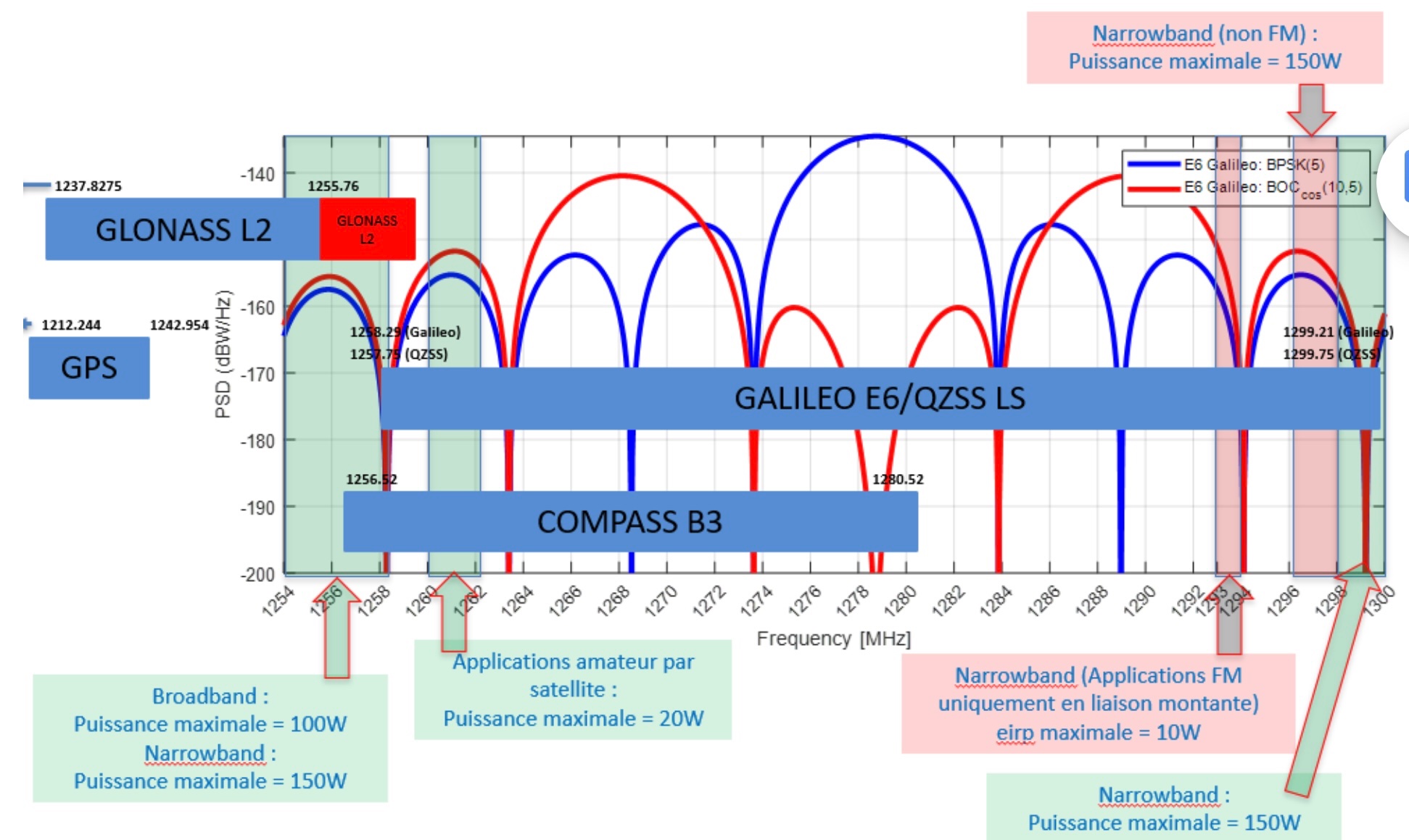
The French National Frequency Agency (ANFR) has posted the following on their website titled – Protection of Galileo against Amateur use.
“Some bands, in red in the figure, are the subject of heated debate because their use by amateur stations is likely to have a significant impact on Galileo”, see
https://www-anfr-fr.translate.goog/liste-actualites/actualite/saga-cmr-23-point-91b-la-protection-de-galileo-vis-a-vis-des-usages-amateur?_x_tr_sl=auto&_x_tr_tl=en&_x_tr_hl=en-US&_x_tr_pto=wapp

ANFR 23cm 1240-1300 MHz Band

ANFR 23cm 1240-1300 MHz Band

AMSAT-India at National Science Day event

Engineering Students were among the visitors to the stand

Engineering Students were among the visitors to the stand

To celebrate National Science Day of India on February 28 one of the biggest Science Carnival 2023 was organised by Gujarat state – India at prestigious Science City Ahmedabad during 28th February to 4th March 2023.

AMSAT-INDIA was specially invited to participate in this biggest scientific exhibition for mass awareness on Amateur Radio & Satellite Communication!

AMSAT-INDIA Regional Coordinator Rajesh Vagadia VU2EXP & team member Sakshi Vagadia VU3EXP did huge efforts to mass promote AMSAT activities amongst all sort of visitors which includes young kids, school-college students, budding engineers, IT Programmers, general public, professionals from various industries, scientists from renowned organization like ISRO, PRL, IPR, VSSE, ISR, officers from BSF, Police, Fire dept and citizens from every walk of life! More than 100,000 visitors were reported and grabbed the opportunity to visit science carnival 2023 and our Science exhibition during 5 days.

AMSAT-INDIA stall was spacious & decent sized at 3m x 3m, it was a big attraction at the center of the Science Exhibition. With well prepared different informative Banners on AMSAT-INDIA, Various Satellite Activities, Amateur Radio Satellite chronology, ARISS Student outreach program, ARISS SSTV event, Question submission for our upcoming ARISS student outreach program etc was absolutely eye catching from a distance.

Kiran on the AMSAT-India stand

Kiran on the AMSAT-India stand

For the curious visitors we tried to highlight every aspect of our hobby and exhibited all sorts of Radio stuff, Documents, QSL Cards, Books, Ham Licence, Awards, Project articles, Tracking software, SSTV software, SDR Software, Cube Satellite models etc to give bit idea of our hobby.

Experiencing various amateur radio gears, satellite antenna & test instruments were highly appreciated by visiting budding engineers from a number of colleges at AMSAT-INDIA stall. Some of the stuff we displayed include; Dual band Arrow-II antenna, dual band Yagi, tape measure antenna, GP, Telescopic antenna for SDR, Radios includes Icom IC-705 with LiFePO4 battery pack, Kenwood VHF base, half dozen of VHF/UHF HTs, RTL-SDR setup, LDG ATU, NanoVNA, Morse Key, cw oscillator, Paddle, electronic keyer, SWR/Power meter, Cable, Connectors etc. It made our task easy to explain the use of each stuff according to the visitors’ query.

We came across various types of queries like how to be a Ham, Procedure to get license, Types of Amateur Radio satellites, operating modes, setting up ground station, how to receive ISS SSTV images, how to establish satellite contact etc. We made a humble attempt to answer & satisfy all of those queries. We enjoyed a very detailed discussion with students/groups who already know about Amateur Radio and always need to learn more on Satellite Communication.

We also highlighted contributions of worldwide AMSAT organizations, IARU, ARISS, RSGB, ARRL and our ARSI & GIAR. I also mark a note on an author and my teacher Mr. Nagendra Vijay of popular Gujarati Science magazine named ‘Scope’ who did tremendous efforts to introduce Ham Radio in Gujarat (India) 40 years back and still continue to create awareness via it’s leading Science magazine ‘Safari’, his stall was just after a row.

Our AMSAT-INDIA stall were visited by many well-wisher GIAR Ham friends including VU2CPV Pravinbhai, VU2JGI Jagdishbhai, VU2MJP Manojbhai, VU2SPF Bhatnagarji, VU3APY Asheshbhai, VU3VDC Vitthhalbhai, VU3GLY Priyesh, VU3WHO Snehal etc.

It was a great experience for us to spend the whole 5 days enjoying talking & explaining our favorite hobby Amateur Radio & Satellite Communication!

We were happy to present amateur radio as a scientific hobby & experimenting platform for diversified fields and not just emergency communication tools!

Lots of positive & appreciating feedback we received in the visitor feedback book.

We are thankful to Science Carnival 2023 Organiser Dr. Vrajesh Parikh, Pulkesh Prajapati, Dr. Narotam Sahoo & team for inviting us for this prestigious Science Carnival Exhibition. I also thank our AMSAT-INDIA Secretary Mr Nitin Muttin VU3TYG, Director Educational B. A. Subramani VU2WMY, President Ramesh Ramsubbu VU2RMS & committee for complete guidance and support extended to us.

I specially thank team member Sakshi Vagadia VU3EXP & my XYL Kiran Vagadia for supporting and assisting me all the time during the 5 day exhibition.

I am optimistic to see the next generation taking keen interest in Amateur Radio & Satellites from VU Land.

Thank you
73 Rajesh Vagadia VU2EXP
Rajkot – Gujarat
Regional Coordinator West India Zone, AMSAT-INDIA

Many youngsters visited the stand

Many youngsters visited the stand