OSCAR News Issue 214

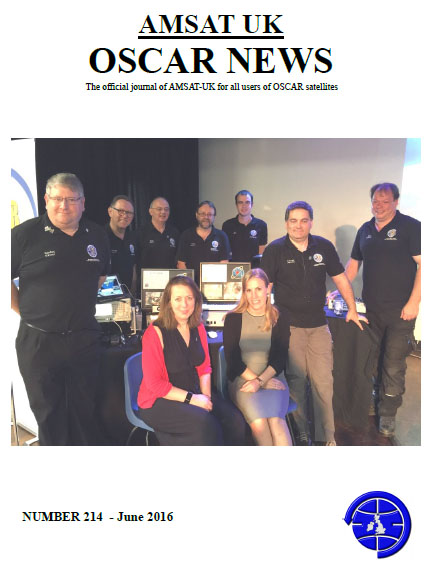
Oscar News 214 front coverIssue 214 of the AMSAT-UK amateur radio satellite publication OSCAR News was released on May 30, 2016. E-members can download it here.

The paper edition is usually posted 2-3 weeks after publication of the electronic issue.

In this issue:
• OSCAR 1
• Es’hail 2 – the first Phase 4 Amateur Satellite
• Damage to the glass in the ISS Cupola Module
• New IARU Satellite Adviser appointed
• ESA Parabolic Flight Coordinator
• HAM TV ON the ISS
• Updates on the FUNcube Project
• More news from ESA
• QB50 project update
• Status of Satellites with Transponders on Amateur Satellite Frequencies
• Notice of the 2016 Annual General Meeting of AMSAT-UK
• ARISS contacts – the inside story and (a few of) the lessons learnt
• AMSAT-UK 2016 Colloquium
• 2016 Events and Meetings Calendar

AMSAT-UK FUNcube Mission Patch

AMSAT-UK FUNcube Mission Patch

Membership of AMSAT-UK is open to anyone who has an interest in amateur radio satellites or space activities, including the International Space Station (ISS).

E-members of AMSAT-UK are able to download OSCAR News as a convenient PDF that can be read on laptops, tablets or smartphones anytime, anyplace, anywhere. Join as an E-member at Electronic (PDF) E-membership

There are two rates for the paper edition to cover the extra postage costs:
• UK
• Rest of the World (Overseas)

PDF sample copy of “Oscar News” here.

Join AMSAT-UK using PayPal, Debit or Credit card at
http://shop.amsat.org.uk/

E-members can download their copies of OSCAR News here.

VHF Handbook Available for Download

IARU_Region_1_logoThe new version of the IARU Region 1 VHF Handbook 7.50 covering VHF, UHF and Microwaves is now available for download.

The handbook has chapters on Band Planning, Contests, Propagation Research, Operating Procedures and the key Amateur Satellite section on pages 123-131. Page 116 specifies a standard for the use of circular polarization defining which way helical beam antennas should be threaded.

Recommendations proposed in the Vienna meeting 2016 and approved by the Executive Committee meeting in Brussels as well as all relevant decisions of the IARU R1 Conference 2014 in Varna Bulgaria are included in this version.

The handbook is available at
http://www.iaru-r1.org/index.php/documents/Documents/VHF/Handbook-7.50.pdf/

Amateur satellite launch from India

Swayam-1 CubeSat Flight Model - Credit COEP

Swayam-1 CubeSat Flight Model – Credit COEP

Mineo Wakita JE9PEL reports on the Indian ISRO PSLV-C34 amateur radio satellite launch planned for June 22, 2016 at 0355 UT into a 500 km 98 degree inclination orbit.

Main Payload, Cartosat-2C, Earth Observing
PSLV-XL(C-34), Satish Dharwan Space Centre, Sriharikota, India

Satellite      Uplink    Downlink  Beacon    Mode
------------  -------  --------  -------  ---------------
BEESAT-4         .      435.950  435.950  4800bps GMSK,CW
BIROS            .      437.525     .     4800bps GMSK
LAPAN-A3      435.880   145.880  145.825  FM,APRS
Max Valier       .      145.860  145.960  CW
Sathyabamasat    .      145.980     .     2400bps BPSK
Swayam COEP      .      437.025  437.025  1200bps BPSK,CW
Venta-1          .         .     437.325  CW
------------  -------  --------  -------  ---------------

http://www.ne.jp/asahi/hamradio/je9pel/be4lapan.htm

Among the satellites being launched is Swayam-1 developed by students at the College of Engineering Pune (COEP). It will provide a text messaging facility using the COEPSAT protocol.
http://amsatindia.org/coep-satellite-swayam-project/
http://www.coep.org.in/csat/track-swayam/

UPDATE: Yono YD0NXX reports the Indonesian built LAPAN-A3 does not have an amateur radio payload.

Es’Hail-2 Geostationary P4-A Transponder Frequencies

Es'Hail-2 Geostationary P4-A Transponder Frequencies

Es’Hail-2 Geostationary P4-A Transponder Frequencies

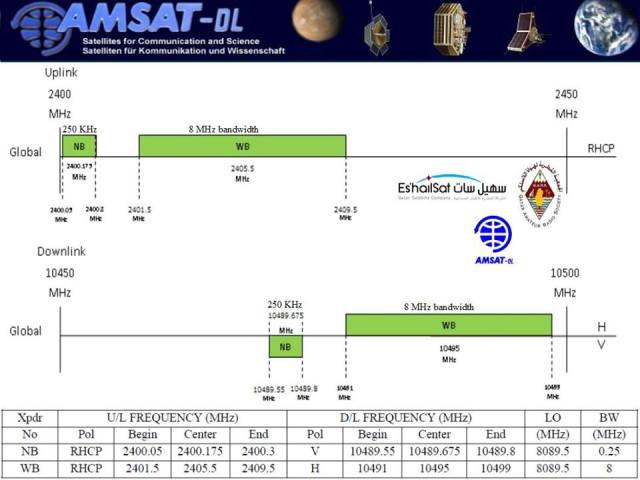
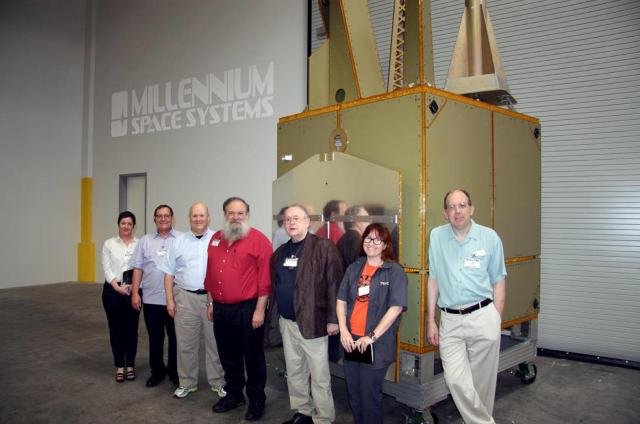
The launch of the Es’Hail-2 satellite into a geostationary orbit at 25.5 degrees East is planned for the 3rd quarter of 2017. The coverage area of the amateur radio Narrowband (NB) and Wideband (WB) transponders should extend from Brazil to Thailand.

Es'hail-2 coverage area

Es’hail-2 coverage area

Es’hail 2 will carry two “Phase 4” amateur radio non-inverting transponders operating in the 2400 MHz and 10450 MHz bands. A 250 kHz bandwidth linear transponder intended for conventional analogue operations and an 8 MHz bandwidth transponder for experimental digital modulation schemes and DVB amateur television.

Narrowband Linear transponder
 2400.050 -  2400.300 MHz Uplink
10489.550 - 10489.800 MHz Downlink

Wideband digital transponder
 2401.500 -  2409.500 MHz Uplink
10491.000 - 10499.000 MHz Downlink

Equipment requirements:

X-Band 10 GHz Downlink:
– 89 cm dishes in rainy areas at EOC like Brazil or Thailand
– 60 cm around coverage peak
– 75 cm dishes at peak -2dB
– NB: linear vertical polarisation
– WB: linear horizontal polarisation

S-Band 2.4 GHz NB-Uplink:
– narrow band modes like SSB, CW
– 5W nominal Uplink power (22.5 dBi antenna gain, 75cm dish)
– RHCP polarisation

S-Band 2.4 GHz WB-Uplink (DATV):
– wide band modes, DVB-S2
– peak EIRP of 53 dBW (2.4m dish and 100W) required
– RHCP polarisation

Presentation on Es’hail by Peter Guelzow DB2OS, President of AMSAT-DL, at the 2013 AMSAT-UK Colloquium http://www.batc.tv/streams/amsat1306

Ofcom propose using Ham Radio band for Wi-Fi

AMSAT members with the amateur radio 5 GHz and 10 GHz Phase 4B transponder MSS geosynchronous satellite

AMSAT members with the amateur radio 5 GHz and 10 GHz Phase 4B transponder MSS geosynchronous satellite

Ofcom is consulting on plans to put Wi-Fi across Amateur and Amateur Satellite spectrum in the 5 GHz band.

The Ofcom consultation document implies that amateur satellites in 5 GHz only operate in very Low Earth Orbits – This is false.
UNITEC-1 Venus spacecraft with amateur radio 5840 MHz payload

UNITEC-1 Venus spacecraft with amateur radio 5840 MHz payload

A5.28 Amateurs can access 5650-5850 MHz with amateur satellite Earth-to-space links in 5650-5670 MHz and space-to-Earth links in 5830-5850 MHz. Most current amateur satellites are typically nano or picosats (also called ‘cubesats’) that occupy slightly elliptical sun-synchronous low earth orbits at 60-800 km altitude. These smaller satellites have relatively low power and antenna gain.

Radio amateurs have sent 5 GHz payloads into far higher orbits. Examples are the Venus orbiter Unitec-1 which operated on 5.840 MHz and AO-40 which is in a 58,836 km High Earth Orbit (HEO). The 5 GHz band will also be used by the Geosynchronous Phase-4B payload and the HEO Phase-3E satellite both of which are currently under construction.

The use of 5725-5850 MHz for Wi-Fi would adversely affect reception of the network of amateur weak-signal propagation beacons.

Ofcom-logo-col-tThe Ofcom press release says:

As broadband delivered to the home gets faster, people increasingly expect their Wi-Fi to provide several services at once – such as video streaming, video calls, gaming and remote working. This demand puts pressure on the spectrum which carries Wi-Fi signals.

Most Wi-Fi routers in the UK currently use a part of the spectrum called the 2.4 GHz band, but this is becoming increasingly congested and can impair broadband delivery of high data rate applications such as streaming video or live TV.

Many people now have newer broadband routers, which use not only the 2.4 GHz band, but also the 5 GHz band – which offers much more spectrum and can accommodate wide channels suitable for high data rate uses.

To make connections faster, Ofcom is proposing to open up an additional ‘sub-band’ within the 5 GHz frequency range for Wi-Fi – while ensuring protection for other users, such as satellite services.

The extra sub-band would increase the number of 80 MHz channels available for Wi-Fi from four to six, to accommodate data-hungry applications. These extra channels – which are already being used in the United States – could be opened up in around two to three years.

The consultation closes on July 22, 2016.

Ofcom 5 GHz consultation http://stakeholders.ofcom.org.uk/consultations/5-GHz-Wi-Fi/

You can respond online at
https://stakeholders.ofcom.org.uk/consultations/5-GHz-Wi-Fi/howtorespond/form

The UK Microwave Group (UKuG) point out that Ofcom’s plans for 5725-5850 MHz would unilaterally raise the noise floor for little benefit to consumers. They say 5760 terrestrial & EME and 5840 satellite reception need maximum protection. A Word Doc response form is available on the UKuG site at http://www.microwavers.org/

The UK Microwave Group loans equipment to get amateurs started on 5.7 GHz
http://www.microwavers.org/6cm-loan-system.htm

Network of amateur weak-signal 5.7 GHz propagation beacons
http://www.microwavers.org/maps/6cms.htm

Unitec-1 amateur radio Venus spacecraft
http://www.southgatearc.org/news/may2010/unitec1_signal_received.htm
IARU-R1: Global APRS Harmonisation and Satellite Coordination

IARU_Region_1_logoThe IARU Region 1 Interim Meeting was held April 15-17, 2016 in Vienna. Minutes for the C5 VHF/UHF/Microwave committee are now available.

Some 70 delegates from over 20 Member Societies discussed a wide range of issues in the VHF/UHF/Microwave, HF and EMC Committees. Recommendations from the meeting will be considered by the Region 1 Executive Committee at its meeting in early May 2016. If approved by the EC, these recommendations will become interim Region 1 policy until the next General Conference in 2017, at which time all Societies present will have the opportunity to ratify the proposals.

Among the key items in the minutes are:

4.1. Report of satellite coordinator C5_04
Graham Shirville G3VZV presented the report of satellite coordinator. G3VZV emphasized that the frequency coordination between the three Regions has to be improved for avoiding interference incidents like PC-Sat and some of the XW2 satellites.

Due to current reports from MS about some observations of harmful interference, RSGB is asked to prepare a statement for publishing to inform MS and members how to take care.

C5 chairman is asked to bring up the issue on EC meeting, because further AC action is required.

5.2. Band Planning 5 GHz: C5_10
VIE16_C5_Rec_06: To correct the satellite segment the table in chapter 4.9 by deleting “5790”, inserting “5830” and adding the footnote: “Any wideband system shall protect narrowband applications”.

6.1. General matters: C5_26
VIE16_C5_Rec_11A: To discuss an even more extended [Grid Square] locator system that is used for ATV (including IARU ATV contest) and for other purposes by using the Wiki and prepares a document for GC 2017 if necessary. (Note this will clarify the definition of 10 digit [character] locators used for microwaves etc see example at http://no.nonsense.ee/qth/map.html )

7.2. APRS Harmonisation: C5_41
VIE16_C5_Rec_23: The C5 chairman to answer Regions 2 and 3 that:
• 144.390 MHz is not suitable for Region 1 and that Region-3 should consider 144.800
• To consider an additional 144 MHz frequency (that might be compatible) with Region 2 and 3
• To also consider 435 MHz usage and newer APRS technologies (for the 2017 GC)

Download the C5 VHF/UHF/Microwave Vienna 2016 Minutes
http://tinyurl.com/IARU-R1-Vienna-2016-C5-Minutes

The input papers are available as a matter of record:

HF Papers http://www.iaru-r1.org/index.php/documents/Documents/HF/Interim-Meeting-2016-HF-Committee-C4-v4.zip/

VHF/UHF/Microwave papers http://www.iaru-r1.org/index.php/documents/Documents/VHF/C5-papers-v3.zip/

EMC Papers http://www.iaru-r1.org/index.php/documents/Documents/EMC/C7v3.zip/