Join AMSAT-UK

AMSAT-UK_Bevelled_Logo

AMSAT-UK Logo

Founded in 1975 AMSAT-UK is a voluntary organisation that supports the design and building of equipment for amateur radio satellites.

AMSAT-UK initially produced a short bulletin called OSCAR News to give members advice on amateur satellite communications. Since those early days OSCAR News has grown in size and the print quality has improved beyond recognition. Today, OSCAR News is produced as a high-quality quarterly colour A4 magazine consisting of up to 40 pages of news, information and comment about amateur radio space communications.

The new lower-cost E-membership provides OSCAR News as a downloadable PDF file giving members the freedom to read it on their Tablets or Smartphones anytime, anyplace, anywhere.

An additional advantage is that the PDF should be available for download up to 2 weeks before the paper copy is posted.

AMSAT-UK FUNcube Mission Patch Rev4 20100609

AMSAT-UK FUNcube Mission Patch

The Membership year lasts for 12 months starting on January 1 each year.

If you join after July 31 of any particular year, then you will receive complimentary membership for the whole of the following year, i.e. join on August 10, 2014, and you have nothing more to pay until Dec 31, 2015.

Take out an Electronic membership here http://shop.amsat.org.uk/shop/category_9/Join-Amsat-UK.html

E-members can download their copies of OSCAR News from http://www.amsatuk.me.uk/on

A sample issue of OSCAR News can be downloaded here.

146-147 MHz Usage and Band Planning FAQ

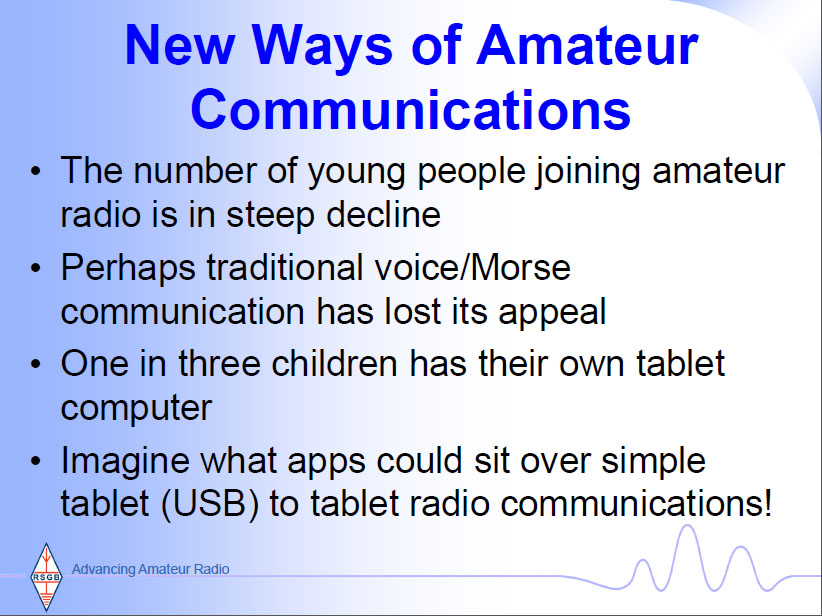
New Ways of Amateur CommunicationsThe new 146-147 MHz allocation is available to UK Full licence holders from October 31, 2014. The RSGB have issued a FAQ document which answers some of the common questions about the new allocation.

They say in terms of enabling innovation and experimentation it might have been preferable if Ofcom was prepared to grant 146 MHz NoVs to holders of all classes of UK amateur licence. However, the Ofcom view was that because Full licensees have demonstrated a greater comprehension of the interference aspects, NoVs will only be available for holders of full amateur licences.

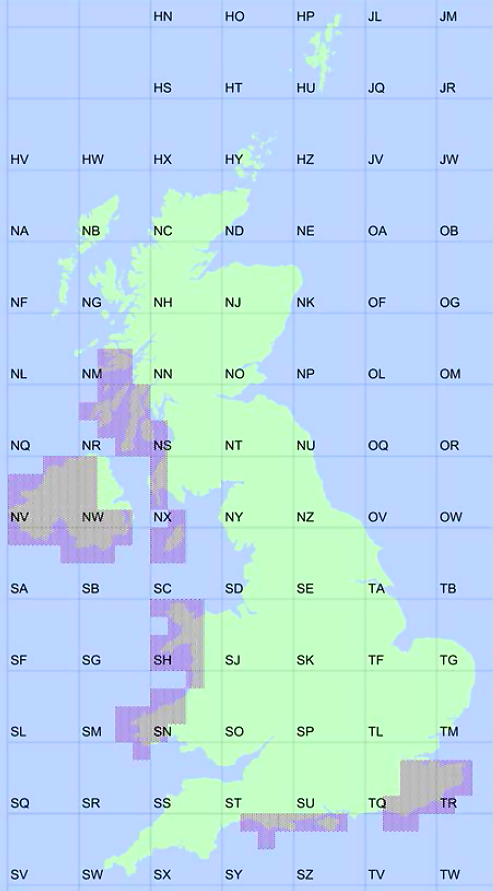
Map illustrating where 146 MHz cannot be used

Map illustrating where 146 MHz cannot be used

It is expected the allocation will be used for wideband digital transmissions. Bandwidth tailoring will be imperative to ensure no RF extends into the weak signal satellite segment at 145.8-146.0 MHz (the Lunar 4M JT65B beacon uses 145.980 MHz). Narrow band users in 147 MHz must also be protected from any increase in the noise floor.

The FAQ says:

The 146‐147 MHz band is ideal for testing new forms of medium bandwidth data transmission that can surpass traditional methods such as amateur AX25 packet data. Some higher speed data modes used by amateurs on microwave frequencies produce a very wide transmitted spectrum and are clearly not suitable for the 146‐147 MHz band. Even the 128kbps medium data rate D‐Star ‘DD Mode’ used on the 1296 MHz band fills up over 500 kHz of bandwidth at 60dB down on the peak transmitted power. However we do expect that amateurs will be able to develop solutions compatible with the spectral constraints of the 146‐147 MHz band.

146 MHz Spectral CompatibilityIn the initial 146‐147 MHz band plan there is a recommendation that wider bandwidth data modes should be centred at 146.500 MHz to make sure that all of the sidebands are contained within the 146‐147 MHz band. For initial experiments the recommendation is to use data rates of no more than 350 kbps and measure the total bandwidth at the transmitter output in order to ensure maximum protection of other users at the 147 MHz band edges and amateur satellite users below 146 MHz. As amateur radio access to the 146‐147 MHz band has been granted on a non‐interference basis, it is important that all amateurs adhere to these guidelines in order to ensure that there is no interference with users of adjacent bands. In the longer term it might be possible with bandwidth tailoring and pre‐distortion techniques to produce cleaner transmitters to permit greater data rates with sharper spectral slopes.

Apply now for your NoV at http://rsgb.org/main/operating/licensing-novs-visitors/online-nov-application/146mhz-147mhz-nov/

The application asks you for your Licence Number which appears on page 1 of your licence. If you don’t have it simply login to the Ofcom licencing page and download a new licence PDF at https://services.ofcom.org.uk/

RSGB 146 MHz http://rsgb.org/main/operating/band-plans/vhf-uhf/vhf-spectrum-release/

FAQ PDF http://rsgb.org/main/files/2014/03/146-147MHz_FAQ.pdf

146 MHz talk slides http://rsgb.org/main/files/2014/03/RSGB_146-147MHz.pdf

UK radio hams start 146 MHz development
http://www.southgatearc.org/news/2014/october/uk_radio_hams_start_146_mhz_development.htm

New UK Amateur Radio 146 MHz allocation
https://amsat-uk.org/2014/10/13/new-uk-amateur-radio-146-mhz-allocation/

First FUNcube 73 on 73 Award Issued

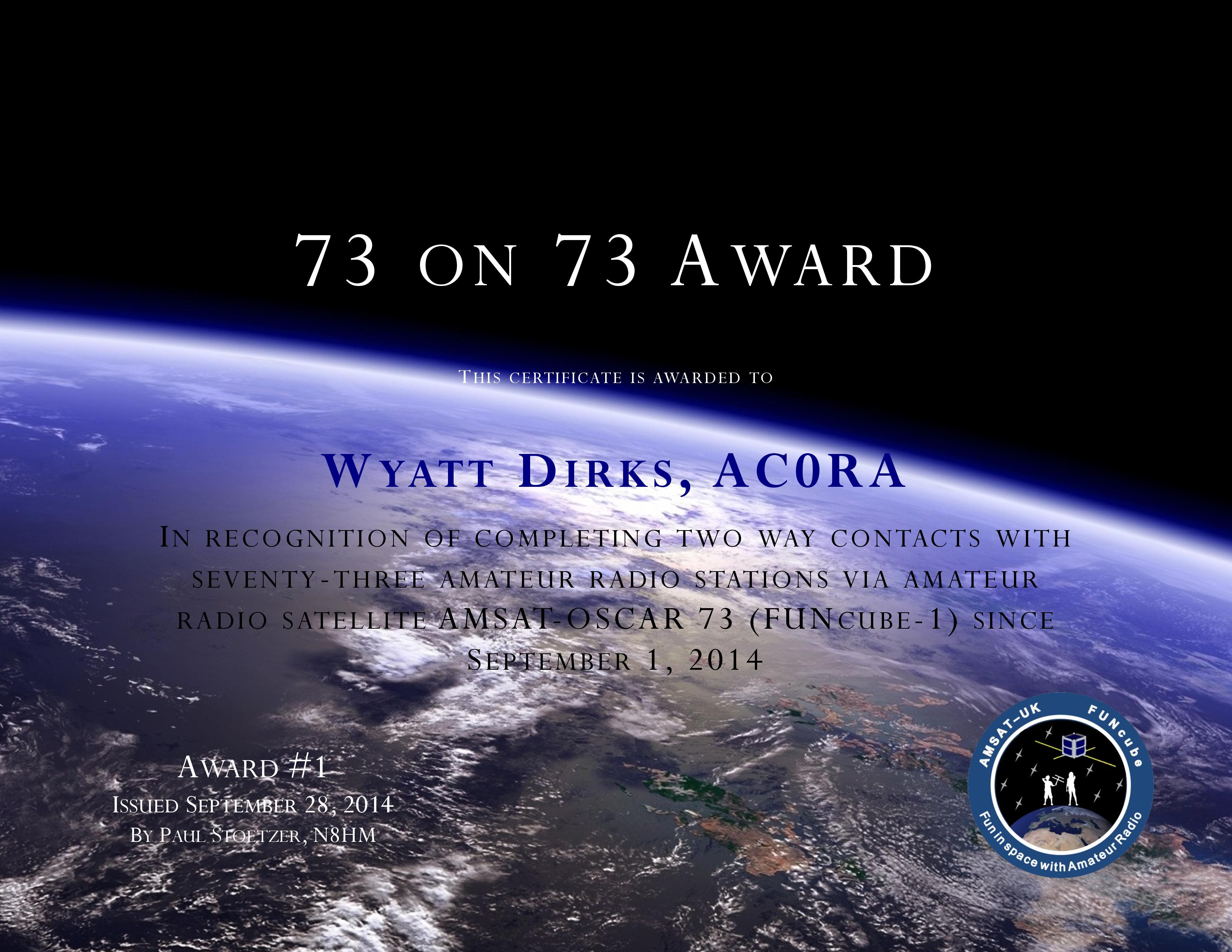
First 73 on 73 Award issued to Wyatt Dirks AC0RA

First 73 on 73 Award issued to Wyatt Dirks AC0RA

Paul Stoetzer N8HM reports the first AO-73 (FUNcube-1) 73 on 73 Award has been issued to Wyatt Dirks AC0RA.

AO-73 (FUNcube-1) - Image credit Wouter Weggelaar PA3WEG

AO-73 (FUNcube-1) – Image credit Wouter Weggelaar PA3WEG

The award aims to promote activity on AO-73 satellite. The requirements are straight-forward:

1. Work 73 unique stations on AO-73.
2. Contacts must be made on or after September 1, 2014.
3. There are no geographic restrictions on your operating location.

Congratulations to Wyatt Dirks, AC0RA, for claiming 73 on 73 Award #1. He has submitted a list with a total of 74 unique calls worked on AO-73 since September 1.

It’s been great to hear all the activity on the satellite over the last few weeks. I look forward to hearing and working many more stations, especially after the end of Daylight Saving Time makes the evening passes a bit earlier!

73, Paul Stoetzer, N8HM

Full details of the award at https://amsat-uk.org/2014/08/18/73-on-73-award-announcement/

Ham Radio Balloon to Commemorate Sputnik

A replica of Sputnik 1 satellite

A replica of the Sputnik 1 satellite

The Secunda Amateur Radio Club will launch two balloons carrying amateur radio equipment from the Vryburg airstrip FAVB on October 4, 2014 at 0600 to 0800 CAT (0400-0600 UT).

This date marks the start of World Space Week 2014. They will commemorate the launch of the Sputnik satellite on October 4, 1957 by attaching an active model replica of Sputnik to one of the balloons. The replica will transmit a Morse code message on 144.076 MHz.

Please e-mail(christo.kriek@live.co.za) a screen print of the decoded message with date, time, GPS location, radio and antenna used to receive a special certificate from the launch team, if you are one of the lucky ones that can “decode” by ear please mail above info without the screen print. The transmitter used is a flea power transmitter.

The South African National Space Agency (SANSA) and eight High Schools (80 children) form part of the program. Each school programmed their own data logger with 2 sensors. The 8 data loggers with sensors will be part of the payload of the balloon payload. Each of the school children had to write a Radio Amateur test (10 Questions) as part of their registration and the results will be used to allocated to their final presentation.

There will be a web link with cameras from the launch site atVryburg airport, one camera at Hartbeeshoek and one at Secunda High School. Please send your e-mail info to christo.kriek@live.co.za to get access to the webcams on the internet.

The first balloon will be launched anytime from 0600 CAT (0400 UT) onwards.

The ground stations will use HF on 3.650 MHz or 7.080 MHz or 20m 14.280 MHz between the ground control, chase cars, Secunda High School and Hartbeeshoek. The bands/frequencies may change due to propagation. If your hear the ground stations operate please keep the frequency clear for ground control operations. If you have any feedback in tracking the balloons specifically on descent please report it on the mentioned HF frequencies.

Due to the low APRS Digipeater and IGate density in the Vryburg area radio hams in the adjacent areas are requested to also help track the payloads as well.

It is vitally important to retrieve the payloads since there are data loggers on-board from several schools in the Secunda area. They need the data to complete their assignments.

A High Altitude Glider will also be launched the same morning as the High Altitude Balloon Experiment, HABEX on 4 October 2014.

On the same day at Secunda High School, Secunda, Unisa University will also have a ROBTICS exhibition. SANSA will also have a presentation via the webcam about GPS’s the same day.

Below are the payload frequencies:
Main balloon: APRS Tracking RX 144.800 FM
CW Telemetry RX 432.075 FM
Sputnik CW RX 144.075 FM
Crew Comms HF 40/80M
Webcam

2nd Balloon: APRS Tracking RX 144.8 FM
RTTY 433.92 USB/ 50 baud 500 shift ascii7,n,1
Crew Comms HF 40/80M
Webcam

3rd Balloon: Remote Glider
Webcam

Skype/Web Camera: Please register at http://www.anymeeting.com/ and send your email address to: christo.kriek@live.co.za to get access to live webcams.

Celebrate UN-declared World Space Week October 4-10. The biggest public space science #STEM event in the world – Use hashtag #WSW2014
Twitter https://twitter.com/WorldSpaceWeek
Web http://www.worldspaceweek.org/

Secunda Amateur Radio Club http://secradio.org.za/

Source SARL http://www.sarl.org.za/

AMSAT-UK Colloquium in TX Factor Show

In this episode of the TX Factor Show Bob McCreadie G0FGX reports from the recent AMSAT-UK Colloquium in Guildford, and finds time to test out the SuperAntenna Superstick delux package. Nick Bennett 2E0FGQ travels north and discovers a rather remarkable radio club.

Among those interviewed at the Colloquium are AMSAT-NA VP Operations Drew Glasbrenner KO4MA, Tom Harle from VR2Space, Graham Shirville G3VZV, Wouter Weggelaar PA3WEG and Carlos Eavis G0AKI.

Watch TX Factor – Episode 5 (TXF005)

View recordings of the talks given at the Colloquium
https://amsat-uk.org/colloquium/colloquium-2014/presentation-videos/

Previous editions of TX Factor are at https://www.youtube.com/user/txfactorshows/videos

TX Factor http://www.txfilms.co.uk/txfactor/

IARU R1 VHF/UHF/uW C5 meeting has started work

Delegates of the key IARU Region 1 C5 VHF, UHF and Microwaves C5 Committee

The key IARU Region 1 VHF, UHF and Microwave C5 Committee

The VHF, UHF and Microwave C5 Committee meeting has started work at the IARU Region 1 General Conference in Varna-Albena, Bulgaria.

The meeting discussed the 70 MHz IARU Region 1 initiative to obtain regulatory recognition in Europe for a secondary frequency allocation to the amateur service at 70 MHz. Also covered were the challenges to Amateur and Amateur-Satellite allocations in the UHF and Microwave bands.

24th IARU Region 1 General Conference opens
https://amsat-uk.org/2014/09/22/24th-iaru-region-1-general-conference-opens/

IARU Region 1 Conference documents and pictures http://iarur1con2014.bfra.bg/

23 cm band and WRC-2018 https://amsat-uk.org/2014/08/13/23-cm-band-and-wrc-2018/