Japanese radio amateurs ask for reports of Z-Sat

Z-Sat - image credit JAXA

Z-Sat – image credit JAXA

Yasutaka Narusawa JR2XEA of the Komaki Amateur SATCOM Club reports the satellite Z-Sat is now planned to launch on an Epsilon rocket at 00:51:21-00:55:16 GMT on Thursday, October 7. It will be sending CW on 145.875 MHz.

On the AMSAT Bulletin Board Yasutaka JR2XEA writes:

Komaki Amateur SATCOM Club has an amateur radio station in Komaki City, Japan.

The 50 kg class infrared observation microsatellite “Z-Sat” developed by Mitsubishi Heavy Industries will be launched by the Epsilon rocket.

After satellite separation, Z-Sat will start transmitting CW beacon of VHF band.

The beacon signal is in Morse code and contains information such as satellite battery voltage.

This information is very important as survival information immediately after the satellite is put into orbit.

Therefore, if you can receive the beacon signal from the satellite immediately after the satellite launch,

We would appreciate it if you could report it.
jr2xea <at> nagoya.so-net.jp

Komaki Amateur SATCOM Club’s Twitter is open at the following address. Information on Z-Sat transmission frequency, data format, orbit TLE, etc. will be released in the future.
https://twitter.com/KOMAKI_AMSATCOM

We look forward to your attention to Z-Sat.

Z-SAT on IARU Frequency Coordination page
http://www.amsatuk.me.uk/iaru/finished_detail.php?serialnum=580

AMSAT Bulletin Board https://www.amsat.org/amsat-email-lists/

New EMF Regulation and QO-100 satellite / Microwave operation

Es'hail-2 Qatar-OSCAR-100Ian GM3SEK is giving an online talk on the application of the RSGB-Ofcom Calculator to Microwaves and QO-100 satellite operation on Saturday, October 16, at 1230 GMT (1:30pm BST)

John G3XDY, Secretary UK Microwave Group, writes:

As I expect you are aware, UK stations must have Electromagnetic Field (EMF) assessments in place for operation above 110 MHz from 18th November 2021. Some RSGB guidance on EMF is here:
https://rsgb.org/main/technical/emc/emf-exposure/

The RSGB has been developing a tool that incorporates the Ofcom EMF Calculator but extends the models to include single and multiple Yagis plus various sizes of dish antennas, and takes account of the directivity of the antenna.

Ian GM3SEK, a key member of the team that developed the spreadsheet tool, will be talking about its application to Microwaves and QO-100 operation on 16th October at 13:30pm, in a joint BATC/UK Microwave Group presentation during the BATC Convention.

Registration is not required, to view the talk just go to https://batc.org.uk/live/cat21

Full details of the BATC CAT21 program are available here
https://forum.batc.org.uk/viewtopic.php?f=135&t=7609

This is an important topic for all that operate on VHF and above, and Ian will dispense invaluable practical advice on how to assess your dishes and Yagis in the microwave bands. Not to be missed!

AMSAT-EA GENESIS satellites may launch September

AMSAT-EA GENESIS Satellites

AMSAT-EA GENESIS Satellites

Spain’s national amateur radio society, the URE, report two AMSAT-EA GENESIS satellites are expected to be launched on September 2, 2021.

A translation of the URE post reads:

The GENESIS-L and GENESIS-N satellites, designed and built by AMSAT-EA in collaboration with students from the European University and ICAI, will be launched, in a first attempt, on September 2, once the American company Firefly has carried out the static test of the Alpha launcher, this being the last step before its launch. The vehicle is ready for takeoff on its platform from Vanderberg Air Force Base in California and carries, for this inaugural flight, many other satellites from various organizations and universities.

The GENESIS are digital repeating satellites of ASK and CW and also carry Applied Ion Systems’ AIS-gPPT3-1C experimental ion thrusters.

The working frequencies of the satellites are as follows:

GENESIS-L
145.875 MHz uplink, Modes: CW, ASK 50 bps
436.875 MHz downlink CW, ASK 50 bps, am2sat callsign

GENESIS-N
145.888 MHz uplink, Modes: CW and ASK 50 bps
436.888 MHz downlink CW ASK 50 bps, am3sat callsign
The description of the telemetry and the mode of operation of its repeaters can be found in the following links:

Link to telemetry transmissions description (in English)
https://www.amsat-ea.org/app/download/12293076/AMSAT+EA+-+GENESIS+transmissions+description.pdf

Source URE https://www.ure.es/satelites-genesis-de-amsat-ea-2/

Antarctica: DP0GVN QO-100 antenna destroyed, rebuild planned for 2022

AWI Neumayer Station III Antarctica - image from AMSAT-DL

AWI Neumayer Station III Antarctica – image from AMSAT-DL

AMSAT-DL reports the antenna used by DP0GVN in Antarctica for the QO-100 geostationary satellite amateur radio transponder is completely destroyed.

According to the Alfred-Wegener-Institute (AWI), a severe winter storm hit Atka Bay (Antarctica) at the end of last week. At Neumayer Station III, about 20 kilometres away, wind speeds of max. 94.9 knots (175.7 km/h) were recorded as a minute average during the night from 13 to 14 August. The strongest gust was 112 knots (207 km/h). This is by far the highest wind speed in recent years.

Unfortunately, the satellite antenna for the geostationary QO-100 amateur radio satellite was also completely destroyed during the storm, despite the weatherproof radome, so no school contacts with DP0GVN can take place until further notice. AMSAT-DL and AWI hope to erect a new antenna early next year, in particular to continue the very successful contacts with schools.

Source AMSAT-DL
https://amsat-dl.org/en/dp0gvn-antenna-destroyed-rebuilding-planned-2022/
https://twitter.com/amsatdl

URE satellite telecommand station automated

AMSAT-EA Hades PocketQube

AMSAT-EA Hades PocketQube

Spain’s national amateur radio society URE has announced their satellite ground station has been automated and is ready for the launch of GENESIS, EASAT-2 and Hades satellites.

A translation of the URE post reads:

The URE satellite monitoring and telecommand station, located at the Madrid headquarters, on Monte Igueldo street, has recently been completely automated, thanks to the efforts made in recent weeks.

These works, which began to be carried out before the confinements due to the pandemic, have consisted of the change of the lifting rotor, which due to its long time without maintenance had been unusable, the alignment of the antennas, both VHF and UHF, of circular polarization, the installation of a Linux computer, the configuration of the reception software with SDR and the emission software using Pluto hardware, acquired by URE, as well as the automation of the rotor control with the hardware provided by EA4TX (ARS).

This station will automatically record and analyze the telemetry of the twin GÉNESIS satellites, as well as EASAT-2 and Hades, all of them designed and built by AMSAT EA, as well as remote control in the event that actions are necessary on your computer from a on board, which, once in space, will be able to receive instructions from Earth to modify its operation, although the satellites themselves implement the intelligence necessary to adapt to adverse circumstances that may occur in space.

The GENESIS satellites should be launched soon, once Firefly, the American company that built the launch vehicle, completes the static tests of its Alpha rocket, which is already prepared at the Vanderberg space base in California. As for Hades and EASAT-2, both are currently at the Momentus space integrator facilities in Santa Clara, also in California, and it is expected that they can be launched aboard SpaceX’s Falcon-9 rocket in late June from Cape Canaveral, once, overcome the problems of the Momentus company, which prevented its scheduled launch in January of this year.

Source URE https://tinyurl.com/IARU-Spain

GB2RS News available on QO-100 satellite from this Sunday

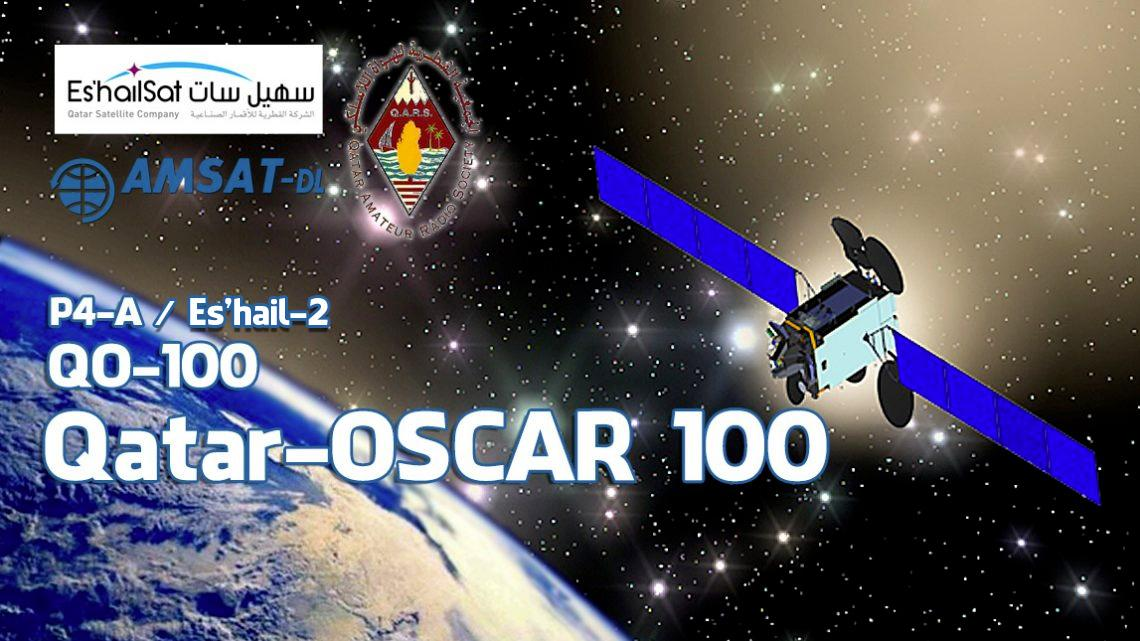
Es'hail-2 Qatar-OSCAR-100The RSGB has announced that their popular weekly GB2RS news broadcast will now be available via the QO-100 amateur radio transponder on the geostationary satellite Es’hail-2.

QO-100 provides continuous coverage from eastern Brazil to as far west as Thailand. There are two amateur transponders, one for Narrowband modes such as SSB and FT8 and the other for digital amateur television (DATV).

The RSGB website says:

“GB2RS can now also be heard via the QO-100 amateur radio satellite. The transmission is provided by Keith, GU6EFB at 0800UTC, using upper sideband on 10489.900 MHz, which is in the mixed-mode section of the narrowband transponder. QO-100 is a geostationary satellite with a footprint that covers Europe, Africa and India, so this news bulletin is a specially-adapted international version. The RSGB would like to thank AMSAT-DL for their kind cooperation in making this broadcast possible.”

If you do not have 10 GHz receive capability you can still listen to the broadcast on the AMSAT-UK and BATC WebSDR located at Goonhilly, see
https://eshail.batc.org.uk/nb/

RSGB https://rsgb.org/
https://twitter.com/theRSGB

QO-100 info https://amsat-uk.org/satellites/geo/eshail-2/