Ground Station Survey

STRaND-1 Ground Station AntennasAs we have done in the past, we are surveying the community for ground station capabilities.  The goal is to estimate how much capacity the community has and our ability to support a variety of missions.

The survey is located online at:  http://gs.engin.umich.edu/gs_survey/

Some of our initial results are published there from a few years ago.   If you have a ground station, we would love to hear from you!

Thanks for your help.

–Jamie, KF6RFX

James W. Cutler, Assistant Professor
University of Michigan
Department of Aerospace Engineering
1320 Beal Avenue
3013 FXB Building
Ann Arbor, MI 48109-2140
Ph: 734-615-7238
Fax: 734-763-0578
http://www.umich.edu/~jwcutler/

Dnepr Launch Animation Video

A Dnepr launch

A Dnepr launch

The Dnepr rocket is a converted ICBM used for launching satellites into orbit, operated by launch service provider ISC Kosmotras. The first launch, on April 21, 1999, successfully placed UoSAT-12, a 350 kg demonstration mini-satellite, into a 650 km circular Low Earth Orbit (LEO).

It is based on the R-36MUTTH ICBM designed by the Yuzhnoe Design Bureau in Dnipropetrovsk, Ukraine. Its control system was developed and produced by the JSC “Khartron”, Kharkiv. The Dnepr is a three-stage rocket using storable hypergolic liquid propellants. The launch vehicles used for satellite launches are withdrawn from service with the Russian Strategic Rocket Forces and stored for commercial use. A group of 150 ICBMs can be converted for use and are available until 2020. The Dnepr can be launched from Baikonur in Kazakhstan and a newly created Cosmodrome at the Dombarovsky launch base, near Yasny, in the Orenburg region of Russia.

Continue reading

WD9EWK working FO-29 using QRP from Scottsdale (Arizona) Hamfest

Amateur Radio Satellite FO-29

Amateur Radio Satellite FO-29

In this video Patrick Stoddard WD9EWK shows that high power isn’t needed to work the satellites.

On Saturday, March 9. 2013, at 1636 UT at the Scottsdale Amateur Radio Club Hamfest in Tempe, Arizona (grid DM43al)  he showed you can work F)-29 using just 5 watts from a FT-817ND to a handheld Elk 2m/70cm antenna. In fact he used two FT-817ND’s, one for transmit on 2m the other for receive on 70cm.

FO-29 was launched from the Tanegashima Space Center on August 17, 1996 into a 1,330 by 808 km orbit.

Continue reading

Radio Amateur G3YJO in ADS Advance Magazine

ADS Advance magazine pages 32-33 March-May 2013

ADS Advance magazine pages 32-33 March-May 2013

Professor Sir Martin Sweeting G3YJO is interviewed on pages 32-34 of the March-May 2013 issue of the free UK magazine for the Aviation, Defence, Security and Space industries ADS Advance.

You can read the March-May 2013 issue online or download it as a PDF file at http://www.adsadvance.co.uk/issue1/volume3/

ADS Advance archive http://www.adsadvance.co.uk/archives.php

FCC Guidance On Obtaining Licenses For Small Satellites

Image of a CubeSat in Space

Image of a CubeSat in Space

The Federal Communications Commission (FCC) released a Public Notice to provide guidance concerning FCC licensing of spectrum for use by small satellites, including satellites that fall within the categories of pico-satellites, nano-satellites and cubesats.

The advent of such small satellite designs has brought with it dramatically lower launch costs, enabling a larger range of organizations to directly launch satellites. Institutions such as universities and research organizations that previously found it cost prohibitive to launch their own satellite can now participate in the exploration of space. Many of these participants may be unfamiliar with the spectrum licensing, scheduling and other requirements attendant on satellites. This Public Notice seeks to alert affected parties of these requirements and thus aid small satellite operators in the planning necessary for a successful launch operation.

Continue reading

TeikyoSat-3 – Slime Mold from Space

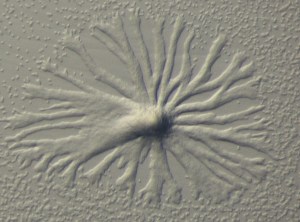
Dictyostelium discoideum - Slime Mold - Image credit Freien Universität Berlin

Dictyostelium discoideum – Slime Mold – Image credit Freien Universität Berlin

Never before have images of Slime Mold growth been transmitted from space using amateur radio but students from Teikyo University plan to do just that with their TeikyoSat-3 satellite.

The TeikyoSat-3 team say “A slime mold is a microbe without a brain, its ecology has been studied by many research institutions with the expectation of applying the behavior of slime molds to network traffic and information technology. Our micro satellite, TeikyoSat-3, takes a picture of the growth process of the slime mold, dictyostelium discoideum, in space, and then transmits the pictures to Earth using amateur radio.”

Closer to the launch date they hope to release information to enable radio amateurs to receive the pictures of the slime mold directly from the satellite.

Pictures will also be released via the web which will enable people to identify the difference in motion of the slime mold in space and on the ground.

TeikyoSat-3 plans to have a 100 mW CW telemetry beacon and a 800 mW 1200 bps AFSK image data downlink on 437.450 MHz. More information is available from http://club.uccl.teikyo-u.ac.jp/~space_system_society/

It is planned to launch TeikyoSat-3 into a 400km 65 degree orbit on a Japanese H-IIA launch vehicle. While the TeikyoSat-3 website appears to indicate a 2013 launch the Wiki page 2014_in_spaceflight lists it as being on the same H-IIA flight as GPM-Core, STARS-II, KSAT2, OPUSAT, Invader and ITF-1 in June 2014.

TeikyoSat-3 site in Google English http://tinyurl.com/TeikyoSat

For further information on Japanese satellites with amateur radio payloads that are being built see
http://www.ne.jp/asahi/hamradio/je9pel/jaxa_gpm.htm
http://www.ne.jp/asahi/hamradio/je9pel/jaxalos2.htm