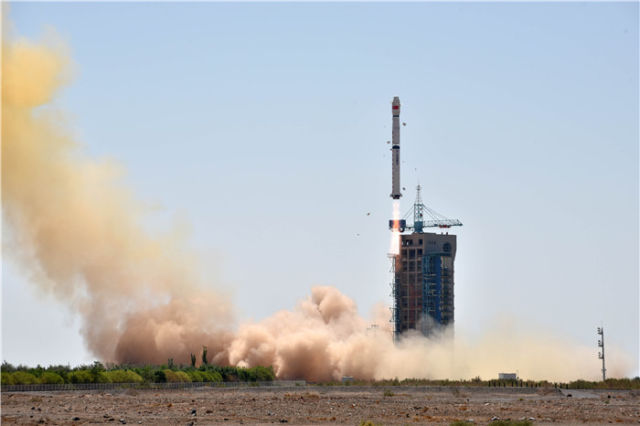
On Wednesday, October 18, 2017 the amateur radio linear (SSB/CW) transponders on the CAS-4A and CAS-4B satellites were activated.
CAMSAT’s amateur radio payloads piggybacked on the optical remote sensing micro-satellites ZHUHAI-1 01 (OVS-1A / CAS-4A) and ZHUHAI-1 02 (OVS-1B / CAS-4B) that were launched at 0300 GMT on Thursday, June 15, 2017 from the Jiuquan Satellite Launch Center, on the CZ-4B launch vehicle. The primary payload of the launch was a hard X-ray modulation telescope satellite (HXMT).
Satellite CAS-4A/OVS-1A/ZHUHAI-1 01:
● Architecture: Micro-satellite
● Dimensions: 494Lx499Wx630H mm
● Mass: 55 kg
● Stabilization: three-axis stabilization system with its +Y surface facing the earth
● Primary Payload: optical Camera with 1.98m resolution
CAS-4A Orbit:
● Orbit type : Sun synchronization orbit
● Apogee: 524 km
● Inclination: 43°
● Period: 95.1 minutes
CAS-4A Amateur Radio Payload:
● Call sign: BJ1SK
● VHF Antenna: one 1/4λ monopole antenna with max. 0 dBi gain located at +Z side
● UHF Antenna: one 1/4λ monopole antenna with max. 0 dBi gain located at -Z side
● CW Telemetry Beacon: 145.855 MHz 17 dBm
● AX.25 4.8k Baud GMSK Telemetry: 145.835 MHz 20 dBm
● U/V Linear Transponder Downlink: 145.870 MHz 20 dBm, 20 kHz bandwidth, Inverted
● U/V Linear Transponder Uplink: 435.220 MHz
CAS-4 Satellite
Satellite Name: CAS-4B/OVS-1B/ZHUHAI-1 02:
● Architecture: Micro-satellite
● Dimensions: 494Lx499Wx630H mm
● Mass: 55 kg
● Stabilization: three-axis stabilization system with its +Y surface facing the earth
● Primary Payload: optical Camera with 1.98m resolution
CAS-4B Orbit:
● Orbit type : Sun synchronization orbit
● Apogee: 524 km
● Inclination: 43°
● Period: 95.1 minutes
CAS-4B Amateur Radio Payload:
● Call sign: BJ1SL
● VHF Antenna: one 1/4λ monopole antenna with max. 0 dBi gain located at +Z side
● UHF Antenna: one 1/4λ monopole antenna with max. 0 dBi gain located at -Z side
● CW Telemetry Beacon: 145.910 MHz 17 dBm
● AX.25 4.8k Baud GMSK Telemetry: 145.890 MHz 20 dBm
● U/V Linear Transponder Downlink: 145.925 MHz 20 dBm, 20 kHz bandwidth, Inverted
● U/V Linear Transponder Uplink: 435.280 MHz
Videos of the presentations given at the AMSAT-UK International Space Colloquium, which was held as part of the RSGB Convention in Milton Keynes, October 14-15, are being made available on YouTube.
The first of the videos is ‘An introduction to Amateur satellites’ by David Johnson G4DPZ and Carlos Eavis G3VHF.
Founded in 1975 AMSAT-UK is a voluntary organisation that supports the design and building of equipment for amateur radio satellites.
AMSAT-UK initially produced a short bulletin called OSCAR News to give members advice on amateur satellite communications. Since those early days OSCAR News has grown in size and the print quality has improved beyond recognition. Today, OSCAR News is produced as a high-quality quarterly colour A4 magazine consisting of up to 40 pages of news, information and comment about amateur radio space communications.
The new lower-cost E-membership provides OSCAR News as a downloadable PDF file giving members the freedom to read it on their Tablets or Smartphones anytime, anyplace, anywhere.
AMSAT-UK FUNcube Mission Patch
An additional advantage is that the PDF should be available for download up to 2 weeks before the paper copy is posted.
Orbits – Illustration by B. Jones, P. Fuqua, J. Barrie, The Aerospace Corporation
David Bowman G0MRFdescribes the coverage area that might be provided by an amateur radio Medium Earth Orbit (MEO) satellite (MEOSAT). He suggests there is a region of space that would be optimum for such satellites.
The Van Allen radiation belts are separated into two layers. The lower layer is comprised of high energy protons between 600 and 6000km. The second belt is essentially electrons and that occupies altitudes above 12,000km. So a MEOSAT could avoid damaging radiation by orbiting in the “safe zone” between 7,000 and 11,000 km.
Watch the MEO satellites presentation given to the AMSAT-UK International Space Colloquium 2009
Video made by the British Amateur Television Club (BATC) Slides here
Elliptical Satellite Orbits
The paper Revisiting elliptical satellite orbits to enhance the O3b constellation by Lloyd Wood, Yuxuan Lou and Opeoluwa Olusola of the University of Surrey is now available for download.
Orbital altitudes of satellite systems
Early low-orbiting satellites were launched into Highly Elliptical Orbits (HEO) as a result of not having much control over trajectory. Circular orbits with minimal eccentricity offer consistent altitudes, with the benefits of consistent free space losses and link budgets throughout the orbit, and soon became the norm. Highly elliptical orbits fell from favor for communications use.
Highly elliptical orbits can be used to provide targeted satellite coverage of locations at high latitudes. We review the history of use of these orbits for communication. How elliptical orbits can be used for broadband communication is outlined. We propose an addition of known elliptical orbits to the new equatorial O3b satellite constellation, extending O3b to cover high latitudes and the Earth’s poles. We simulate the O3b constellation and compare this to recent measurement of the first real Internet traffic across the newly deployed O3b network.
The orbits of satellites at altitudes above 2500 km can decay faster than might at first be expected. The Dash-2 satellite was a 1 kg 2.5 meter diameter balloon launched on July 19, 1963 with the West Ford Needles. The 3500 km orbit, originally circular, increased in eccentricity rapidly under the action of solar radiation pressure. Dash 2 reentered the Earth’s atmosphere less than 8 years later on April 12, 1971.
The AMSAT-UK International Space Colloquium is being held at the Holiday Inn, Guildford, GU2 7XZ on July 26-27, 2014. The event is open to all, further details at https://amsat-uk.org/colloquium/colloquium-2014/
You must be logged in to post a comment.