School SSTV CubeSat to deploy from ISS

STM students designing antenna to receive data from STMSat-1 - Credit STM

STM students designing antenna to receive data from STMSat-1 – Credit STM

A Slow Scan TV (SSTV) CubeSat developed by students at Saint Thomas More Cathedral School (STM) in Arlington, VA, is set to be deployed from the International Space Station between 1400 and 1500 UT on May 16. For latest date/time check here.

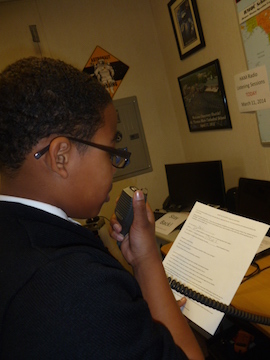
STM student using amateur radio station

STM student using amateur radio station

STM is thought to be the first Elementary school to build their own satellite, even Pre-Kindergarten, Kindergarten, and First Grade students were involved in the project.

The satellite, a 1U CubeSat called STMSat-1, will transmit a SSTV Robot36 mode signal on 437.800 MHz.

Middle School Students took the initiative to begin exploring how to receive data from the CubeSat and formed a Ham Radio Club. There, they learned the basics of operating a ham radio station and explored Slow Scan Television as an option for receiving images once the satellite is deployed.

How Did 400 Grade School Students Built A Nano-Satellite?
http://jewelbots.tumblr.com/post/134465599599/how-did-400-grade-school-students-built-a

Watch the CBS This Morning show report on the satellite
http://www.cbsnews.com/videos/satellite-built-by-elementary-students-to-be-deployed-in-space/

STMSat-1
https://twitter.com/STMSAT11
https://www.facebook.com/stmsat1/
https://www.facebook.com/groups/491135804399695/
http://www.stmsat-1.org/

ISS SSTV activity January

ISS SSTV image 1 received by Murray Hely ZL3MH January 31, 2015

ISS SSTV image 1 received by Murray Hely ZL3MH January 31, 2015

The ARISS Russia Team is planning to support a couple of Slow Scan Television (SSTV) events in the next few months on 145.800 MHz FM.

The upcoming spacewalk (EVA) will result in the amateur radio equipment on the ISS being powered down on Friday, January 15 at about 07:40 UT. Power-up is expected to take place on January 16 at 15:15 UT.

An SSTV session had been targeted for Saturday, January 16 to celebrate 15 years of ARISS school contacts with the ISS crew. The new date will be announced at http://ariss-sstv.blogspot.co.uk/

The SSTV transmissions, in mode PD120, will be made from the amateur radio station located in the Russian Service Module of the ISS using the callsign RS0ISS. The equipment used for SSTV is a Kenwood D710 transceiver running about 25 watts output which provides a very strong signal enabling reception on simple equipment.

A 2m handheld with a 1/4 wave antenna will be enough to receive the transmissions. In the UK we use narrow 2.5 kHz deviation FM but the ISS transmits on 145.800 MHz with the wider 5 kHz deviation used in much of the world. Most rigs can be switched been wide and narrow deviation FM filters so select the wider filter. Hand-held rigs all seem to have a single wide filter fitted as standard.

Check the ARISS SSTV blog for updates and additional information as it becomes available
http://ariss-sstv.blogspot.co.uk/

ISS Slow Scan TV hints, links for PC and iPhone SSTV Apps and a sample PD120 signal are at
https://amsat-uk.org/beginners/iss-sstv/

ISS SSTV video and “ISS SSTV Reception Hints” by John Brier KG4AKV
https://spacecomms.wordpress.com/iss-sstv-reception-hints/

Dmitry Pashkov R4UAB reports SSTV activity postponed to Saturday, January 16
http://tinyurl.com/R4UAB-ISS-SSTV-201501

ISS SSTV activity planned for mid January

ISS SSTV image 1 Murray Hely ZL3MH 20150131

ISS SSTV image 1 received by Murray Hely ZL3MH January 31, 2015

The ARISS Russia team is making plans to support a couple of Slow Scan TV (SSTV) events in the next few months on 145.800 MHz FM.

The first session is being targeted for mid January (subject to change) to celebrate 15 years of ARISS school contacts with the ISS crew.

The down link mode will be PD120 which should allow for the opportunity to receive more images in a single pass. Watch for updates and additional information as it becomes available.

The ISS puts out a strong signal on 145.800 MHz FM and a 2m handheld with a 1/4 wave antenna will be enough to receive it. The FM transmission uses 5 kHz deviation which is standard in much of the world. In IARU Region 1 (British Isles, Europe, Africa) FM equipment is usually set by default to the narrower 2.5 kHz deviation.

Many FM rigs can be switched been wide and narrow deviation FM filters. For best results you should select the filter for wider deviation FM. Handhelds all seem to have a single wide filter fitted as standard.

ISS Slow Scan TV hints and links https://amsat-uk.org/beginners/iss-sstv/

ISS SSTV Video and “ISS SSTV Reception Hints” by John Brier KG4AKV https://spacecomms.wordpress.com/iss-sstv-reception-hints/

John Brier KG4AKV has made available a test recording of a PD120 transmission to help you prepare for the ISS SSTV transmissions

ARISS SSTV Blog http://ariss-sstv.blogspot.co.uk/

AO-85 Slow Scan TV

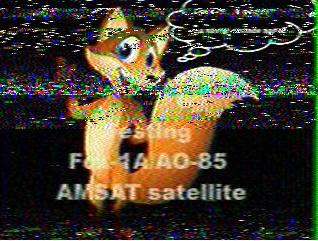
Fox-1A / AO-85 SSTV image received by Roland PY4ZBZ

Fox-1A / AO-85 SSTV image received by Roland PY4ZBZ

On Sunday, December 13, Roland Zurmely PY4ZBZ received a Slow Scan TV (SSTV) image which had been uplinked to the amateur radio CubeSat Fox-1A / AO-85.

Roland says he was not prepared and the antenna was misguided but even so he managed to receive a recognizable image.

AO-85 was launched October 8, 2015 and transmits 5 kHz deviation FM on around 145.980/.975 MHz.

In the UK amateur radio transceivers are set to default to narrow FM filters (2.5 kHz deviation). If possible you should select your radio’s wider FM filter designed for 25 kHz channel spacing.

AO-85 information https://amsat-uk.org/satellites/communications/ao-85-fox-1a/

Hints on how to receive Slow Scan TV from space are at
https://amsat-uk.org/beginners/iss-sstv/

Roland PZ4ZBZ http://www.qsl.net/py4zbz/fox.htmhttp://www.qsl.net/py4zbz/fox.htm

Successful SSTV and Digitalker transmissions from SPROUT

SPROUT SSTV received by Paulo PV8DX Nov 22, 2015

SPROUT SSTV received by Paulo PV8DX

On November 22, 2015 SSTV and Digitalker transmissions were made from the SPROUT amateur radio satellite on 437.600 MHz FM (+/- 9 kHz Doppler shift). These transmissions are planned to take place every Sunday (Japanese Standard Time).

Many FM radios can be switched been wide and narrow deviation FM filters. For best results you should select the wider filter designed for 5 kHz deviation FM.

SPROUT (Space Research On Unique Technology) was built by students from Nihon University. It is a 20 x 20 x 22 cm nano-satellite with a mass of 7.1 kg in a 654 km, 97.9 degree inclination Sun Synchronous Orbit (SSO).

Paulo PV8DX in Brazil reports receiving both the SSTV image and the Digitalker transmission a recording of which can be heard here:

.
Real-Time tracking of SPROUT at http://www.n2yo.com/?s=39770 (tick Draw Footprint)

SPROUT SSTV and Digitalker are active every Sunday
https://amsat-uk.org/2015/11/19/sprout-sstv-active-sundays/

SPROUT Digitalker full text http://www.ne.jp/asahi/hamradio/je9pel/sprdigie.htm

SPROUT SSTV and Digitalker active every Sunday

SSTV image received from SPROUT by Mario LU4EOU on May 31, 2014 at 0408 UT

SSTV image received from SPROUT by Mario LU4EOU on May 31, 2014 at 0408 UT

Slow Scan TV (SSTV) images in Scottie 1 format will be transmitted from the SPROUT satellite every Sunday (Japanese Standard Time) on 437.600 MHz FM (+/- 9 kHz Doppler shift). The Digitalker will also be active.

SPROUT, a 20 x 20 x 22 cm amateur radio nano-satellite with a mass of 7.1 kg, launched successfully with the L-band (1236.5 MHz/1257.5 MHz/1278.5 MHz) Synthetic Aperture Radar (SAR) satellite ALOS-2 on May 24, 2014 at 0305 UT. SPROUT is in a 654 km, 97.9 degree inclination Sun Synchronous Orbit (SSO).

SPROUT (Space Research On Unique Technology) was built by students from Nihon University and its objectives are:

SPROUT Satellite - Credit Nihon-Univ. Miyazaki Laboratory

SPROUT Satellite – Credit Nihon-Univ. Miyazaki Laboratory

1. Operation of satellite by radio amateurs.

A FM Digitalker will enable the satellite to speak to amateurs around the world.

The Voice Message Box will record transmissions from radio amateurs and play them back.

Pre-loaded images from the Message Gallery can be transmitted using Slow Scan TV (SSTV).

Pictures of the Earth can be transmitted by SSTV and radio amateurs can receive it using free software such as MMSSTV. As part of the Earth mapping project the team ask radio amateurs to contribute pictures they have received from the satellite for display on the SPROUT website.

The satellite also has a packet radio Digipeater and Text Message Box function.
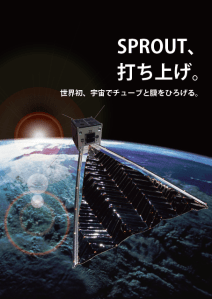
SPROUT in orbit2. Demonstration of the deployment of the combined membrane structure and verification of the design method of the structure SPROUT has a triangular membrane supported by two tubes like framework. They are folded and stored in the satellite before the launch. After the launch, the nitrogen gas is injected into the tubes in space, and they extend, so that the membrane deploys (called “combined membrane structure”).

3. Demonstration of attitude determination and control of a nanosatellite using the sun sensors, gyros, geomagnetic sensor and magnetic torquers.

Callsign: JQ1ZJQ
Size: 214x210x220 mm
Weight: 7.1 kg
Mode: 1200bps AFSK, 9600bps GMSK
CW downlink 437.525 MHz
FM packet downlink 437.525 MHz
Digipeater uplink 437.600 MHz
Digitalker downlink 437.600 MHz
SSTV downlink 437.600 MHz

Many FM radios can be switched been wide and narrow deviation FM filters. For best results you should select the wider filter designed for 5 kHz deviation FM.

SPROUT Amateur Radio SSTV Satellite

SPROUT Amateur Radio SSTV Satellite

SPROUT English website http://sat.aero.cst.nihon-u.ac.jp/sprout-e/

SPROUT Japanese website http://sat.aero.cst.nihon-u.ac.jp/sprout/

Nihon-Univ. Miyazaki Laboratory on Facebook
https://www.facebook.com/pages/Nihon-Univ-Miyazaki-Laboratory/406566642818860

Telemetry Software http://sat.aero.cst.nihon-u.ac.jp/sprout-e/2-Software-e.html

Telemetry format http://sat.aero.cst.nihon-u.ac.jp/sprout-e/2-Formats%20of%20telemetry-e.html

SPROUT launch data page
http://sat.aero.cst.nihon-u.ac.jp/sprout-e/2-Launch%20data-e.htmlTLE’s from the North American Aerospace Defence Command (NORAD) are also available at http://celestrak.com/NORAD/elements/tle-new.txt

Free Slow Scan TV (SSTV) software MMSSTV http://hamsoft.ca/pages/mmsstv.php

The JE9PEL website has information on other satellites on this launch
http://www.ne.jp/asahi/hamradio/je9pel/jaxalos2.htm

Read the Overview of the L-band SAR Onboard ALOS-2 here.

SPROUT satellite students at Nihon-Univ. Miyazaki Laboratory

SPROUT satellite students at Nihon-University Miyazaki Laboratory