Live Broadcast of School’s Balloon Launch

Damini, Matt and Isaac prepare to launch Armstrong in windy conditions

Damini, Matt and Isaac prepare to launch Armstrong in windy conditions

On Saturday, weather permitting, students at Queen Mary’s Grammar School in Walsall will be launching a High Altitude Balloon “Armstrong” carrying a 434.400 MHz beacon.

Project Horizon - Gagarin - Isle of Wight

Project Horizon – Gagarin – Isle of Wight

The launch is planned for 10am (0900 GMT) on Saturday, June 28, 2014 with reserve dates of June 29, July 5 and July 6. A live broadcast of the launch should be available via http://horizon.qmgs.walsall.sch.uk/

The students are attempting to send a balloon to a higher altitude that than achieved by Felix Baumgartner. Their first attempt named “Gagarin” was just short of target reaching an altitude of 35,118 metres before bursting and returning safely to Earth by parachute. The students were able to retrieve the stunning still images and video taken in near-space.

Horizon Team Hard at Work

Horizon Team Hard at Work

For the “Armstrong” balloon they have built a telemetry payload which will transmit sensor data on 434.400 MHz USB FSK with 580 Hz shift, 50 baud, ASCII 7, No Parity, 2 stop bits.

The telemetry transmitter should have a range of over 700 km at maximum altitude and be receivable by radio amateurs across the British Isles and into Europe. They will upload the data received to the UK High Altitude Society (UKHAS) central server enabling anyone to see the current location of the balloon on the web.

The Horizon team will use a Yaesu FT-817 transceiver at the school to receive the signal from the balloon and dl-fldigi software to decode it. Among those supporting the project are Yaesu and Essex-based Rapid Electronics.

CASSiE and the proto-type flight computer

CASSiE and the proto-type flight computer

Listen to the Balloon via the Web

Radio amateurs Noel G8GTZ, Martin G8JNJ and Phil M0DNY from the Southampton University Wireless Society, have established an Internet accessible WebSDR receiver near Basingstoke in the UK. It has special helix antennas optimised for balloon and satellite reception in the 144 and 434 MHz bands and can be listened to from anywhere in the world.

The WebSDR is at http://websdr.suws.org.uk/

Project Horizon http://horizon.qmgs.walsall.sch.uk/

Twitter https://twitter.com/horizonqmgs

You can see the  online real time track at http://spacenear.us/tracker/

Project Horizon - Letter from the RT Hon David Willetts MP

Project Horizon – Letter from the RT Hon David Willetts MP

Download the dl-fldigi software from http://ukhas.org.uk/projects:dl-fldigi

Beginners Guide to Tracking using dl-fldigi http://ukhas.org.uk/guides:tracking_guide

Check the #highaltitude IRC channel for chat about launches. A web client is available at
http://webchat.freenode.net/?channels=highaltitude

To get up-to-date information on balloon flights subscribe to the UKHAS Mailing List by sending a blank email to this address: ukhas+subscribe@googlegroups.com

MP Congratulates Students on near Space Program
https://amsat-uk.org/2014/06/25/mp-congratulates-students-on-near-space-program/

The UK Department for Education (DfE) has selected the Horizon balloon project to feature in the department’s #yourlife campaign to promote Maths and Science. https://amsat-uk.org/2014/05/11/434-mhz-balloons-have-a-role-in-stem-education/
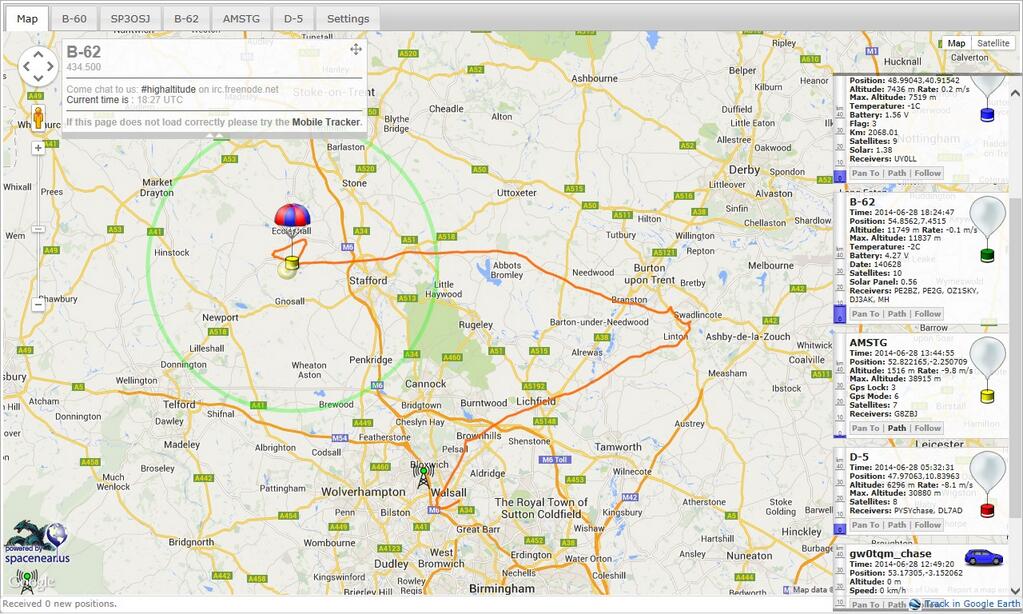
Project Horizon - Armstrong Balloon Flight Path

Project Horizon – Armstrong Balloon Flight Path

Post launch update: The flight was a success and reached an altitude of 38915 metres just 130m short of the altitude achieved by Felix Baumgartner.

The team searched the area of the last know coordinates and the predicted landing site but there was no hint of a signal from the payload.

Although Armstrong was not located it set a new record for the school which will catapult Queen Mary’s Grammar School (QMGS) from 59th to 32nd on the World Altitude Rankings.

Project Horizon Armstrong Balloon Coverage Area June 28, 2014

Project Horizon – Armstrong Balloon Coverage Area June 28, 2014
Talk – Launching and Tracking of 434 MHz Balloons

Chris Stubbs M6EDF with 434 MHz trackers

Chris Stubbs M6EDF with 434 MHz trackers

On Tuesday, July 1, Chris Stubbs M6EDF will be giving a talk on 434 MHz high altitude balloons to the Chelmsford Amateur Radio Society (CARS). Weather permitting it is hoped to be able to do a balloon launch (434.300 MHz FSK). The meeting is open to all.

Chris took the amateur radio Foundation training course run by CARS in January 2013. He is keen on both electronic construction and software development and combines the two interests in High Altitude Ballooning (HAB). Chris has built many tracker payloads for his balloon launches which usually take place from Danbury Common near Chelmsford.

In May he undertook a STEM (Science, Technology Engineering and Mathematics) event for pupils at the Sandon School in Chelmsford, launching a balloon equipped with his 434.300 MHz tracker enabling the students to track the position of the balloon in real-time. In June he did a similar event for pupils at the Stewards Academy in Harlow.

A balloon like this carrying a small electronic tracker payload traveled all the way to Japan – Image credit Leo Bodnar M0XER

A balloon like this carrying a small electronic tracker payload traveled all the way to Japan – Image credit Leo Bodnar M0XER

The trackers typically transmit 50 bps FSK RTTY in 434 MHz and can have a radio range of over 500 km. The data transmitted comprises the GPS location of the balloon and other sensor readings such as pressure, temperature and altitude. The signals are received by a network of listeners who upload the data to the UK High Altitude Society (UKHAS) central server enabling anyone to see the current location of the balloon on the web.

Some balloon flights aim to achieve very high altitudes, other aim to stay aloft for as low as possible. Leo Bodnar M0XER recently achieved a record breaking flight from Silverstone to Japan using a party balloon with a tiny solar powered payload.

The talk will explain how you can participate in this increasing popular activity.

The Chelmsford Amateur Radio Society meeting takes place at the Oaklands Museum, Oaklands Park, Moulsham Street, CM2 9AQ on Tuesday, July 1. The doors open at 7pm for a 7:30pm start. Admittance and parking are free and the usual raffle will be held.

A map showing the venue can be seen at http://www.g0mwt.org.uk/meeting-map.pdf

Flight path of M6EDF's balloon STEWARDS on June 3. 2014

Flight path of M6EDF’s balloon STEWARDS on June 3. 2014

M6EDF electronics and HAB website http://www.chris-stubbs.co.uk/

The Chelmsford Amateur Radio Society run short training courses for those wishing to get their amateur radio licence. To find out more about amateur radio and the course speak to Clive on
Tel: 01245-224577
Mob: 07860-418835
Email: training2014 at g0mwt.org.uk
Web: http://www.g0mwt.org.uk/training/

What is Amateur Radio ? http://www.essexham.co.uk/what-is-amateur-radio

M6EDF CHEAPO Micro Tracker

MP Congratulates Students on near Space Program
https://amsat-uk.org/2014/06/25/mp-congratulates-students-on-near-space-program/

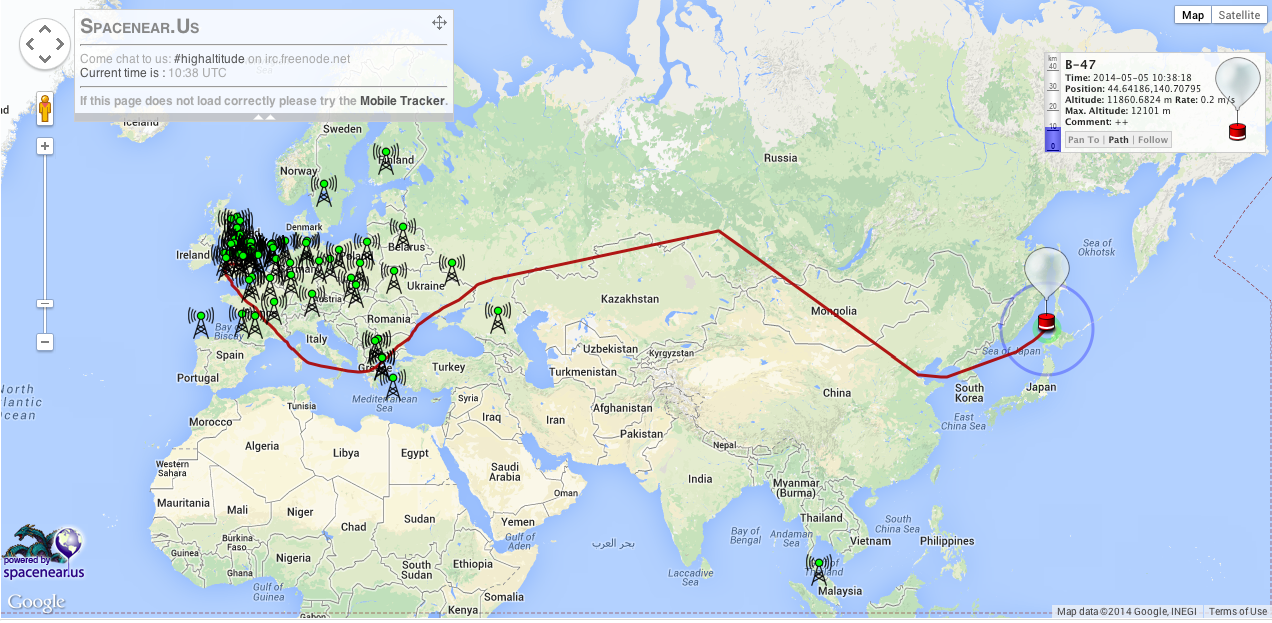
Asian Trek for B-47 Party Balloon

8-Day flight path of the B-47 party balloon

8-Day flight path of the B-47 party balloon

A solar-powered foil party balloon, B-47, transmitting telemetry on 434.500 MHz USB using the amateur radio data mode Contestia 8/250 was launched on Monday, April 28, 2014 from Silverstone in the UK by radio amateur Leo Bodnar M0XER.

The balloon’s eight-day journey took it over the United Kingdom, France, Italy, Greece, Bulgaria, Ukraine, Russia, Kazakhstan, Mongolia, China, North Korea before flying over Japan at an altitude of 11860 metres on Monday, May 5.

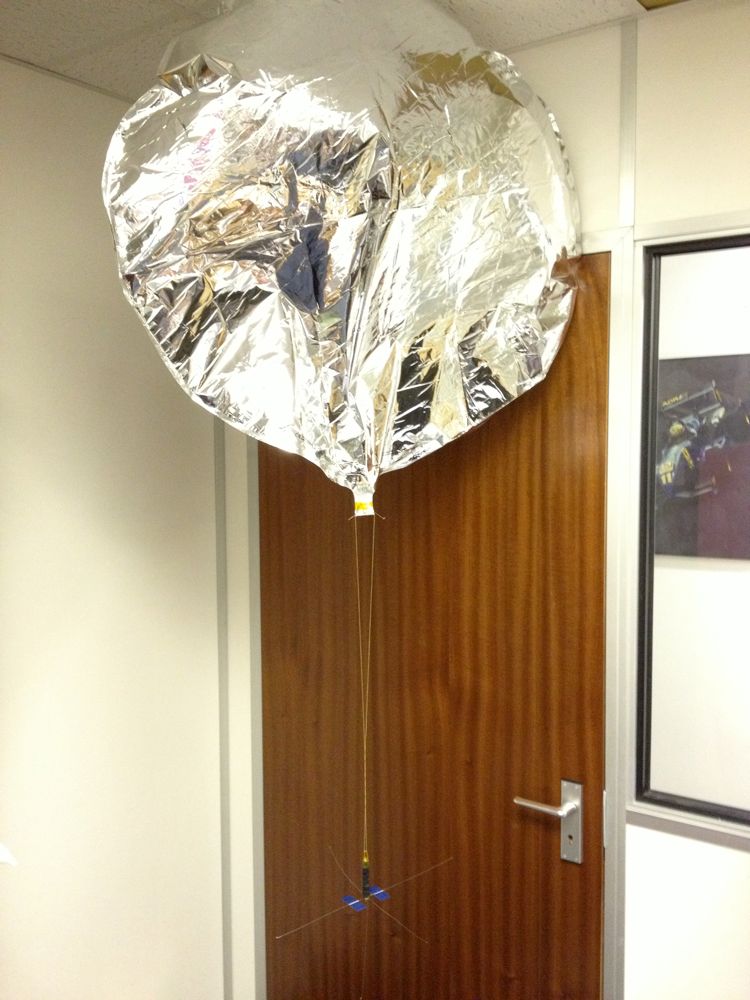
Typical 434 MHz solar powered payload - Image credit Leo Bodnar M0XER

Typical 434 MHz solar powered payload – Image credit Leo Bodnar M0XER

Depending on the altitude, the balloon can have a radio range of 300-500 km. See the current track of the balloon at http://spacenear.us/tracker/?filter=B-47
APRS backup: http://aprs.fi/#!call=a%2FM0XER-7

Balloon: 90cm Qualatex foil party balloon
Payload: 12 grams solar powered tracker

Telemetry: 434.500 MHz, USB, vertical polarisation, Contestia 8/250
Transmission contains two lines of telemetry every 4 minutes and lasts about 1 minute
Time between telemetry data is filled with beeps at 3 sec intervals.
Enable RxID (RSID) to automatically track the signal drift

Leo Bodnar M0XER balloons
http://www.leobodnar.com/balloons/

You can see online real time tracks and frequencies of balloons at http://spacenear.us/tracker/

Typical party balloon with tiny solar powered 434 MHz transmitter - Image credit Leo Bodnar M0XER

Typical party balloon with tiny solar powered 434 MHz transmitter – Image credit Leo Bodnar M0XER

Download the dl-fldigi software from
http://ukhas.org.uk/projects:dl-fldigi

Listen to balloons online (when in range of south-east UK) from anywhere in the world with the SUWS 434 MHz WebSDR (select USB) https://amsat-uk.org/2013/12/28/websdr-for-434-and-1296-mhz/

Beginners Guide to Tracking using dl-fldigi http://ukhas.org.uk/guides:tracking_guide

Check the #highaltitude IRC channel for chat about launches. A web client is available at
http://webchat.freenode.net/?channels=highaltitude

To get up-to-date information on balloon flights subscribe to the UKHAS Mailing List by sending a blank email to this address: ukhas+subscribe@googlegroups.com

Radio ham launches Spud into Space for TV show

David Akerman M0RPI and Heston Blumenthal with balloon - Image credit M0RPI

David Akerman M0RPI and Heston Blumenthal with balloon – Image credit M0RPI

In October 2013 Celebrity TV chef Heston Blumenthal visited radio amateur David Akerman M0RPI to fly a potato to near-space on a high altitude balloon as part of his TV show Heston’s Great British Food.

David Akerman M0RPI and Heston Blumenthal - Image credit M0RPI

David Akerman M0RPI and Heston Blumenthal – Image credit M0RPI

Dave says: “It started with a call from a TV production company who were working on a series for Heston Blumenthal. They’d heard that I fly the Raspberry Pi and wanted to include it in their Pie episode. The idea was to fly a potato as that was the first vegetable to be grown in space.”

Read Dave’s well illustrated account of the event at http://www.daveakerman.com/?p=1496

The show Heston’s Great British Food was broadcast on Channel 4 on Thursday, May 1. You can watch it online during the next few days at
http://www.channel4.com/programmes/hestons-great-british-food/4od

The Spud in Space segment starts at about 24:38 into the show.

SSDV picture from a PIE balloon - Image credit Dave Akerman M6RPI

SSDV picture from a PIE balloon – Image credit Dave Akerman M6RPI

Dave is well known for his balloon flights using the Raspberry Pi computer board. On July 14 2012 Dave, then M6RPI, built and launched PIE1 from Brightwalton, in Berkshire. The images taken by the camera were transmitted in the amateur radio 70cm band (434 MHz) using the Slow Scan Digital Video (SSDV) standard, see
https://amsat-uk.org/2012/07/17/pie1-raspberry-pi-sends-live-images-from-near-space/

His next flight will take place on Sunday, May 4 at around 6:30pm BST and aims to capture the sunset with some new cameras.

The two trackers are:
PIE – 434.650 MHz, 300 baud, 750Hz shift, 8, N, 2.  Telemetry and SSDV.
BUZZ – 434.600 MHz, 50 baud, 460Hz shift, 7, N, 2.  Telemetry only

There will be one or maybe two BATC video streams:
http://www.batc.tv/streams/m0rpi_chase
http://www.batc.tv/streams/m0rpi

Expected flight profile is burst alt 30km ascent 5m/s descent 5m/s. Landing spot NW of Cheltenham.

Dave M0RPI http://www.daveakerman.com/

You can see online real time tracks and frequencies of balloons at http://spacenear.us/tracker/

Download the dl-fldigi software from http://ukhas.org.uk/projects:dl-fldigi

Beginners Guide to Tracking using dl-fldigi http://ukhas.org.uk/guides:tracking_guide

Slow Scan Digital Video (SSDV) Guide http://ukhas.org.uk/guides:ssdv

Listen to balloons online (when in range of south-east UK) from anywhere in the world with the SUWS 434 MHz WebSDR (select USB) https://amsat-uk.org/2013/12/28/websdr-for-434-and-1296-mhz/

Check the #highaltitude IRC channel for chat about launches. A web client is available at
http://webchat.freenode.net/?channels=highaltitude

To get up-to-date information on balloon flights subscribe to the UKHAS Mailing List by sending a blank email to this address: ukhas+subscribe@googlegroups.com

Balloon repeater to launch from Suffolk on Sunday

James Coxon M6JCX launching a PICO balloon on 434.301 MHz USB

James Coxon M6JCX launching a balloon carrying a transmitter payload

LAUNCH POSTPONED: Sadly due to technical issues I’m going to have to postpone this flight for a little longer – no point launching something that will definitely won’t work!

On Sunday, April 27, at around 11am (1000 GMT) radio amateur James Coxon M6JCX will launch the first UKHASnet balloon repeater from Suffolk. He writes:

Just a heads up that I’m going to try and launch tomorrow the first UKHASnet balloon repeater. The aim of the flight is to test both the concept of UKHASnet and if it works the range of the current setup. UKHASnet (http://www.ukhas.net/) is a simple wireless network that uses licence exempt radio modules.

There are a number of nodes around the UK and also in the Netherlands which normally just communicate on a local scale, the balloon payload will act as a airborne node which will hopefully connect these networks together temporarily.

The payload is based on a ATmega328 (arduino bootloader) with a Ublox 6 GPS and a RFM69HW Radio module. It’ll be tx and rx on 869.500 MHz using FSK, 2000 bps and using the UKHASnet protocol. Balloon will be a 100g latex filled for a very slow ascent to maximise flight time, launched from Suffolk. Launch will be around 11:00, however, there are forecasts of showers so this may change.

There is NO onboard 434 MHz module and no RTTY or other traditional format, we’ll be aiming to pipe the location data onto spacenear.us to allow easy following. That said it’ll be possible to hear the payload with good radios and SDRs that can tune to 869.500 MHz and we would be grateful if recordings of signal can be made as this could then be played back and decoded via the hardware (there is no software decoder – yet).

More information can be found on the website http://www.ukhas.net/ and there is a IRC channel on freenode #ukhasnet where you can follow the progress. A web client is available at http://webchat.freenode.net/?channels=ukhasnet

As with many of my flights this is highly experimental so probably won’t work so don’t get disappointed if it gets delayed, postponed or fails!

UKHASnet http://www.ukhas.net/

A UKHASnet Workshop was held in March http://www.southgatearc.org/news/2014/march/ukhasnet_a_uhf_mesh_network.htm

You can see online real time tracks and frequencies of balloons at http://spacenear.us/tracker/

To get up-to-date information on balloon flights subscribe to the UKHAS Mailing List by sending a blank email to this address: ukhas+subscribe@googlegroups.com

7-Day Arctic Tour for B-46 Party Balloon

7-Day Arctic Tour for B-46 Balloon

7-Day Arctic Tour for B-46 Balloon

A long duration foil party balloon transmitting Contestia 8/250 telemetry data on 434.500 MHz USB was launched on Friday, April 18 from Silverstone in the UK by radio amateur Leo Bodnar M0XER. Its seven day journey has taken it to Iceland, Greenland across the Norwegian Sea and down into Finland.

According to the current projected course it may continue south into Russia and travel close to the Ukrainian border.

Depending on the altitude, the balloon could have a radio range of 300-500 km. See the current track of the balloon at http://spacenear.us/tracker/?filter=B-46

Typical 434 MHz solar powered payload - Image credit Leo Bodnar M0XER

Typical 434 MHz solar powered payload – Image credit Leo Bodnar M0XER

Balloon: 90cm Qualatex foil party balloon
Payload: 12 grams solar powered tracker

Telemetry: 434.500 MHz, USB, vertical polarisation, Contestia 8/250
Transmission contains two lines of telemetry every 4 minutes and lasts about 1 minute
Time between telemetry data is filled with beeps at 3 sec intervals.
Enable RxID (RSID) to automatically track the signal drift

Tracking link: http://spacenear.us/tracker/?filter=B-46
APRS backup: http://aprs.fi/#!call=a%2FM0XER-6

Leo Bodnar M0XER balloons
http://www.leobodnar.com/balloons/

You can see online real time tracks and frequencies of balloons at http://spacenear.us/tracker/

Typical pico balloon with tiny solar powered 434 MHz transmitter - Image credit Leo Bodnar M0XER

Typical pico balloon with tiny solar powered 434 MHz transmitter – Image credit Leo Bodnar M0XER

Download the dl-fldigi software from
http://ukhas.org.uk/projects:dl-fldigi

Listen to balloons online (when in range of south-east UK) from anywhere in the world with the SUWS 434 MHz WebSDR (select USB) https://amsat-uk.org/2013/12/28/websdr-for-434-and-1296-mhz/

Beginners Guide to Tracking using dl-fldigi http://ukhas.org.uk/guides:tracking_guide

Check the #highaltitude IRC channel for chat about launches. A web client is available at
http://webchat.freenode.net/?channels=highaltitude

To get up-to-date information on balloon flights subscribe to the UKHAS Mailing List by sending a blank email to this address: ukhas+subscribe@googlegroups.com