These video shows CubeSat deployment experiments carried out in a weightless environment on the “Vomit Comet” aircraft by students from the University of Texas.
The team write:
Nanosatellites are becoming increasingly common in the aerospace industry due to their reduced size, small mass, and economical cost. These small satellites will often operate in groups rather than as single satellites, and once they are clear of the carrier, separate from one another.One topic of immense interest is the characterization of the separation dynamics of such satellites.
The amateur radio 3U CubeSat Armadillo is a collaboration between students at University of Texas at Austin and Baylor University.
Armadillo stands for Attitude Related Maneuvers And Debris Instrument in Low (L) Orbit and the satellite is being designed for Flight Unit delivery in June 2013 with an assumed launch in January 2014.
Mission Objectives:
– Characterize the low altitude space dust environment and the orbit effects of this space dust as potential threats to military satellites.
– Operate a cold-gas thruster to extend mission lifetime and perform a controlled de-orbit maneuver in order to gather more scientific data at different altitudes.
– Establish optical navigation by taking and downloading a celestial image to obtain an independent verification of satellite position and attitude.
– Demonstrate on-orbit reprogrammable software so the satellite may use updated commands and algorithms.
– Develop a reusable 3U picosatellite bus for potential use on future missions in an effort to cut design and fabrication costs
Watch Bevo 2 / ARMADILLO Cold Gas Thruster Pendulum Test 3
 These video shows CubeSat deployment experiments carried out in a weightless environment on the “Vomit Comet” aircraft by students from the University of Texas.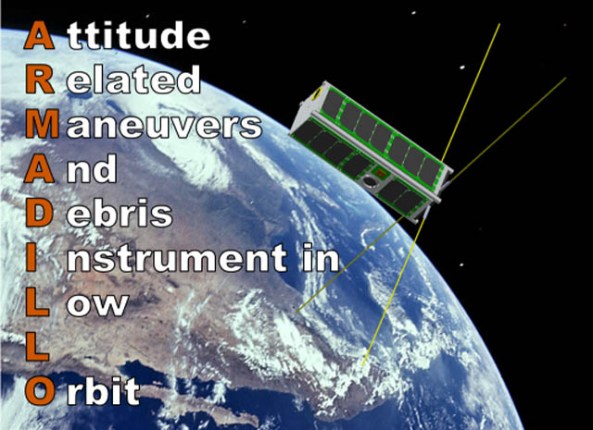
 AMSAT-UK
You must be logged in to post a comment.