Shin’en2 Satellite Linear Transponder Frequencies

Shin-En2 satellite

Shin’en2 satellite

The IARU Amateur Satellite Frequency Coordination Panel has announced frequencies for the Shin’en2 linear transponder.

Shin’en2 is a 17 kg satellite measuring 490×490×475 mm built by students at Kagoshima University in Japan which will carry a 145 to 435 MHz linear transponder into a deep space orbit.

The aims of the mission are:
• To establish communication technologies with a long range as far as moon.
• To establish a new technology of the ultra-light-weight satellite. Proposing a WSJT 29dBm UHF downlink and a 29dBm 20 kHz linear transponder and a CW beacon all on UHF with a VHF uplink for the transponder. Note it is now understood the transponder will not be operational

The orbit will be quite different from the previous satellites. Shin-En2 will have an elliptic orbit around the Sun and travel to a deep space orbit between Venus and Mars. Its inclination will be almost zero, which means Shin-En2 will stay in the Earth’s equatorial plane.

The distance from the Sun will be between 0.7 and 1.3 AU. An Astronomical Unit (AU) is 149,597,871 km.

Shin’en2 IARU coordinated frequencies:
• 437.505 MHz CW beacon
• 437.385 MHz WSJT telemetry

Originally it was planned to fly an inverting SSB/CW transponder but it is now understood the transponder will not be operational
– 145.940-145.960 MHz uplink LSB
– 435.280-435.260 MHz downlink USB

Shin’en2 is expected to launch in the 4th quarter of 2014 with another amateur radio satellite ARTSAT2:DESPATCH on a H-IIA rocket with the asteroid explorer Hayabusa 2 as the main payload.

Kagoshima University satellite development team
http://tinyurl.com/Kagoshima-Satellite

Shin’en2 English Website
http://www.eee.kagoshima-u.ac.jp/~fuku-lab/sinen,english.html

ARTSAT2:DESPATCH – Art and Ham Radio in Deep Space
https://amsat-uk.org/2013/11/03/art-and-ham-radio-in-deep-space/

Radio hams help attempts to command NASA spacecraft

ISEE-3 - ICE Spacecraft - Image credit NASA

ISEE-3 – ICE Spacecraft – Image credit NASA

An IEEE article describes how volunteers, including many radio amateurs, are attempting command a 35-year-old NASA spacecraft, the International Sun-Earth Explorer 3 (ISEE-3).

Rachel Courtland interviews Dennis Wingo KD4ETA about the project and mentions the Bochum facility where AMSAT-DL members will be using their 20 metre dish antenna to help establish communications.

Software-defined radio peripherals built by Ettus Research (founded by Matt Ettus N2MJI) have been purchased, which can be used to implement modulator and demodulator programs that would once have had to be built in hardware.

Read the IEEE article at
http://spectrum.ieee.org/tech-talk/aerospace/satellites/space-hackers-prepare-to-reboot-35-year-old-spacecraft

The Watts Up With That website has a more detailed article on the project. The section about the AMSAT-DL Bochum facility mentions two of the team, Achim Vollhardt DH2VA and Mario Lorenz DL5MLO. The problems caused by ITAR are noted.

Read the Watts Up With That article ISEE-3 Reboot Project: Aiming for First Contact at
http://wattsupwiththat.com/2014/05/15/update-isee-3-reboot-project-aiming-for-first-contact/

Watch ISEE-3 Reboot Project – Recovering a 30 year old space probe

ISEE-3 / ICE Telecommunications Summary
http://mdkenny.customer.netspace.net.au/ISEE-3.pdf

Dennis Wingo KD4ETA blog http://denniswingo.wordpress.com/

Can radio amateurs command the ISEE-3 / ICE spacecraft ?
https://amsat-uk.org/2014/03/19/can-radio-amateurs-command-the-isee-3-ice-spacecraft/

Radio amateurs receive NASA ISEE-3 / ICE Spacecraft
https://amsat-uk.org/2014/03/09/radio-amateurs-receive-nasa-isee-3ice-spacecraft/

ITAR restrictions on US radio amateurs to be eased
https://amsat-uk.org/2014/05/19/itar-restrictions-to-be-eased/

ISEE-3/ICE on Facebook https://www.facebook.com/ISEE3returns

SPROUT Amateur Radio Slow Scan TV Satellite

SPROUT Amateur Radio SSTV Satellite

SPROUT, a 20 x 20 x 22 cm amateur radio nano-satellite with a mass of 7.1 kg, launched successfully with the L-band (1236.5 MHz/1257.5 MHz/1278.5 MHz) Synthetic Aperture Radar (SAR) satellite ALOS-2 on May 24, 2014 at 0305 UT. SPROUT is now in a 654 km, 97.9 degree inclination Sun Synchronous Orbit (SSO).

SPROUT Satellite - Credit Nihon-Univ. Miyazaki Laboratory

SPROUT Satellite – Credit Nihon-Univ. Miyazaki Laboratory

SPROUT (Space Research On Unique Technology) was built by students from Nihon University and its objectives are:

1. Operation of satellite by radio amateurs.

A FM Digitalker will enable the satellite to speak to amateurs around the world.

The Voice Message Box will record transmissions from radio amateurs and play them back.

Pre-loaded images from the Message Gallery can be transmitted using Slow Scan TV (SSTV).

Pictures of the Earth can be transmitted by SSTV and radio amateurs can receive it using free software such as MMSSTV. As part of the Earth mapping project the team ask radio amateurs to contribute pictures they have received from the satellite for display on the SPROUT website.

The satellite also has a packet radio Digipeater and Text Message Box function.

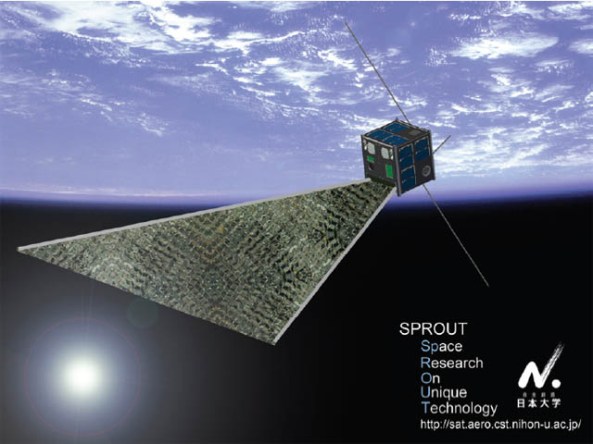
SPROUT in orbit2. Demonstration of the deployment of the combined membrane structure and verification of the design method of the structure SPROUT has a triangular membrane supported by two tubes like framework. They are folded and stored in the satellite before the launch. After the launch, the nitrogen gas is injected into the tubes in space, and they extend, so that the membrane deploys (called “combined membrane structure”).

3. Demonstration of attitude determination and control of a nanosatellite using the sun sensors, gyros, geomagnetic sensor and magnetic torquers.

It carries two UHF/VHF radio systems – one for Telemetry, Tracking & Control (TTC) using CW, 1200 bps AFSK and 9600 bps GMSK AX.25 packet and one for amateur operations using 1200 bps AFSK AX.25 packet.

SPROUT plans to launch from the Tanegashima Space Center into a 654 km Sun Synchronous Orbit (SSO) on May 24, 2014.

SPROUT 5 Days to Launch PictureCallsign: JQ1ZJQ
Size: 214x210x220 mm
Weight: 7.1 kg
Mode: 1200bps AFSK, 9600bps GMSK
CW downlink 437.525 MHz
FM packet downlink 437.525 MHz
Digi-peater uplink 437.600 MHz
Digi-talker downlink 437.600 MHz
SSTV downlink 437.600 MHz

SPROUT English website http://sat.aero.cst.nihon-u.ac.jp/sprout-e/

SPROUT Japanese website http://sat.aero.cst.nihon-u.ac.jp/sprout/

Nihon-Univ. Miyazaki Laboratory on Facebook
https://www.facebook.com/pages/Nihon-Univ-Miyazaki-Laboratory/406566642818860

Telemetry Software http://sat.aero.cst.nihon-u.ac.jp/sprout-e/2-Software-e.html

Telemetry format http://sat.aero.cst.nihon-u.ac.jp/sprout-e/2-Formats%20of%20telemetry-e.html

Keplerian elements (TLEs) from SPROUT launch data page
http://sat.aero.cst.nihon-u.ac.jp/sprout-e/2-Launch%20data-e.html

SPROUT
1 00000U 14001A 14144.15446759 .00000000 00000-0 00000-0 0 0013
2 00000 97.8740 241.6718 0035980 58.6810 194.6458 14.85960816 14

After launch TLE’s from the North American Aerospace Defence Command (NORAD) should also be available at http://celestrak.com/NORAD/elements/tle-new.txt

Adding new satellites to SatPC32, Gpredict and Nova
https://amsat-uk.org/2013/11/23/adding-new-satellites-to-satpc32/

Free Slow Scan TV (SSTV) software MMSSTV http://hamsoft.ca/pages/mmsstv.php

The JE9PEL website has information on other satellites on this launch
http://www.ne.jp/asahi/hamradio/je9pel/jaxalos2.htm

Read the Overview of the L-band SAR Onboard ALOS-2 here.

SPROUT satellite students at Nihon-Univ. Miyazaki Laboratory

SPROUT satellite students at Nihon-University Miyazaki Laboratory

Satellites at Amateur Radio Skills Workshop

Working the OSCAR Satellites - Graham Leggett G7JYD and Steve Hedgecock M0SHQ

Working the OSCAR Satellites – Graham Leggett G7JYD and Steve Hedgecock M0SHQ

Steve Hedgecock M0SHQ took along some rigs, antennas and software to the Chelmsford Amateur Radio Society (CARS) Skills Workshop held in Danbury, Essex on May 19.

He explained how to get started in listening to satellites, track them, and have contacts through them. Hopefully we’ll be seeing some new stations from Essex on the satellites in the near future.

Peter M0PXD and Christopher G0IPU running the construction and soldering workshop

Peter M0PXD and Christopher G0IPU running the construction and soldering workshop

The free Skills Workshops are held on the third Monday of each month and provide a great opportunity to chat, swap ideas, and get hands-on with something new. Find out more at http://www.hamskills.co.uk/

As well as the Skills Workshops the Chelmsford Amateur Radio Society run training courses for those wishing to get their amateur licence. To find out more speak to Clive G1EUC on
Tel: 01245-224577
Mob: 07860-418835
Email: training2014 at g0mwt.org.uk
Web: http://www.g0mwt.org.uk/training/

Follow CARS Training on Twitter @TrainWithCARS

What is Amateur Radio ? http://www.essexham.co.uk/what-is-amateur-radio

Watch a short overview of the Amateur Radio Skills Workshop, a new training initiative from the Chelmsford Amateur Radio Society (CARS)

How to work a FM satellite video https://amsat-uk.org/beginners/how-to-work-a-fm-satellite/

How to work a SSB satellite video https://amsat-uk.org/beginners/how-to-work-the-ssb-satellites/

RadCom article Getting started on satellites https://amsat-uk.org/beginners/radcom-getting-started-on-satellites/