ARISSat-1 . . A Fun HAM Satellite!


ARISSat-1 . . A Fun HAM Satellite!

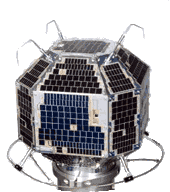
David Pruett KF7ETX has released this video of the amateur radio satellite ARISSat-1. There are only a few days left to hear it before it re-enters the Earth’s atmosphere.

The YouTube description reads:

Tune your radios / scanners to 145.950 and listen into the signal from ARISSat-1. ARISSat-1/KEDR Deployed on August 3, 2011 from the International Space Station (ISS). The mission of ARISSat-1/KEDR was specifically designed as an education-based satellite built by amateur radio operators to specifically interest students in scientific and technological careers.

Watch ARISSat-1 . . . A Fun HAM Satellite!


ISS & ARISSat-1 Predictions:
http://www.n2yo.com/

ARISSat Website
http://www.arissat1.org/v3/

You can find the details of the ARISSat-1/KEDR radio frequencies, links to telemetry decoding software and mission details on-line at:
http://www.amsat.org
http://arissat1.org

ARISSat-1/KEDR can be accessed on these frequencies:
+ 145.950 MHz FM Downlink
+ 435 MHz – 145 MHz Linear Transponder
+ 145.919 MHz CW Beacon
+ 145.920 MHz SSB BPSK-1000 Telemetry

The latest telemetry can be seen LIVE on your computer or cell phone
at: http://www.arissattlm.org/mobile

David Carr, KD5QGR has added ARISSat-1/KEDR to the list of satellites at the popular “Live OSCAR Satellite Status Page” at:
http://oscar.dcarr.org/ You are invited to submit your reports on this page.

Last chance to hear ARISSat-1
http://www.uk.amsat.org/2011/12/23/last-chance-to-hear-arissat-1/

Merry Christmas & Happy New Year from AMSAT-UK

AMSAT-UK would like to wish all it’s members and followers a very Merry Christmas,and a prosperous new year. Good Luck in 2012.

Seasons Greetings from ARISS Europe

A seasonal message from ARISS Europe Chairman Gaston Bertels ON4WF.

The year is coming to its end. The arrow of time points to the next cycle, which promises to be as exciting and successful for ARISS as 2011.

In the last twelve months, our organization set up 112 radio contacts with the international space station, offering 120 schools in several continents the privilege of a space talk. The educational benefits of these conversations between students and astronauts cannot be over-emphasized. Teachers take advantage of such events and develop science oriented projects. Schoolchildren and students participate to a once in a lifetime experience and ­ reportedly ­ this often impacts on their studies and career.

2011 was also the ARISSat-1 / Kedr year. A great achievement, a spendid success, even if not all functions could be fully deployed. The AMSAT team which developed and built this innovative satellite deserves full appreciation and praize. Now we have to think about ways to improve the use of this type of satellite, also for educational purposes.

In 2012, ARISS partners will continue their volunteering work and help schools on the way to successful space conversations.  In the same time, a team is working on adding video to sound for ARISS school contacts. ESA intends to install a DATV transmitter in Columbus. The project, called HamTV, is progressing and deployment of the system is foreseen in 2013. New challenges are facing us. No doubt, we will be up to this fascinating task.

Dear colleagues, to you and to your families, my best wishes of health and happiness.

Merry Christmas and a Happy New Year !

Gaston Bertels, ON4WF – ARISS Chairman

ARISS Europe http://www.ariss-eu.org/

Announcement of Opportunity: CubeSat Mission Concept Studies

The core of the UK Space Agency strategy is to lead and sustain the growth of the UK Space Sector. In support of this the National Space Technology Programme (NSTP) promotes the development of new commercial and scientific applications by offering grant funding for truly novel concepts to be fully explored.

CubeSats offer huge potential to accelerate technology development of sensors and instruments in a miniaturised package for deployment in space. New technology concepts for space missions can be demonstrated on CubeSat payloads, delivering a test bed at low cost and significantly reduced timescales. The CubeSat is a relatively new concept, which is maturing rapidly, in which the UK has existing leading capability.

This NSTP programme is to facilitate the acceleration of space technologies up the Technology Readiness Level (TRL) curve but can also attract new players into the space sector by offering a low cost route to getting flight heritage. To follow, the NSTP Pathfinder studies programme is to be released in early 2012 and will be specifically to develop technology concepts.

FO-29 Test Successful

Amateur Radio Satellite FO-29

Amateur Radio Satellite FO-29

On the AMSAT bulletin board Masa JN1GKZ reports that the December 23 command test on the 15 year old amateur radio satellite FO-29 was successful.

FO-29 has been inoperative due to eclipse length and the poor condition of the batteries. It carries a 100 kHz wide 145/435 MHz linear transponder for SSB/CW contacts.

Masa wrote:  JTA was on at 1422z. Loud CW telemetry was heard. Unfortunately, the telemetry was shut off by UVC at 1426z.

I put the telemetry MP3 file on the following URL: http://www.ne.jp/asahi/m-arai/gkz/sound/FO29-111223142200-142544z.mp3

The command station announced Dec. 24 sked as starting at 0405z. I guess this is typo. The correct time is 0505z. Transponder will operate until eclipse. East Asia, VK and southern South American stations will chat over FO-29.

FO-29 frequencies and tracking http://www.amsat.org/amsat-new/satellites/satInfo.php?satID=5

John Heath G7HIA mentions FO-29 in his article ‘Getting started on amateur radio satellites’. Download the article:
http://www.uk.amsat.org/2011/05/09/getting-started-on-amateur-radio-satellites/

Working the SSB satellites http://www.uk.amsat.org/2011/12/04/working-the-ssb-satellites/

Seven Student CubeSats Ready For Flight

Artists impression of Vega launch

Artists impression of Vega launch

The first student built amateur radio CubeSats to be sponsored by ESA’s Education Office have passed their Final Acceptance Review and have been declared ready for launch on board the maiden flight of Vega, the new ESA launcher.

The launch window for this historic lift-off opens on 26 January and ends in the first week of February 2012.

The seven university-built picosatellites, each weighing only 1 kilogram, were integrated with the devices that will carry them during launch – the P-PODs, or Poly-Picosatellite Orbital Deployers – between late October and mid November. Before they could be cleared for launch, they had to pass a detailed technical examination known as the Final Acceptance Review.

The single-unit CubeSats, whose development represented a highly valuable, if not unique hands-on learning experience for the university students that were involved – were developed by teams from 6 different European countries:

  • Xatcobeo (a collaboration of the University of Vigo and INTA, Spain)
  • Robusta (University of Montpellier 2, France)
  • E-St@r (Politecnico di Torino, Italy)
  • Goliat (University of Bucharest, Romania)
  • PW-Sat (Warsaw University of Technology, Poland)
  • MaSat-1 (Budapest University of Technology & Economics, Hungary)
  • UniCubeSat GG (Universitá di Roma ‘La Sapienza’, Italy)

As well as the CubeSats Vega will also carry the Amateur Radio microsatellite ALMASat-1.

Frequencies and links for the satellites can be found at http://www.ne.jp/asahi/hamradio/je9pel/esa9cubf.htm

Read the full ESA story at http://www.esa.int/SPECIALS/Education/SEMG1C8XZVG_0.html

2007 – AO-51 to switch to V/S 38k4 to support ALMASat ground station testing
http://www.southgatearc.org/news/march2007/ao51_switch.htm

AMSAT-UK publishes a colour A4 newsletter, OSCAR News, which is full of Amateur Satellite information.
Free sample issue at http://www.uk.amsat.org/on_193_final.pdf
Join online at http://tinyurl.com/JoinAMSAT-UK