“Awesome” Amateur Radio Space Station Contact

Students at the Donald P. Sutherland Elementary School used Ham Radio to talk to the ISS, a student said the experience “was amazing. It was awesome. It was the best experience of my life.”

Fourteen youngsters, representing grades Kindergarten through fifth grade, were lined up to ask questions of Astronaut Michael E. Fossum KF5AQG, who is on his third visit to the Space Station.

Read the WNYT story and watch the Channel 13 news report at
http://thegreenbushes.wnyt.com/news/news/93797-nassau-elementary-students-talk-astronaut

Amateur Radio on the International Space Station (ARISS) http://ariss.org/

Documents for New Satellite Users http://www.amsat.org/amsat-new/information/faqs/

PDF of RadCom article Getting Started on Amateur Radio Satellites
http://www.uk.amsat.org/archives/getting-started-on-amateur-radio-satellites

OSCAR News is published quarterly by AMSAT-UK and posted to members. To get your copy join AMSAT-UK online at http://tinyurl.com/JoinAMSAT-UK/
Free sample issue at http://www.uk.amsat.org/on_193_final.pdf

"Awesome" Amateur Radio Space Station Contact

Students at the Donald P. Sutherland Elementary School used Ham Radio to talk to the ISS, a student said the experience “was amazing. It was awesome. It was the best experience of my life.”

Fourteen youngsters, representing grades Kindergarten through fifth grade, were lined up to ask questions of Astronaut Michael E. Fossum KF5AQG, who is on his third visit to the Space Station.

Read the WNYT story and watch the Channel 13 news report at
http://thegreenbushes.wnyt.com/news/news/93797-nassau-elementary-students-talk-astronaut

Amateur Radio on the International Space Station (ARISS) http://ariss.org/

Documents for New Satellite Users http://www.amsat.org/amsat-new/information/faqs/

PDF of RadCom article Getting Started on Amateur Radio Satellites
http://www.uk.amsat.org/archives/getting-started-on-amateur-radio-satellites

OSCAR News is published quarterly by AMSAT-UK and posted to members. To get your copy join AMSAT-UK online at http://tinyurl.com/JoinAMSAT-UK/
Free sample issue at http://www.uk.amsat.org/on_193_final.pdf

How to Receive Amateur Radio Cubesat E-1P

In his blog Nader ST2NH describes how to receive the 437.505 MHz LSB data telemetry from the Explorer-1[PRIME] (E-1P) Amateur Radio CubeSat.

His step by step guide showing how to set up MiXW and the E-1P Telemetry Decoder software can be read here

Watch Nader’s video showing reception of E-1P

ST2NH Blog http://st2nh-blogger.blogspot.com/

ST2NH YouTube channel http://www.youtube.com/user/st2nh/

Amateur Radio CubeSats Launch http://www.uk.amsat.org/2011/10/28/amateur-radio-cubesats-launch/

AMSAT Bulletin Board (AMSAT-BB) http://www.amsat.org/amsat-new/tools/maillist/

OSCAR News is published quarterly by AMSAT-UK and posted to members.
To get your copy join AMSAT-UK online at http://tinyurl.com/JoinAMSAT-UK/
Free sample issue at http://www.uk.amsat.org/on_193_final.pdf

Catch the Last ARISSat-1 Telemetry

Now that the submissions are complete for the Chicken Little Contest, AMSAT is announcing a new contest: Catch the Last ARISSat-1 Telemetry. With luck, we will have real time data to go along with the final reentry. While telemetry sent by e-mail is valuable and requested, the contest will be judged solely on data sent through the official ARISSatTLM programs directly to the Internet telemetry server.

How do I enter? Simple. Just submit ARISSat-1 telemetry over the Internet using either ARISSatTLM telemetry program. You can use the PC version or the MAC version of ARISSatTLM. You are automatically eligible.

Are there separate categories for entrants? No.

How is the winner determined? The call, or name, in the last block of data received by telemetry server wins.

How will the winner be announced? Via the usual AMSAT News Service, and on the Chicken Little Contest site.

If ARISSat-1 fails sometime before reentry, does it count? Yes! Engineering data is essential input for future projects!

What do I get if I win? A certificate in PDF format suitable for framing, and the gratitude of the ARISSat-1 team.

In short, just keeps those telemetry blocks flowing!

Remember: you can see the latest ARISSat-1 telemetry at
http://www.arissattlm.org/live

Mark L. Hammond  [N8MH]

AMSAT-NA

ARISSat-1 http://www.amsat.org/amsat-new/ARISSat/ARISSatContest

Online pass predictions (select ARISSat-1) http://www.amsat.org/amsat-new/tools/

Download the Windows and Mac versions of the ARISSatTLM free ground station soundcard demodulator and display software from http://www.arissattlm.org/

ARISSat-1 Frequency Guide http://tinyurl.com/4t497t2

AubieSat-1 designated AO-71

OSCAR Number Administrator, Bill Tynan, W3XO reports that he has advised J. M. Wersinger, PhD, KI4YAU, Professor Emeritus and Director of Auburn University’s Student Space Program, that following the successful NASA ELaNa III launch on October 28, 2011 of AubieSat-1, and by the request of the AubieSat-1 team, the new satellite has been assigned an OSCAR number.

Professor Wersinger documented that telemetry has been received from the satellite. The IARU-Sat Website states that AubieSat-1 was fully coordinated with the IARU.

Bill wrote, “Therefore, by the authority vested in me by the AMSAT-NA President, I hereby designate AubieSat-1 as AubieSat Oscar 71 or AO-71 and welcome this newest OSCAR into the Amateur Radio satellite community.

On behalf of AMSAT-NA and the world’s amateur radio satellite community, I congratulate Professor Wersinger, Auburn University and all of those responsible for building, testing and launching this new CubeSat. May its mission meet with success.”

Bill Tynan, W3XO
OSCAR Number Administrator

UKube-1 final design approved

The UK space Agency and Astrium have just approved the final design of UKube-1 – the UK’s first CubeSat mission.
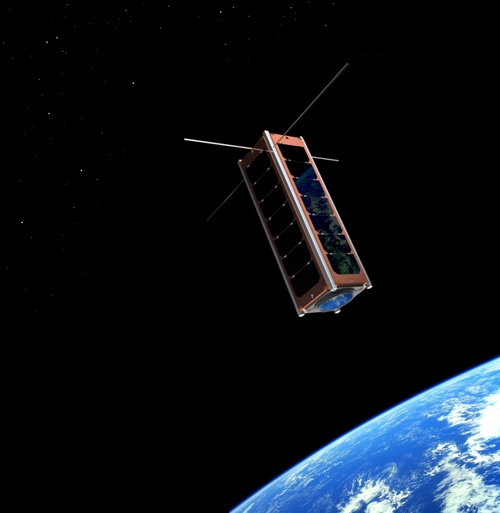
Artist's impression of UKube-1. Credit: Clydespace.

Artist's impression of UKube-1. Credit: Clydespace.

On Thursday and Friday last week (3rd and 4th November 2011), a young team of engineers from Clyde Space presented their final design to a team of experts for the Critical Design Review (CDR) – the typical ‘gateway’ for space missions to proceed into the flight build and implementation phase.

The CDR for Ukube-1 thus marks an important point in the development of the mission, establishing the robustness of the design, the level of technical risk and the schedule/resourcing for the completion of all the tasks to build the flight spacecraft.

clydespace-ukube-engineers

clydespace-ukube-engineers

At the CDR, the review panel scrutinised the design in detail to ensure it was sufficiently mature for flight. Key areas of focus included the structure and mechanisms, the communications system, the on board software and processing, the attitude control system and power generation.

At the end of the meeting the review board concluded that Ukube-1 had successfully passed CDR.

The next stage is the implementation of the mission that will lead to a launch on a Russian Dneper rocket (ex ICBM converted for small satellite launches) towards the end of 2012.

More on the aims and objectives of Ukube-1 can be found in the missions section of the website.


The UK Space Agency’s pilot programme to design and launch a CubeSat – a miniature cube-shaped satellite that will allow the UK to test cutting-edge new technologies in space – is now well underway. In December 2010 the payload competition for the pilot mission, UKube-1, stimulated more than 20 high quality proposals from UK industry and academia, and from these the Space Agency selected 7 excellent proposals for further development. In March 2011 four payloads were finally selected to fly on UKube-1. These will be integrated onto the spacecraft, which measures just 10cm x 10cm x 34cm, by Clyde Space. In addition UKube-1 will fly FunCube, an educational payload provided by AMSAT-UK, with the goal of enthusing and education young people about space, electronics, physics and radio.