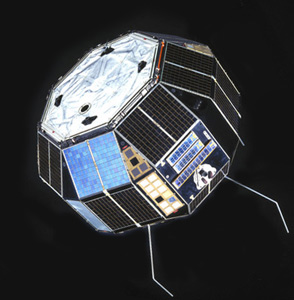
FUNcube Dongle used in new Prospero X-3 Satellite Tests

Prospero

Roger J A Duthie M0RJA and the team are carrying out further attempts to reactivate Prospero, the United Kingdom’s first satellite launched on a UK-built rocket, Black Arrow, on October 28, 1971.

The team now have an AMSAT-UK FUNcube Dongle (FCD) VHF/UHF Software Defined Radio to receive Prospero on 137.560 MHz and use an Icom IC-746 tranceiver on transmit commands to the satellite.

Because the frequency is now used by a number of Orbcomm satellites it can be difficult to identify the Prospero X-3 signal. The intention is to switch the satellite on and off by making commanding attempts and listening for a response in the RF carrier to indicate that Prospero is indeed still in some sort of working condition.

It is hoped Amateur Radio operators will be able to provide recordings of the signals on 137.560 MHz.

For further information check the Prospero X-3 blog and the AMSAT bulletin board.

Prospero 40th Anniversary has links to the real time tracking page and the history of the satellite

PE0SAT – Prospero

Join the FUNcube Yahoo Group

OSCAR News is published quarterly by AMSAT-UK and posted to members. Download a free sample issue here join here

PW-Sat to launch in January

PW-Sat, a 1U CubeSat to be launched on the first VEGA flight in January, will carry a 435 to 145 MHz Amateur Radio transponder.

The single channel transponder will operate in a similar way to the amateur satellite AO-16. The uplink on 435.020 MHz will be FM and the downlink on 145.900 MHz will use the BPSK telemetry beacon transmitter to produce Double Sideband (DSB) that can be received on an SSB radio.

PW-Sat should be launched into a 1450 by 300 km 71 degree orbit and may be expected to have a lifetime of about 4 years before re-entry. It was built by students of Warsaw University of Technology in cooperation with the Space Research Centre and will be Poland’s first satellite.

PW-Sat has five modes of operation:
1. Receive only mode – no downlink
2. Beacon CW mode – Downlink On-Off Keying (OOK) CW (1kHz) 12 WPM on 145.900 MHz
3. Beacon BPSK mode – Downlink BPSK (3 kHz) 1200 bps AX25 (1 frame on 20 sec) on 145.900 MHz
4. Control communication mode. Downlink BPSK (3 kHz) 1200 bps AX25 on 145.900 MHz
5. Voice Repeater mode (aka “AO-16” mode) – Uplink 435.020 MHz FM (15 kHz) Downlink 145.900 DSB (3 kHz)

For more information on PW-Sat in Google English see  http://tinyurl.com/CubeSatPW-Sat 

Vega to Launch Amateur Radio Satellites

IARU Amateur satellite frequency co-ordination panel pages hosted by AMSAT-UK http://www.amsat.org.uk/iaru/

AO-16 FM-DSB transponder http://www.southgatearc.org/news/january2008/ao16_reconfigured.htm

OSCAR News is published quarterly by AMSAT-UK and posted to members.
To get your copy join AMSAT-UK online at http://tinyurl.com/JoinAMSAT-UK/
Free sample issue at http://www.uk.amsat.org/on_193_final.pdf

Norwegian Student’s CubeSTAR in the press

CubeSTAR

CubeSTAR

The CubeSTAR amateur radio satellite being built by students at the University of Oslo features on page 2 of the December 14 issue of Electronics Weekly.

CubeSTAR is a project which aims to improve and support future space weather monitoring. Its scientific purpose is to monitor space weather in the Polar Regions where it will measure ion density and turbulence using the multiple-Neddle Langmuir Probes system developed at the University in Oslo.

These probes are based on a new concept that will increase the spatial resolution down to a few meters. After deployment in space the probes will unfold and record data that will be transmitted to a ground station. CubeSTAR is a 2U cubesat and will use AX.25 packet radio on 437.465 MHz.

Read page 2 of Electronics Weekly at http://cde.cerosmedia.com/1C4ee6257db71e1467.cde

CubeSTAR http://cubestar.no/

University of Oslo – CubeSTAR http://www.mn.uio.no/fysikk/english/research/projects/cubestar/

CubeSTAR on IARU Amateur Satellite Frequency Coordination pages provided by AMSAT-UK
http://www.amsatuk.me.uk/iaru/finished_detail.php?serialnum=191

AMSAT-UK publishes a colour A4 newsletter, OSCAR News, which is full of Amateur Satellite information.
Free sample issue at http://www.uk.amsat.org/on_193_final.pdf
Join online at http://tinyurl.com/JoinAMSAT-UK

Norwegian Student's CubeSTAR in the press

CubeSTAR

CubeSTAR

The CubeSTAR amateur radio satellite being built by students at the University of Oslo features on page 2 of the December 14 issue of Electronics Weekly.

CubeSTAR is a project which aims to improve and support future space weather monitoring. Its scientific purpose is to monitor space weather in the Polar Regions where it will measure ion density and turbulence using the multiple-Neddle Langmuir Probes system developed at the University in Oslo.

These probes are based on a new concept that will increase the spatial resolution down to a few meters. After deployment in space the probes will unfold and record data that will be transmitted to a ground station. CubeSTAR is a 2U cubesat and will use AX.25 packet radio on 437.465 MHz.

Read page 2 of Electronics Weekly at http://cde.cerosmedia.com/1C4ee6257db71e1467.cde

CubeSTAR http://cubestar.no/

University of Oslo – CubeSTAR http://www.mn.uio.no/fysikk/english/research/projects/cubestar/

CubeSTAR on IARU Amateur Satellite Frequency Coordination pages provided by AMSAT-UK
http://www.amsatuk.me.uk/iaru/finished_detail.php?serialnum=191

AMSAT-UK publishes a colour A4 newsletter, OSCAR News, which is full of Amateur Satellite information.
Free sample issue at http://www.uk.amsat.org/on_193_final.pdf
Join online at http://tinyurl.com/JoinAMSAT-UK

Delfi-N3XT Amateur Radio Satellite

The Dutch team that produced Delfi-C3 (DO-64) are planning to launch a new amateur radio satellite, the Delfi-N3XT in September 2012.

Continue reading

Nanosat Mission Idea Contest

Nanosat Misssion Idea Contest