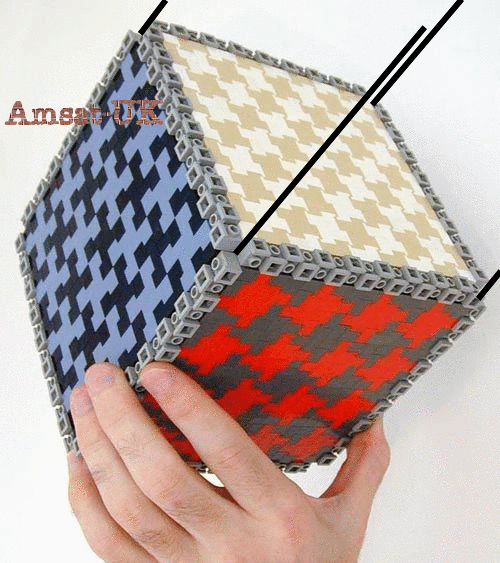
Lego™ 1U Cubesat,launch confirmed April 2012

Lego ™ first 1U Cubesat

In a little under a weeks time Lego-1 is due to make history by being the first 1U cubesat to be made from 40% lego,a team from ogel universtiy hope to be the first
team to have a cubesat in orbit, made by the 1940’s building blocks.

Mr Smith, the team leader says “The glue used to construct Lego-1 has been tested
by  NASA” after a little more questioning we was told the compound is ‘top secret’
but we managed to see a tube of it on the way into the clean room. ‘Polymerization of methyl-2-cyanoacrylate’ holds this cubesat together,incasing all the electronics, including a mode V beacon, and an impressive Linear Transponder (Inverting).

Uplink 435.2000-435.2600
Downlink 145.9200-TBD

Lego-1 is due to launch on the English built ‘yadslooflirpa’ Rocket in April this year,all final checks are now complete and  finger crossed, be the first lego built Cubesat in orbit’ A full in-depth article is due to be officially released on the 3rd of April 2012.

Steve from Ogel university comments “We are all looking forward to the launch,I worked on the solar-sail as part of my Masters degree,after this project I hope to release my new concept,a ‘1R’  a round cubesat, it’s a little bigger than a tennis ball”

GoodLuck with your round cubesat Steve!

Telemetry software will become available within the next few days,Lego-1 also hopes to become the first cubesat to allow amateur radio operators to tweet messages direct to the Cubesat, for them to be rebroadcasted via a 5w beacon. ( @lego-1 )

For more information please contact Rob, m0tfo@amsat.org

Download a photo of the team behind the Lego Cubesat

[wpdm_file id=3]

Don’t forget you can give a kind donation towards the FUNcube Launch Fund http://tinyurl.com/czfcro4

MicroThrust Motor for Nanosats

Imagine reaching the Moon using just a tenth of a liter of fuel. With their ionic motor, MicroThrust, EPFL scientists and their European partners are making this a reality, ushering in a new era of low-cost space exploration.

Watch EPFL – A Couple Drops of Fuel to Get to the Moon with MicroThrust

The goal is to provide efficient propulsion systems for nanosatellites (1-100 kg), which are currently stuck in whatever orbit they were initially placed: the plan is to free them to allow nanosatellites to perform orbital maneuvering, and missions to the Moon, to Near Earth Objects, or even to Mars.

Read Micromachined Propulsion systems for very small satellites http://lmts.epfl.ch/microthrust

Around the World 28 MHz Balloon Launched

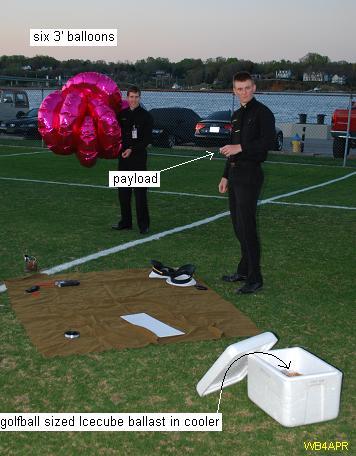
A long duration balloon mission that is using 6 Party Balloons to carry a 50 gram amateur radio 28.223 MHz CW beacon is hoping to go around the world.

The ballon was released at 2330 UT (1930 EDT) March 29, from Annapolis in Maryland and started its journey heading SE at 6 knots. By 0300 UT, March 30, it had reached a speed of 60 MPH (96 km/h).

It has no APRS, just the 28.223 MHz 100 milliwatt CW telemetry system and it is hoped to locate it by signal strength and beam headings only.

The mission is to give an insight into constant-pressure balloons and especially the use of common mylar party balloons as a fixed volume envelope. Unfortunately, these balloons have a high mass and so the theoretical maximum altitude no matter how many balloons are used is only about 26,000 feet and that is with no payload other than the fixed balloon mass.

The payload weighs about 50 grams. The team are targeting 6 party balloons 3′ in diameter which should give a float altitude around 16,000 feet.

The Telemetry will be in CW on 28.223 MHz (USB DIAL) and will contain Battery voltage, inside and outside temperatures, and surface luminosity of the ocean/clouds. It has no GPS. The team will rely entirely on DF bearings and signal reports.

EMAIL DF reports to W3ADO@homeside.to Be sure to include:
Your LAT/LONG
Time of observation
Quality of heading (subjective 1 to 10)
The CW string copied

If you have APRS you can uplink your beam heading via APRS.

Since the balloon is only flying at 16,000 feet or so it will be vulnerable to weather. The battery is expected to have a lifetime of about 10 days.

Further information including details of CW telemetry at http://aprs.org/balloons.html

ESA – CubeSats satellite operations update

Members of XaTcobeo team at ground station

Members of the XaTcobeo CubeSat team at the ground station

ESA have issued an update on the amateur radio CubeSats that were launched on February 13.

Since the launch ESA’s Education Office has maintained frequent contacts with the student teams to follow the progress of their satellite operations.

For each team, this is the first hands-on experience of operating an orbiting satellite, and some of them have had to deal with some challenging difficulties.

Read the ESA report at http://www.esa.int/SPECIALS/Education/SEM2KRGY50H_0.html

Student CubeSats BEESAT-2 and BEESAT-3

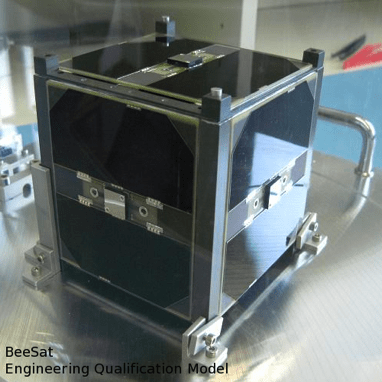
BEESAT-1 Engineering Qualification Model

BEESAT-1 Engineering Qualification Model

Two CubeSats, built by students at the Technical University of Berlin, are expected to launch in the 4th quarter of 2012 from Baikonour into a 575km circular 65 degree orbit.

BEESAT-2 is a 1U cubesat project intended to test a reaction wheel and an Attitude Determination and Control (ADC) system. Will also carry an experimental camera.

BEESAT-3 is a 1U cubesat project intended to test a transmitter using commercial S Band frequencies outside the amateur satellite service.

Up- and downlink of both of these CubeSats is established by half-duplex GMSK modulated narrow-band radio at 436.000 MHz. The standard data rate is 4800 bps but can be switched to 9800 bps for increased channel capacity at higher elevations. Each transmission at the higher data rate is announced by a small 4800 bps header to allow for adaptive receiver re-configuration. The modem device used is the CML CMX909b.

For more information see http://tinyurl.com/TUB-BEESAT

IARU Amateur Satellite Frequency Coordination pages hosted by AMSAT-UK http://www.amsat.org.uk/iaru/

HumSAT-D CubeSat

HumSAT Mission Concept

HumSAT Mission Concept

HumSAT-D is a 1U CubeSat mission developed by the University of Vigo. It is planning to use MSK telemetry and a CW beacon on UHF. The main mission is educational: to provide a hands-on experience to the students in the complete process of developing a space mission.

The other goal is to demonstrate the validity of the concept of HumSAT. A new subsystem to collect data from sensors located on the ground, store on-board and transmit it to ground stations will be developed and validated in orbit.

Universities and amateurs are invited to develop their own sensors compatible with HumSAT.

HumSAT-D is planning a launch from Russia into a Sun Synchronous Orbit (SSO) at 700km.

HumSAT System

The main purpose of the HumSAT system is the development of a satellite-based system for connecting a set of users with a network of worldwide distributed sensors which they have previously deployed.

Sensors will be responsible for acquiring user data and for transmitting it to the satellites through an standard radio interface (SSI interface, definition of this interface is published here). Users will be able to define their own sensors, for monitoring different types of parameters; for example, water temperature or wind speed.

For retrieving data from the satellites, the GENSO network of ground stations will be one of the core components of the data distribution system. Several universities from different ESA member states, Japan and USA are coperating in this project, whose second release (R2) is expected to provide the functionalities that the HumSAT system will require. For more information about the GENSO project, please visit the www.genso.org website.

Once data has been transported by HumSAT satellites, authorized users will be able to access it through an Internet connection. Several security restrictions shall be applied for guaranteeing a correct access to the data gathered.

HumSAT http://www.humsat.org/

HumSAT: example for international cooperation in small satellite missions
http://www.oosa.unvienna.org/pdf/bst/ISU-SSP2011/Small-Sats-_v1-Graz-26-07-2011-ISU.pdf

IARU Amateur Satellite Frequency Coordination pages hosted by AMSAT-UK http://www.amsat.org.uk/iaru/