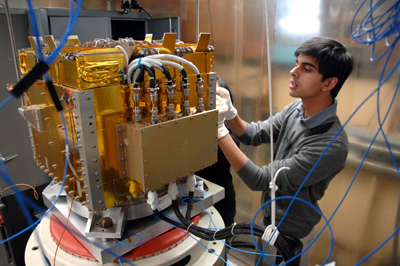
Multi-Cubesat Launcher Built by Naval Postgraduate School.

Vidur Kaushish, a student at the Naval Postgraduate School, works on the NPS CubeSat Launcher. (Courtesy NPS website)

Students at the Naval Postgraduate School have developed an auxiliary payload platform that will permit the launch of as many as 24 cubesats at a time. AMSAT News Service reports that the NPS CubeSat Launcher is designed to release satellites one at a time by opening spring-loaded doors at the desired orbital altitude. The first launch, slated to carry 11 cubesats, is planned for this August.


‘Kinect’ STRaND-2 at UK Space Agency Conference

Tim Peake at UKSA Conference 20120426

Prospective UK Astronaut Tim Peake addressed the conference via Skype

On the anniversary of the launch of Ariel-1, April 26, the UK Space Agency and the Science Museum co-hosted a two-day conference celebrating 50 years of the UK in space. It brought together those who started the UK on the road to being a world-renowned centre for space technology and research with the scientists and engineers of the next fifty years.

Vince Cable at UKSA Conference 20120426

Vince Cable Secretary of State for Business, Innovation and Skills

Ariel-1 was the world’s first international satellite. The United Kingdom stepped up to an offer from NASA to launch scientific satellites at an international meeting on space research in 1959. From this point, the UK took the lead in satellite technology as well as beginning the UK’s long history of international collaboration.

As part of the programme on the 26th, there were personal insights from scientists and engineers involved in the original design and build of the Ariel series of satellites, as well as those teams developing the flagship programmes of today and tomorrow. The Science Museum will be highlighting historic milestones in the UK space sector over the course of the week.

Shaun Kenyon at UKSA Conference 20120426

Shaun Kenyon of the STRaND project

The future is set to be as innovative and inspirational as the last 50 years. There is a vast potential for space technology. From the growing need for Earth observation satellites to monitor urgent social and environmental issues; to the emerging reality of space tourism; to our ever-improving capability to see deep into the Universe, the UK space sector is at the forefront of facing up to these challenges.

During the conference prospective UK astronaut Tim Peake, currently in the USA, addressed the conference via a Skype video link.

Shaun Kenyon, who has worked on the innovative STRaND-1 SmartPhone satellite project, gave a well received presentation about the future opportunities for the UK Space Industry. He also described another UK first – STRaND-2 – twin 3U CubeSats with docking capabilities using a gridded Lidar system based on that used in the Kinect games controller.

Surrey Space Centre http://www.surrey.ac.uk/ssc/
STRaND on Facebook http://www.facebook.com/nanosats

'Kinect' STRaND-2 at UK Space Agency Conference

Tim Peake at UKSA Conference 20120426

Prospective UK Astronaut Tim Peake addressed the conference via Skype

On the anniversary of the launch of Ariel-1, April 26, the UK Space Agency and the Science Museum co-hosted a two-day conference celebrating 50 years of the UK in space. It brought together those who started the UK on the road to being a world-renowned centre for space technology and research with the scientists and engineers of the next fifty years.

Vince Cable at UKSA Conference 20120426

Vince Cable Secretary of State for Business, Innovation and Skills

Ariel-1 was the world’s first international satellite. The United Kingdom stepped up to an offer from NASA to launch scientific satellites at an international meeting on space research in 1959. From this point, the UK took the lead in satellite technology as well as beginning the UK’s long history of international collaboration.

As part of the programme on the 26th, there were personal insights from scientists and engineers involved in the original design and build of the Ariel series of satellites, as well as those teams developing the flagship programmes of today and tomorrow. The Science Museum will be highlighting historic milestones in the UK space sector over the course of the week.

Shaun Kenyon at UKSA Conference 20120426

Shaun Kenyon of the STRaND project

The future is set to be as innovative and inspirational as the last 50 years. There is a vast potential for space technology. From the growing need for Earth observation satellites to monitor urgent social and environmental issues; to the emerging reality of space tourism; to our ever-improving capability to see deep into the Universe, the UK space sector is at the forefront of facing up to these challenges.

During the conference prospective UK astronaut Tim Peake, currently in the USA, addressed the conference via a Skype video link.

Shaun Kenyon, who has worked on the innovative STRaND-1 SmartPhone satellite project, gave a well received presentation about the future opportunities for the UK Space Industry. He also described another UK first – STRaND-2 – twin 3U CubeSats with docking capabilities using a gridded Lidar system based on that used in the Kinect games controller.

Surrey Space Centre http://www.surrey.ac.uk/ssc/
STRaND on Facebook http://www.facebook.com/nanosats

50th Anniversary of the UK in Space

The United Kingdom sent up its first satellite 50 years ago when Ariel 1 launched on April 26, 1962. To celebrate the occassion BBC News interviewed radio amateur Sir Martin Sweeting G3YJO.

The launch of the joint UK/US satellite Ariel-1, also known as UK-1, made the United Kingdom the third country to operate a satellite, after the Soviet Union and the USA.

Deployed into a 1,202 by 397 km orbit Ariel-1 carried six experiments, five of these examined the relationship between two types of solar radiation and changes in the Earth’s ionosphere.

Ariel-1 marked the first time the UK sent something into orbit, and gave a lift-off for a part of the British economy that gets little attention but makes a lot of money.

In this BBC News report Adam Fleming speaks to Doug Millard at the Science Museum, Sir Martin Sweeting G3YJO from Surrey Satellite Technology and Space Minister David Willetts on the UK’s role in space today. http://www.bbc.co.uk/news/uk-politics-17854280

Watch the UK Space Agency video – 50 Years of the UK in Space

UK Space Agency – Celebrating 50 Years of the UK in Space http://www.bis.gov.uk/ukspaceagency/50-years-in-space

Wiki – Ariel-1 http://en.wikipedia.org/wiki/Ariel_1

UK industry to build Solar Orbiter satellite http://www.bbc.co.uk/news/science-environment-17743190

ISS: successful contact with Balaklava school

We are pleased to announce very successful contact of Balaklava school
(Sevastopol, Crimea, Ukraine) with International Space Station.
More than 100 children came to take part of the evening event on April
11, 2012 in Balaklava – very unique place with interesting history as well
as known as a place where Russian cosmonaut Anton Shkaplerov was born.
17 questions were asked and after the radio contact was finished we continued
communication via phone in combination with video stream available on http://spacestationlive.jsc.nasa.gov/timeline/index.html
Anton came to the place where web camera is located so we were able
not only to speak but also to see what he was doing on board of the station.
During the conversation Daniel Burbank joined giving greetings to all participants
on the ground.
Anton has answered 5 more questions and shown how Orlan space suit glovers
works, how to drink water in the space. Under storm of applause Anton presented
Balaklava’s school pennon which he has on board.
Space station

Space station

Event was organized by Ukrainian radio-amateurs Andrey Begunov – UT9UF and
Oleg Dmitrenko UR4UKV with support of Sevastopol’s radio-amateurs, space enthusiast
Vladimir Kovgan and Anton’s first teacher Irina Bogdanova.
Andrey
UT9UF

Innovative nanosat will test space software

Designing Ops-Sat at ESA's Concurrent Design Facility

Designing Ops-Sat at ESA's Concurrent Design Facility

A new ESA nanosat aiming for a 2015 launch plans to provide a platform to test software in space.

Space software rarely runs the latest operating systems, languages or interfaces. It is selected for its proven, rock-solid reliability rather than its use of the latest and newest programming technologies. For example ESA is still using the Packet Utilisation Standard to control their satellites, which was defined in 1994.

There are many reasons why satellites continue to use decades-old, tried-and-trusted software based on older technical standards. It’s not because satellite designers and builders aren’t innovative. On the contrary, some of the best ideas in software development come from the space industry.

“However, with mission-critical software, there’s a lot of risk-aversion, which is very understandable,” says Mario Merri, Head of the Mission Data Systems Division at ESOC.

“No one wants to use new and possibly problematic software on a multi-million-euro mission in space.”

Traditionally, one of the major barriers to providing updated software for use in space has been the lack of opportunities to test new tools, systems and procedures.

It’s difficult and expensive to replicate in-orbit conditions using an Earth-bound simulator, yet this is precisely the tough standard that new space software must meet.

That’s where an innovative nanosatellite design developed at ESA promises to help satellite designers, ground engineers and spacecraft and component manufacturers. Dubbed Ops-Sat, for Operations Satellite, it is specifically designed to allow controlled testing and validation of critical onboard and ground software.

The design calls for a CubeSat configuration, measuring just 30x10x10 cm and costing far less than a traditional scientific or Earth observation satellite.

“The secret behind the Ops-Sat design is that the satellite is easily recoverable from the effects of ‘buggy’ software and we use commercial, off-the-shelf processors to provide increased computing power compared to normal spacecraft,” says Dave.

“We can completely replace the entire onboard software suite with new and fresh code more or less daily, allowing developers to troubleshoot their products in a real but safe environment.”

Ops-Sat has generated considerable interest from European industry, which sees the possibilities for demonstrating new concepts, ideas and products that presently have difficulty breaking into mainstream spacecraft design.

This could accelerate innovation and lower costs in the field of satellite control.

Source ESA