After many attempts, Hector Martinez CO6CBF in Cuba and Dale Pelzer KL7R in Alaska have achieved a contact between Grid Squares EL92sd and BP54xt using the amateur radio satellite FO-29.
Cubans cannot operate on AO-7 mode B, So FO-29 is our only opportunity for long contacts.
I cannot say how much time we tried but I am sure that it was more than 10 attempts. Dale did all the hard work, he drove around 4 miles from his home to a nearby hill. Majority of times he drove very late in the night.
All the SSB attempts failed. Today [Sunday, July 8] at 1920z was our first attempt on CW and it was successful!
Dale’s working conditions are a Yaesu FT-817 (only 5W semi-duplex) and ARROW antenna with preamplifier. My working conditions are a majority homebrew setup, 10 elements Yagi on 2m and 18 elements Yagi for 70cm with a homebrew preamplifier.
Thanks very much to Dale for his constancy and effort!
PS: I continue looking for new grids and long contacts on satellite, if you are into any footprint with EL92sd and wan to try, please drop me an email [address at qrz.com]
Download the article ‘Getting started on amateur radio satellites’ by John Heath G7HIA at https://amsat-uk.org/wp-content/uploads/2011/05/satellites_radcom_mar07.pdf Copyright 2007 Radio Society of Great Britain. For personal use only – no copying, reprinting or distribution without written permission from the RSGB.
For 2012 the NASA CubeSat Launch Initiative includes 6U CubeSat satellites. An 8 kg 6U CubeSat can be designed to perform some of the Earth observation missions of 100 kg microsatellites. A 6U CubeSat (~33 x 10 x 22 cm, ≤ 8kg) has 4 times the payload capacity of a 3U CubeSat (33 x 10 x 10 cm, ≤ 4 kg) which uses two thirds of its volume for system components.
This workshop, the first in the world dedicated to the 6U CubeSat, will explore the range of missions possible with a 6U CubeSat in the areas of:
Astronomy
Atmospheric Science and other Planetary Science
Space Physics
Earth Observation
Biology
Other
Program
Day 1 – Tuesday 17th July 2012
Time
Presentation Title
Speaker
10:00-10:30AM
Morning tea
10:30-10:35AM
Welcome
Andrew Dempster (ACSER)
10:35-10:45AM
Workshop Introduction
Steven Tsitas (ACSER)
10:45-11:10AM
6U CubeSat Design for Earth Observation with 6.5 m GSD, 5 Spectral Bands and 14 Mbps downlink
Steven Tsitas (ACSER)
11:10-11:35AM
Scheduling multi-spectral collection of the Australian landmass using a 6U cubesat constellation
Leon Stepan (DSTO)
11:35-12:00PM
From SmallSat to 6U CubeSat: A Case Study in size and mass reduction
Jeremy Straub (University of North Dakota)
12:00-01:00PM
Lunch
01:00-01:25PM
6U CubeSat as the basis for a sustainable Australian space program
Steven Tsitas (ACSER)
01:25-01:50PM
TBC
Roger Franzen, Mike Petkovic (ANU, Mt Stromlo Observatory)
01:50-02:50PM
KEYNOTE: Research and Technology Implications and Applications for Very Small (MesoScale) Spacecraft
John Hines (NASA-Ames)
02:50-03:15PM
Synergy between 6U, fractionated and adaptable systems
Gordon Roesler
03:15-03:45PM
Afternoon tea
03:45PM
Panel Discussion: Can the 6U CubeSat form the basis of a sustainable Australian space program?
Day 2 – Wednesday 18th July 2012
Time
Presentation Title
Speaker
09:05-09:10AM
Workshop introduction final day
Steven Tsitas (ACSER)
09:10-09:40AM
TBC
Stephanie Thomas (Princeton Satellite Systems)
09:40-10:05AM
Satellite-borne impact detectors for small meteoroids, interplanetary dust and space debris
Duncan Steel (UNSW)
10:05-10:35AM
Morning tea
10:35-11:00AM
A CubeSat Mission for Exoplanet Transit Detection and Asteroseismology
Jeremy Bailey (UNSW)
11:00-12:00PM
KEYNOTE: Astrophysics with 6U platforms
Harvey Butcher (ANU)
12:00-01:00PM
Lunch
01:00-01:25PM
6U CubeSat Commercial Applications
Steven Tsitas (ACSER)
01:25-01:50PM
40 kg to LEO; a low cost launcher for Australia
Nicholas Jamieson (UNSW)
01:50-02:15PM
6U Radar Altimeter Concept Design
Nick Stacy (DSTO)
02:15-02:40PM
GNSS Remote Sensing in a 6U Cubesat
Andrew Dempster (UNSW)
02:40-03:05PM
Preliminary parameters for an experimental payload for Trospospheric CO2 measurement using a space-born lidar 6U cubesat platform
Manny Fabiao Dionizio (UNSW)
03:05-03:35PM
Afternoon tea
03:35-04:05PM
6U CubeSat Systems (TBC)
TBC
04:05-04:35PM
CubeSat deorbit devices (TBC)
TBC
04:35-04:45PM
Workshop conclusion and next steps
Steven Tsitas (ACSER)
Keynotes
Technology Keynote – John W. Hines, Chief Technologist, NASA-Ames Research Center Science Keynote – Professor Harvey Butcher , Director Research School of Astronomy and Astrophysics Chair
Dr Steven Tsitas, Senior Research Associate, Australian Centre for Space Engineering Research, University of New South Wales Who Should Attend
Presentations are invited describing payloads and mission concepts for the 6U CubeSat. Presentations are also invited regarding 6U launch opportunities and 6U CubeSat standards.
SESSION 1: Earth Observation Missions
SESSION 2: Astronomy Missions
SESSION 3: Planetary Science and Space Physics Missions
SESSION 4: Biology and other missions
SESSION 5: 6U CubeSat launch opportunities
SESSION 6: 6U CubeSat standards
Abstracts
If you wish to submit an abstract for the 6U CubeSat Low Cost Space Missions Workshop please email them to Stanija Buvac before the 3rd July 2012.
On Tuesday, July 3, the amateur radio satellite HORYU-2 (call sign JG6YBW) recovered from the problems affecting the 437.375 MHz telemetry and the Blog indicates the team are now attempting to take pictures using the on-board camera.
Nano-Satellite “HORYU2”, built by students from the Kyushu Institute of Technology, was launched by JAXA from Tanegashima Space Center on May 18 with the Observation Mission “SHIZUKU” (GCOM-W1). The SHIZUKU observation images acquired by AMSR2 have been released.
Independence Day, July 4, saw AC0RA and OM3BD set another world distance record using the amateur radio satellite AMSAT-OSCAR-7 breaking their own record set just 48 hours earlier.
The new distance record was 7903.55km comfortably exceeding the previous record of 7849km.
Bill OM3BD in Grid Square JN88mf reports that Wyatt AC0RA once again woke up early and this time drove 150 miles to EN41ad. They had a 30 second contact at 0949Z to extend the record to 7903.55km.
Bill’s equipment comprised an FT847, 2 x 10 element yagi on 2m with SP2000 preamp, and an 8 element Yagi for 70cm while Wyatt had an FT-847, a 7 element Yagi on 2 meters and a 12 element Yagi on 70cm.
The article “Guide To OSCAR Operating” that was published in “The Best of OSCAR News” Volume 1 in 1980 notes that the maximum theoretic range of AO-7 without propagation enhancements was expected to be about 7900 km. In some ways it’s surprising that it’s taken 37 years since the launch of AO-7 before the extremes of range were tested to their limits.
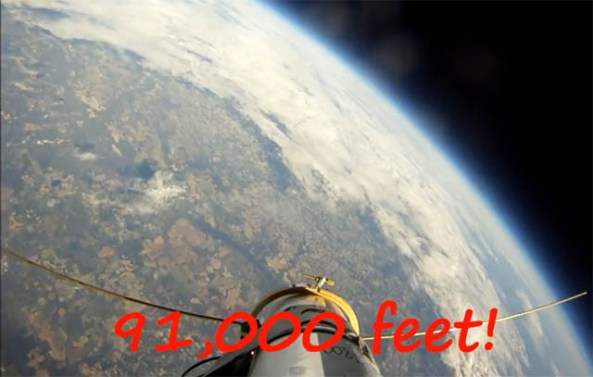
Erin King, AK4JG, a 17-year-old from Columbus, Georgia, who re-founded her high school’s radio club and then lofted a ham radio-carrying balloon to over 90,000 feet, recovered the flight data and used it to produce a truly striking video of that flight, has been named as recipient of the 2012 Amateur Radio Newsline Young Ham of the Year Award.
Watch MIT’16 EA Tube goes to Near Space!
Ever wondered how to execute a high altitude balloon mission? Erin King, AK4JG, talks about the process, planning and options in a presentation at Dayton in 2012.
Watch Launching Radios and Other Cool Stuff into the Stratosphere AK4JG.wmv
Erin is the daughter of Paul, K4ETY, and Patricia King. She has two siblings: Brandon, age 16 and Rachel, age 15. Erin became a licensed radio amateur in 2009 and now holds an Extra Class license. She is a member of the ARRL, the Columbus Amateur Radio Club, and the Russell County Radio Club. She enjoys operating on local VHF and UHF repeaters as well as phone and digital modes on the High Frequency amateur radio bands. She is looking forward to mastering Morse Code as her next amateur radio challenge.
Erin King AK4JG
Erin became interested in amateur radio after joining a club at her high school dealing with robotics and then ham radio-equipped high-altitude balloon launches. This school group has participated in FIRST Robotics competitions, and Erin has twice been Team Lead for Programming. The club also launches several high-altitude balloon missions each year, in a program called DREAMS. They have flown various scientific experiments as part of these missions, in addition to planning, building, and integrating radios, Global Positioning System (GPS) units and TNCs to track and recover the balloons. To facilitate these activities, the group’s sponsor, Luther Richardson, KI4AOJ, has encouraged the students to obtain their amateur radio licenses.
A subset of this group,including Erin, has participated in the Massachusetts Institute of Technology’s (MIT’s) “InvenTeam” competition, designing and building a portable lightning detector and early warning system. In addition, Erin re-started the Columbus High School Radio Club and served as its president for the past two years. The club was active in the 1950s and ’60s, and Erin’s great-grandfather (the original K4ETY) was one of its mentors at that time. The new club obtained the callsign W4CHS (Columbus High School) and has been active on the air.
Erin King AK4JG working 6m for Field Day 2011 – Image Credit Columbus Amateur Radio Club W4CVY
Erin’s involvement with amateur radio and FIRST Robotics has helped fuel her interest in science and engineering. Last year, she applied for early admission to both Georgia Tech and MIT; she was accepted to both and will be attending MIT this fall.
Inside the shiny tube which contained Erin’s MIT acceptance letter was a note suggesting that the students “hack” their tubes, meaning to do something cool with them, in along-standing tradition of MIT hacks or stunts. Erin chose to send her tube to near-space.
Drawing on her ballooning experience,Erin planned, built, integrated, and tested a complete new tracking setup to fit into the very small shipping tube. The payload consisted of two GPS units, two custom-made antennas, one Argent Data OpenTracker+ kit (which Erin built), one handheld radio, and a fellow ham’s Byonics Pocket Tracker, a self-contained 100-milliwatt tracker/radio combination in an Altoids® tin. Erin also talked her mother into letting her use mom’s brand new GoPro Hero HD video camera.
With the assistance of a group of hams from the Columbus Amateur Radio club, Erin launched her balloon from Lumpkin, GA. A couple of hours later, she and the tracking team successfully recovered it, along with the complete HD video record of the flight. Erin took this video, as well as other photos and videos taken of the launch activities, and compiled it into an 8-minute presentation,complete with background music. She posted it to YouTube, and put a link to it on the MIT hack-the-tube site (see<http://tinyurl.com/ak4jg-space-video>). According to YouTube statistics, Erin’s video has been viewed thus far in excess of 82,500times.
This past May, Erin was invited to participate in no less than three forums and sessions at the 2012Dayton Hamvention®. These included the 25thanniversary “Youth Forum,” the “Ham Radio Town Meeting” and an “ARRL Expo”presentation where her video was screened.
Award Ceremony
The 2012 Amateur Radio Newsline™ “Young Ham ofthe Year Award” will be presented on Saturday, August 18th at the Huntsville Hamfest in Huntsville, Alabama. As the 2012″Young Ham of the Year,” Erin will receive –courtesy of Yaesu USA — an expense-paid trip to the Huntsville Hamfest, along with a gift of Yaesu brand ham radio equipment. CQ magazine will treat her to an expense-paid week at Spacecamp Huntsville,and will present Erin with a variety of CQ products. Amateur Radio Newsline™ will provide Erin with a commemorative plaque at the award ceremony. Once again, the cost of year’s plaque has been underwritten by Dave Bell (W6AQ), President of DBA Entertainment Inc., Hollywood, California. Heil Sound Ltd. will also be presenting Erin with a ham radio-related gift.
The presentation of the Young Ham of the Year Award has been a regular feature of the Huntsville Hamfest since 1993. This has been made possible through the generosity and kindness of the event’s Planning Committee and the good offices of Huntsville Hamfest Association Vice President Charlie Emerson, N4OKL. (See http://www.hamfest.org)
This year’s award ceremony will be hosted by Bill Pasternak, WA6ITF, and Don Wilbanks, AE5DW, of Amateur Radio Newsline™, Rich Moseson, W2VU, of CQ Communications, and representatives of Yaesu USA and Heil Sound.
Award Program Background
The Amateur Radio Newsline™ “Young Ham of the Year” award (formerly the Westlink Report Young Ham of the Year Award) has been presented annually since 1986 to a licensed radio amateur (ham) who is 18years of age or younger and who has provided outstanding service to the nation,his/her community or the betterment of the state of the art in communications through the amateur radio hobby/service. A website with full information on the award program and background material is located at http://www.arnewsline.org/YHOTY.
Award Sponsors
The award program is sponsored by the Los Angeles, California-based Amateur Radio Newsline™ with corporate support from Yaesu USA Corporation of Cypress, California, CQ Magazine of Hicksville, New York, and Heil Sound of Fairview Heights, Illinois.
Since 1976, Amateur Radio Newsline™ and its predecessor, the Westlink Radio Network, have been providing radio amateurs around the world with up-to-the-minute news at no cost to them. (See http://www.arnewsline.org)
The award’s three major corporate underwriters are world leaders in their respective areas of Amateur Radio product support.
Yaesu USA, which has been a corporate underwriter since the inception of the award program in 1986, is considered the trailblazer in the design, manufacture and distribution of high quality amateur gear as well as commercial two-way, monitoring, marine and air-band communications equipment (See http://www.yaesu.com).
CQ magazine and its sister publications, CQ VHF,Popular Communications and World Radio Online, are publishedby CQ Communications, Inc., and are considered the trend-setting publications serving today’s modern radio amateur. (See http://www.cq-amateur-radio.com)
Heil Sound Ltd. Is considered as a world leader in the development and manufacture of new technology microphones and related audio products for professional sound reinforcement and amateur radio communications. (See http://www.heilsound.com)
Earthrise viewed from Apollo 9 lunar orbit prior to landing – Image Credit NASA
ARI, the Associazione Radioamatori Italiani, and their club station IQ1TW have announced a special operating award “Apollo Space Program – From the Earth to the Moon” for contacts between July 1 – July 31, 2012.
This is to commemorate and keep alive the memory of the space program which has revolutionized the life of humankind.
To qualify for the award you need to have confirmed contacts with the ARI Headquarters Station IQ1TW and any three stations from this list: IZ1UMD, IZ1RFU, IZ1XBB, IZ1WVX, IZ1LBH, IK1WGZ, IZ1RGY, IZ2SMV, I1MXI.
On July 20, the anniversary of the first moon landing, a confirmed contact with IQ1TW (without the necessity of the other 3 contacts) will qualify you for the award.
The special event stations will operate with 200 watts using dipole and vertical antennas.
Full details, including a list of the planned HF operating frequencies and modes, log and confirmation information, rules, and application instructions are posted on the ARI web pages: http://aritortona.xoom.it/
[Thanks to ANS, Associazione Radioamatori Italiani and the DXNL Bulletin #1786 -Jun 27, 2012 – for the above information]


 Workshop Details





 AMSAT-UK
You must be logged in to post a comment.