The first Nanosatellite Launch Adapter System, or NLAS has been shipped for integration for a launch expected in late 2013.
Right now, nanosatellites can be deployed only in small numbers by rocket or from the International Space Station. But NLAS, developed by the Ames Research Center, can hold up to 24 cube satellites, opening up opportunities for smaller research projects to access space.
NLAS is expected to be used by NASA, other government agencies, and commercial entities.
Hojun Song DS1SBO performing final assembly of OSSI-1 satellite on April 9, 2013
The OSSI-1, BEESAT-2, BEESAT-3 and SOMP amateur radio CubeSats lifted off on a Soyuz-2-1a with research satellites Bion-M1, AIST and Dove-2 from Launch Complex 31 at Baikonur in Kazakhstan on Friday, April 19 at 1000 UT. The OSSI-1 CubeSat was deployed from its Pod on the top of Bion-M1 at 1615 UT.
The launch vehicle went into an initial elliptical orbit of 290 km by 575 km orbit at an inclination of 64.9°. A series of orbital maneuvers will be carried out to raise the orbit to 575 km circular before BEESAT-3, SOMP, then BEESAT-2 are deployed at around 1045 UT on Sunday, April 21.
The Center for Operation of Space Ground-Based Infrastructure said the satellites attached to the outer surface of the spacecraft “Bion-M” will be deployed in the period between the 4th and the 35th orbit. It is thought this may mean deployments will take place on the 4th and the 32-34th orbit but that there will be no deployments on the other obits.
OSSI-1 weighs 963 grams
Korean artist Hojun Song DS1SBO has spent 7 years developing his Open Source Satellite Initiative satellite OSSI-1. He has designed and built it from scratch using readily available components rather than expensive space qualified hardware. The launch was the most expensive part of the project costing $100,000.
It has a 12 WPM CW Morse code beacon on 145.980 MHz, a data communications transceiver on 437.525 MHz using AX.25 packet radio and carries a 44 watt LED optical beacon to flash Morse code messages to observers on Earth.
When deployed the OSSI-1 145.980 MHz Morse Code beacon will send “OS0 DE OSSI1 ANYOUNG”.
The Korean national amateur radio society KARL described the OSSI-1 CubeSat in their report to the International Amateur Radio Union Region 3 Triennial conference which was held in Viet Nam in 2012. Read the report at http://www.iaru-r3.org/15r3c/docs/019.doc
In this 20 minute video Korean artist Hojun Song DS1SBO and Donghee Park describe the Open Source Satellite Initiative amateur radio CubeSat OSSI-1.
Watch How OSSI-1 Satellite Works: General Overview
CubeSat deployment pods on top of the Bion-M1 spacecraft BeeSat-2, BeeSat-3 and SOMP are in the three 1U Launchers in the front OSSI-1 is a 1U and alone in a 3U-Pod behind left DOVE-2 is a 3U Cubesat and fills the 3U-Pod behind right
Soyuz-2-1a is planned to launch Friday, April 19, 2013 at 1000 UT from Baikonur in Kazakhstan. Among the satellites it will carry are four CubeSats with amateur radio payloads, OSSI-1, BEESAT-2, BEESAT-3 and SOMP.
Unusually the CubeSats will not be deployed straight after launch. Deployment of OSSI-1 is expected to take place after the 4th orbit and BEESAT-3, SOMP then BEESAT-2 are expected to be deployed at 16 second intervals after the 32nd orbit on Sunday, April 21 at around 1045 UT. Until then orbital maneuvers will be carried out to achieve a circular orbit at 575 km altitude.
It is expected that the four CubeSats may be deployed at intervals of about 16 seconds.
The satellites on the launch are:
Bion-M1
Bion-M is the next generation of Russian biological research satellites. While retaining the Vostok/Zenit-derived reentry module of the earlier Bion, the propulsion module has been replace by a Yantar type module, which provides maneuvering capabilities and longer mission support. The mission duration has been increased to up to 6 months by using solar cells for energy generation. The weight of scientific equipment has been increased by 100 kilograms. Source Gunters Space Page
Bion-M1 is carrying live mice, geckos and gerbils, see the BBC story at http://www.bbc.co.uk/newsround/22218589
Watch Bion-M Mission
Student Satellite AIST-2
AIST-2
AIST is a russian microsatellite developed by designed by a group of students, postgraduates and scientists of Samara Aerospace University in cooperation with TsSKB Progress.
The satellite will measure the geomagnetic field, test the new small space vehicle bus, test methods to decrease microaccelerations to a minimum level and measure micrometeoroids of natural and artificial origin. Source Gunters Space Page
Believed to have a 435 MHz downlink and an 145 MHz command uplink.
OSSI-1 weighs 963 grams
OSSI-1
Korean artist Hojun Song DS1SBO has spent 7 years developing his Open Source Satellite Initiative satellite OSSI-1. He has designed and built it from scratch using readily available components rather than expensive space qualified hardware.
It has a 12 WPM CW Morse code beacon on 145.980 MHz, a data communications transceiver on 437.525 MHz and carries a 44 watt LED optical beacon to flash Morse code messages to observers on Earth. https://amsat-uk.org/satellites/ossi-1/
BEESAT-1 Engineering Qualification Model
BEESAT 2
The Berlin Experimental and Educational Satellite 2 is a 1U CubeSat project intended to test a reaction wheel and an Attitude Determination and Control (ADC) system. It will also carry an experimental camera. http://tinyurl.com/TUB-BEESAT
BEESAT 3
A 1U CubeSat project intended to test a transmitter using commercial S Band frequencies outside the amateur satellite service but will have a downlink on 435.950. It will have passive attitude control. http://tinyurl.com/TUB-BEESAT
SOMP
The Student Oxygen Measurement Project (SOMP) is a 1U cubesat developed by students of the Technische Universität Dresden, Germany, organized in the Students’ Research Group for Spacecraft Engineering in Dresden (STARD). The CubeSat will be able to determine and to a limited extent, also control the attitude https://amsat-uk.org/2013/03/22/somp-students-oxygen-measurement-project-carries-amateur-radio-payload/
Dove-2
The Dove-2 mission is a technology demonstration nanosatellite for Cosmogia Inc. for remote sensing purposes based on the triple (3U) CubeSat form factor. It is also an internal company technology demonstration experiment to test the capabilities of a low-cost spacecraft constrained to the 3U cubesat form factor to host a small payload. Dove 2 is licensed to collect images of the Earth and will undertake a short-duration experimental mission in a 290 km by 575 km orbit at an inclination of 64.9°.
Source Gunters Space Page
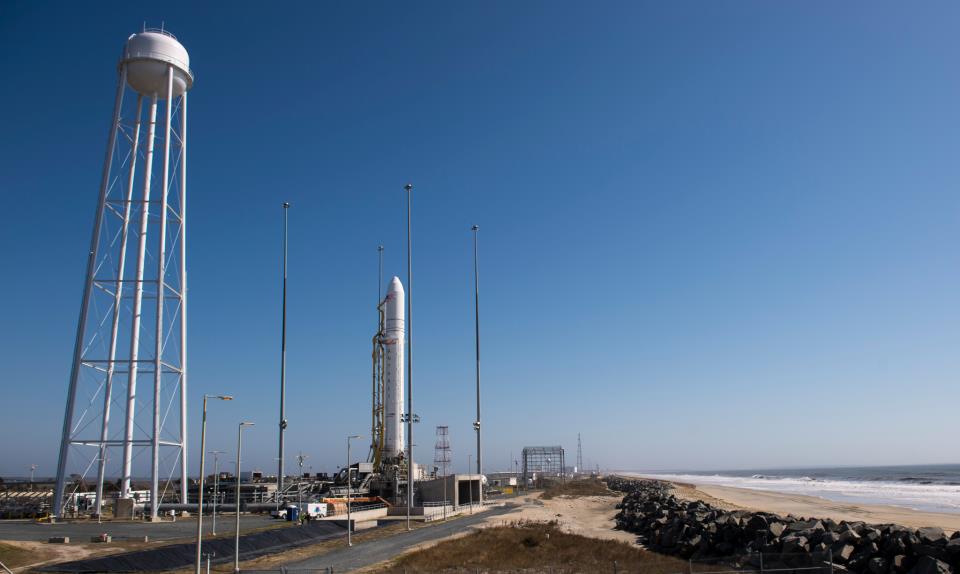
The planned launch of the Antares rocket carrying three CubeSats with amateur radio payloads has been postponed.
Space Flight Now report the countdown for the launch of the first Antares rocket was halted with 12 minutes on the clock after a second stage umbilical prematurely separated.
The test flight is to prove the booster’s reliability before future flights to service the International Space Station. A new launch date has yet to be announced.
The launch of Antares carrying three CubeSats with amateur radio payloads is expected to take place on Wednesday, April 17.
ANS reports that three PhoneSat cubesats will be aboard the Orbital Sciences Corporation Antares(TM) rocket from NASA’s Wallops Flight Facility (WFF) in eastern Virginia scheduled for April 17 at approximately 5:00 p.m. (EDT). The launch will be shown live on NASA TV at http://www.nasa.gov/ntv and also at http://www.nasa.gov/orbital
The three PhoneSats carry amateur radio payloads on 437.425 MHz, each transmits at intervals so all three should be receivable during a pass.
The callsign will be KJ6KRW all three satellites will transmit using AFSK (1200 bps) modulation, AX.25 packet coding. The two PhoneSat 1.0 satellites, Graham and Bell, transmit with a periodicity of respectively 28 seconds and 30 seconds. The PhoneSat 2.0 beta satellite, Alexandre, transmits with a periodicity of 25 seconds.
PhoneSat was chosen as one of the winners in the Aerospace category for the Popular Science magazine “Best of What’s New 2012″ awards. The PhoneSat is a technology demonstration mission consisting of three 1U CubeSats intended to prove that a smartphone can be used to perform many of the functions required of a spacecraft bus.
The satellite is built around the Nexus smartphone which will be running the Android operating system and will be enclosed in a standard 1U CubeSat structure. The main function of the phone is to act as the Onboard Computer, but the mission will also utilize the phone’s SD card for data storage, 5MP camera for Earth Observation, and 3-axis accelerometer and 3-axis magnetometer for attitude determination.
One of the nanosatellites, powered by the HTC Nexus One smartphone, will send back pictures of Earth. The other two, running on the Samsung Nexus S, will have two-way S-band radio allowing them to be controlled from Earth.
With a short lifetime of only about one week, the satellites have no solar cells and operate on battery only.
The Antares launch includes the commercial DOVE-1 satellite, a technology development experiment. The satellite had requested IARU coordination for a 1 watt transmitter on 145.825 MHz to downlink a 1200 baud AFSK AX.25 beacon with telemetry and health data. The AMSAT News Service reported in ANS-027 that according to the IARU DOVE-1 will no longer be using frequencies in the amateur radio bands.
Sharlene Katz WB6FFE and James Flynn WB9AWX – Image credit CSUN
Radio hams Professor Sharlene Katz, WB6FFE and Professor James Flynn, WB9AWX have received $25,000 from the Jet Propulsion Laboratory for a CubeSat project.
The Daily Sundial newspaper carries a report on the California State University Northridge (CSUN) CubeSat project which says the 2U CubeSat aims to test alternative power techniques for satellites and spacecrafts and is estimated to cost between $60,000 and $80,000.
“And that’s all just parts. Our labor, of course, is for free,” joked Sharlene Katz [WB6FFE], Professor of Electrical and Computer Engineering.
Typically, it would cost another $45,000 just to launch the satellite. But thanks to their sponsorship from the Jet Propulsion Laboratory (JPL) in Pasadena, the satellite will be hitching a ride with a shuttle in a few years.
In order to communicate with the CubeSat, the team is also building an automated ground station on top of Jacaranda Hall. The system is going to be using old equipment from a previous experiment.
“There’s a lot of problems with the ground station right now, it’s old equipment,” said member Rufus Simon. “We’re fixing it! Step by step.”
The station will not only help the team track CSUN’s CubeSat, but other satellites as well. It will become part of the Global Educational Network for Satellite Operations (GENSO), which is a community of universities across the world who track and communicate with satellites.
Phase two of the project is set to start during the fall semester of 2013, and the team is hoping to complete the satellite by December of 2014.



 AMSAT-UK
You must be logged in to post a comment.