UK STRaND-1 Amateur Radio Smartphone CubeSat is Back !

Dr Susan Jason working on STRaND-1 - Image credit Surrey Space Centre

Dr Susan Jason working on STRaND-1 – Image credit Surrey Space Centre

On July 23, 2013 at 1634 UT Mike Rupprecht DK3WN received signals from the UK STRaND-1 satellite after a near four month absence.

Built by volunteers from the Surrey Space Centre (SSC) and SSTL in Guildford STRaND-1 was launched on February 25, 2013 and was the World’s first Smartphone CubeSat to be put into orbit.

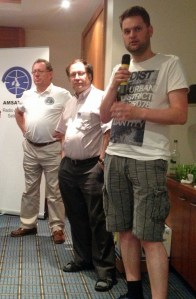
Dr Chris Bridges M6OBC and STRaND-1

Dr Chris Bridges M6OBC and STRaND-1

STRaND-1 unexpectedly stopped transmitting on March 30, 2013 and radio amateurs around the world have been listening for it ever since on a frequency of 437.568 MHz (+/- 10 kHz Doppler).

Radio amateurs are requested to email reports of reception of telemetry data from STRaND-1 to: strand.messages<at>gmail.com

See the report from Mike Rupprecht DK3WN at http://www.dk3wn.info/p/?p=35582

STRaND-1 information https://amsat-uk.org/satellites/strand-1/

How to decode the telemetry https://amsat-uk.org/satellites/strand-1/strand-1-telemetry/

Online real-time tracking of STRaND-1 http://www.n2yo.com/?s=39090&df=1

Watch the presentation on STRaND-1 given by Chris Bridges M6OBC to the AMSAT-UK International Space Colloquium on July 21, 2013 at http://www.batc.tv/streams/amsat1315. Download the video by right-clicking on http://www.batc.tv/vod/strand.flv

AMSAT-UK publishes a quarterly colour A4 newsletter, OSCAR News, that is full of Amateur Satellite information. A sample issue of OSCAR News can be downloaded here.
Join AMSAT-UK online at http://tinyurl.com/JoinAMSAT-UK/

Video of STRATODEAN High Altitude Balloon Presentation

Team STRATODEAN - Cassie Phelps and Mark Ireland

Team STRATODEAN – Cassie Phelps and Mark Ireland

The members of Team STRATODEAN, Cassie Phelps and Mark Ireland, gave a presentation on their High Altitude Balloon project to the AMSAT-UK International Space Colloquium on Saturday, July 20, 2013.

Image from STRATODEAN Two

Image from STRATODEAN Two

The STRATODEAN team have sent high altitude weather balloons complete with payload from the Forest of Dean up to the edge of space (approx. 34 km up into the Stratosphere).

Each balloon was equipped with a camera and video recorder as well as GPS and a 434 MHz telemetry transmitter running 50 bps, 350 Hz shift, ASCII. The transmitter enables the balloon to be tracked during its flight and then located once it has burst and returned to earth with the help of a parachute.

Their first balloon STRATODEAN One launched on April 21, 2013 followed by STRATODEAN Two on May 18, 2013 and they managed to capture some stunning pictures and video.

Watch the STRATODEAN presentation

STRATODEAN High Altitude Balloon Project http://www.stratodean.co.uk/

To get details of upcoming UK balloon launches subscribe to the UKHAS Mailing List by sending a blank email to this address: ukhas+subscribe@googlegroups.com

Videos of other presentations at the AMSAT-UK International Space Colloquium can be seen via
https://amsat-uk.org/colloquium/colloquium-2013/presentation-videos/

AMSAT-UK publishes a colour A4 newsletter, OSCAR News, that is full of Amateur Satellite information. A sample issue of OSCAR News can be downloaded here.
Join AMSAT-UK online at http://tinyurl.com/JoinAMSAT-UK/

Ham Radio Satellite Operation from Guernsey

Peter Goodhall 2E0SQL operating portable through the satellites

Peter Goodhall 2E0SQL operating portable through the satellites

Peter Goodhall 2E0SQL/2U0SQL will be active on the amateur radio satellites from Guernsey during July 24-30, 2013

On the AMSAT Bulletin Board he writes:

I will be active sporadically on satellite passes from Guernsey (IN89RL) as 2U0SQL.

I shall be focusing on FO-29 [SSB] and SO-50 [FM] passes but no firm pass times, but hopefully will have internet access and will try posting on Twitter (@2E0SQL) when I’ll be on.

Due to this being camping I will be battery powered using a FT-817 and a Arrow antenna.

If anyone needs a QSL Card its direct to 2E0SQL or bureau.

73 Peter Goodhall, 2E0SQL/2U0SQL
Twitter @2E0SQL

Online satellite tracking:
• FO-29 http://n2yo.com/satellite/?s=24278
• SO-50 http://n2yo.com/satellite/?s=27607

Free satellite tracking software:
• SimpleSat Look Down http://www.tomdoyle.org/SimpleSatLookDown/
• Gpredict http://gpredict.oz9aec.net/
• Orbitron http://www.uk.amsat.org/?p=9051

RSGB General Manager: The Future of Amateur Radio

Graham Coomber G0NBI

Graham Coomber G0NBI

In this video the RSGB General Manager, Graham Coomber G0NBI, gives his personal vision for the future of Amateur Radio.

Graham G0NBI gave the presentation at the AMSAT-UK International Space Colloquium on Sunday, July 21, 2013 and the video is now available in the Film Archive section of the BATC site.

You can watch the video and others from the colloquium at http://www.batc.tv/
Click on the ‘Film Archive’ icon
Select ‘AMSAT-UK 2013′ from the Category drop down menu
Click ‘Select Category’
Select the video ‘AMSAT2013 09 RSGB’
Click on ‘Select Stream’
Click the play icon ‘>’ on the player
Clicking on the icon to the left of the player volume control will give you full screen display.

You can also download the video file to your PC by right-clicking on the ‘Click Here’ link under the player.

AMSAT-UK Colloquium Videos Now Available

AMSAT-UK_Bevelled_LogoThanks to the hard work of volunteers from the British Amateur Television Club (BATC) videos of the presentations given to the AMSAT-UK International Space Colloquium held in Guildford July 20-21, 2013 are now available to view online or download to your PC.

To access them follow these steps:
• Go to http://www.batc.tv/
• Click on the ‘Film Archive’ icon
• Select ‘AMSAT-UK 2013′ from the Category drop down menu
• Click ‘Select Category’
• Select the video you wish to watch
• Click on ‘Select Stream’
• Click the play icon ‘>’ on the player
• Clicking on the icon to the left of the player volume control will give you full screen display.

You can also download a video file to your PC by right-clicking on the ‘Click Here’ link under the player.

AMSAT-UK publishes a colour A4 newsletter, OSCAR News, that is full of Amateur Satellite information. A sample issue of OSCAR News can be downloaded here.
Join AMSAT-UK online at http://tinyurl.com/JoinAMSAT-UK/

QB50: Amateur Radio transponder payloads to launch 2014

Graham Shirville G3VZV, Gerard Auvray F6FAO and Wouter Weggelaar PA3WEG

Graham Shirville G3VZV, Gerard Auvray F6FAO and Wouter Weggelaar PA3WEG

It was announced during the QB50 presentation at the AMSAT-UK International Space Colloquium that two CubeSats, one carrying a linear transponder for SSB/CW, the other a FM voice transponder, should be launched into a 600 km orbit in the first half of 2014.

The QB50 project team has announced that on July 19, 2013 they signed a Memorandum of Understanding with AMSAT-UK, AMSAT-Francophone, and AMSAT-NL to enable two amateur radio payloads to fly on two 2-Unit CubeSats in the first half of 2014. These precursor CubeSats, which have still to be named, will be placed into a conventional 600 km 98o orbit in advance of the main mission. This allows for the testing of key satellite and payload components ahead of the full QB50 mission. In addition, the precursor mission allows for experimentation and validation of operational concept of the QB50 mission. Next to these objectives the amateur radio payloads will be operated as well. At the beginning of the mission, the various payloads onboard the spacecraft will be operated in an alternating fashion, whilst the amateur radio payloads will be operated as the primary payload of the spacecraft once all QB50 related experimentation has been concluded.

Typical QB50 CubeSatThe main mission of QB50 has the scientific objective to study in situ the temporal and spatial variations of a number of key constituents and parameters in the lower thermosphere (90-320 km) with a network of about 40 double and 10 triple CubeSats. These, university built, CubeSats will be launched into a 320km circular orbit, will be separated by a few hundred kilometres and carry identical science sensors. The sensors will monitor parameters that will greatly increase our knowledge and understanding of this little explored region of the E and F layers of the Ionosphere. QB50 will also study the re-entry process by measuring a number of key parameters during re-entry and by comparing predicted and actual CubeSat trajectories and orbital lifetimes.
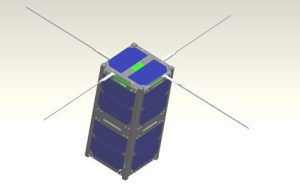
QB50The AMSAT-Francophone (AMSAT-F) payload for one of the satellites will be a U/V (435/145 MHz) FM transponder. It will also transmit FX25 telemetry at 9600 bps. This secondary payload will be also used in several satellites in the main constellation as their main receiver and transmitter.

The AMSAT-NL payload, on the other precursor satellite, will incorporate a linear U/V transponder core.

The QB50 spacecraft in the main, short duration, mission will, generally, have downlinks operating on frequencies in the 435-438 MHz Amateur Satellite Service allocation and some are expected to use 2.4 GHz. They will be notified to the ITU as a Belgian network after having been coordinated by the IARU Frequency Coordination Panel. Some of these will also, on occasions, act as FM voice relays during their missions.

Watch the video of the QB50 Presentation at the 2013 AMSAT-UK International Space Colloquium
http://www.batc.tv/streams/amsat1308
Direct video download http://www.batc.tv/vod/qb50.flv

More information about the QB50 project can be found at http://www.qb50.eu/

Webcast of International Space Colloquium this weekend
https://amsat-uk.org/2013/07/18/webcast-of-international-space-colloquium/