
Deployment of Amateur Radio CubeSats from ISS 2014-02-28-0730
The last two days in February saw satellite deployments from the JAXA H-IIA F23 mission and the ISS which between them released 12 satellites carrying amateur radio payloads along with a number of commercial and research satellites.
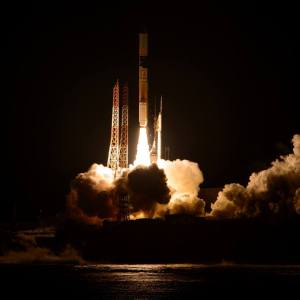
JAXA H-IIA F23 Launch February 27, 2014 at 1837 UT Credit NASA/Bill Ingalls
After a launch the North American Aerospace Defence Command (NORAD) issue the Keplerian Two Line Element Set which can be used to determine the position and velocity of the associated satellite. CelesTrak make this information available and the file for launches in the past 30 days is available here.
After a new launch this file will list the ID’s of the objects that NORAD have detected. These objects can be parts of the rocket body as well as the satellites. The challenge in the days after launch is to work out which object ID’s correspond to which satellites.
In 2012 Mike Rupprecht DK3WN developed a simple solution to this perennial problem by using an SDR-IQ receiver and a bit of software.
In the case of Masat-1 he chose a high elevation pass (89 deg) where the Doppler shift should be significant and recorded the complete pass with his SDR-IQ without Doppler correction. With some software he simulated the entire pass with different TLE’s.
He then chose the TLE that best matched the doppler shift of the audio signal.
Read Mike’s full article with pictures on his website at http://www.dk3wn.info/p/?p=26038
 Keplerian Two Line Elements (TLEs or ‘Keps’):
• New satellites launched in past 30 days http://celestrak.com/NORAD/elements/tle-new.txt
• CubeSats http://celestrak.com/NORAD/elements/cubesat.txt
• Experimental satellites http://celestrak.com/NORAD/elements/x-comm.txt
• Engineering satellites http://celestrak.com/NORAD/elements/engineering.txt
• Amateur radio satellites http://www.amsat.org/amsat/ftp/keps/current/nasa.all
NORAD Two-Line Element Set Format http://celestrak.com/NORAD/documentation/tle-fmt.asp
Free satellite tracking software https://amsat-uk.org/beginners/satellite-tracking/
Adding new satellites to SatPC32 and Gpredict https://amsat-uk.org/2013/11/23/adding-new-satellites-to-satpc32/
ISS CubeSats deployment https://amsat-uk.org/2014/02/20/iss-cubesat-deployments-to-resume-february-25/
JAXA H-IIA F23 launch https://amsat-uk.org/2014/02/23/launch-of-japanese-amateur-radio-satellites/

JAXA H-IIA F23 Launch Frequency Chart by Mike Rupprecht DK3WN


 AMSAT-UK
You must be logged in to post a comment.