BRICsat to carry 28 MHz PSK31 transponder

28 MHz PSK31 Receiver Board Flight Prototype - Brno University of Technology

28 MHz PSK31 Receiver Board Flight Prototype – Brno University of Technology

BRICsat is a 3U CubeSat built by students at the US Naval Academy.

It has two Amateur Satellite Missions:
• APRS constellation transponder with downlink on 437.975 MHz and with uplink on 145.825 MHz 1k2 and 9k6 AX25
• PSK31 transponder with a 28.120 MHz uplink (2.5 kHz bandwidth) and a UHF FM downlink

BRICsat is planned to launch with Psat-A and Psat-B.

Read the paper Communication and Data Handling System for BRICsat Satellite by Tomáš Urbanec, Petr Vágner, Miroslav Kasal and Ondřej Baran, of the Department of Radio Electronics Brno University of Technology http://www.aprs.org/PSK31/Brno-PSK31_2-PID2722925.pdf

IARU amateur satellite frequency coordination panel http://www.amsat.org.uk/iaru

DX-1 Microsatellite to launch from Baikonur

Dauria Aerospace microsatellite DX-1

Dauria Aerospace microsatellite DX-1

The microsatellite DX-1 (27 kg 40x40x30 cm) built by Dauria Aerospace, is planned to launch June 28, 2014 on the Soyuz-2.1b, Fregat-M rocket from Baikonur in Kazakhstan.

It is understood the satellite will be using the following frequencies:
• 144.975-145.025 MHz Uplink – Command and control
• 434.975-435.025 MHz Downlink – Telemetry data
• 162.0125-162.0375 MHz Uplink – AIS ship tracking receiver
• 2269.5-2270.5 MHz Downlink – Data

Dauria Aerospace http://dauriaspace.com/

Watch DX-1 on Russian TV

Balloon repeater to launch from Suffolk on Sunday

James Coxon M6JCX launching a PICO balloon on 434.301 MHz USB

James Coxon M6JCX launching a balloon carrying a transmitter payload

LAUNCH POSTPONED: Sadly due to technical issues I’m going to have to postpone this flight for a little longer – no point launching something that will definitely won’t work!

On Sunday, April 27, at around 11am (1000 GMT) radio amateur James Coxon M6JCX will launch the first UKHASnet balloon repeater from Suffolk. He writes:

Just a heads up that I’m going to try and launch tomorrow the first UKHASnet balloon repeater. The aim of the flight is to test both the concept of UKHASnet and if it works the range of the current setup. UKHASnet (http://www.ukhas.net/) is a simple wireless network that uses licence exempt radio modules.

There are a number of nodes around the UK and also in the Netherlands which normally just communicate on a local scale, the balloon payload will act as a airborne node which will hopefully connect these networks together temporarily.

The payload is based on a ATmega328 (arduino bootloader) with a Ublox 6 GPS and a RFM69HW Radio module. It’ll be tx and rx on 869.500 MHz using FSK, 2000 bps and using the UKHASnet protocol. Balloon will be a 100g latex filled for a very slow ascent to maximise flight time, launched from Suffolk. Launch will be around 11:00, however, there are forecasts of showers so this may change.

There is NO onboard 434 MHz module and no RTTY or other traditional format, we’ll be aiming to pipe the location data onto spacenear.us to allow easy following. That said it’ll be possible to hear the payload with good radios and SDRs that can tune to 869.500 MHz and we would be grateful if recordings of signal can be made as this could then be played back and decoded via the hardware (there is no software decoder – yet).

More information can be found on the website http://www.ukhas.net/ and there is a IRC channel on freenode #ukhasnet where you can follow the progress. A web client is available at http://webchat.freenode.net/?channels=ukhasnet

As with many of my flights this is highly experimental so probably won’t work so don’t get disappointed if it gets delayed, postponed or fails!

UKHASnet http://www.ukhas.net/

A UKHASnet Workshop was held in March http://www.southgatearc.org/news/2014/march/ukhasnet_a_uhf_mesh_network.htm

You can see online real time tracks and frequencies of balloons at http://spacenear.us/tracker/

To get up-to-date information on balloon flights subscribe to the UKHAS Mailing List by sending a blank email to this address: ukhas+subscribe@googlegroups.com

UK CubeSat Workshop: Student Research Pitches

FUNcube Dongle Pro+ Software Defined Radio

FUNcube Dongle Pro+ Software Defined Radio

AMSAT-UK have donated a FUNcube Dongle SDR to be awarded to the best student research pitch at the UK CubeSat workshop to be held in Harwell on May 13.

Please send your 5 minute research pitches along with the following details to send to Chris Bridges M6OBC email:  c.p.bridges@surrey.ac.uk There will be a prize for best presentations on the day! The prize includes a UK Space Agency goody-bag including a mug, t-shirt, badges, and more.  Plus a FUNcube Dongle, kindly donated from AMSAT-UK.

Please include the following to your submission:

• Presentation Title
• Author/ Supervisor
• Affiliation
• 5 Bullet Points on the Presentation Content (what, why, who cares?).

Presenters will be notified on 10th May 2014.

Source: http://www.cubesatforum.org.uk/wordpress/2014-uk-cubesat-workshop/student-research-pitches/

2014 UK CubeSat Workshop – Free Registration
http://www.cubesatforum.org.uk/wordpress/2014-uk-cubesat-workshop/

FUNcube Yahoo Group https://amsat-uk.org/funcube/yahoo-group/

FUNcube Dongle Pro+ SDR Yahoo Group https://amsat-uk.org/funcube/funcube-dongle-sdr/

GS3PYE/P Isle of Lewis from April 26

GS3PYE/P

GS3PYE/P

Camb-Hams will be operating on the amateur radio satellites, EME and HF using the call sign GS3PYE/P from the Isle of Lewis (IO68UL, EU-010) on April 26 to May 3, 2014.

The Camb-Hams have been activating the Scottish Isles each year since 2008 and will be travelling to the Isle of Lewis in the Scottish Outer Hebrides in 2014. Thirteen operators will be active on all bands and many modes from 4m to 80m, 2m & 70cm for Satellites and 2m & 23cm for EME from 26 April to 3 May 2014.

The HF bands will be covered by five simultaneous stations, while the 6m & 4m stations will have a great take-off towards the UK and Europe from the island’s northern tip in IO68 square. All stations will be able to run at the full UK power limit.

EME operations will use 150W to 55 elements on 23cm and 400W to 17 elements on 2m. Primarily on JT65 but also available for CW skeds – if your station is big enough.

Satellite operations on 2m & 70cm will use X-Quad antennas and a fully automatic Az/El tracking system. Activity is planned on AO-7 (mode B), VO-52, FO-29, SO-50 & AO-73.

GS3PYE MapContest operations will take place in the RSGB 70MHz UKAC on 29 April.

A number of the group are planning to make an extra trip to operate as GS6PYE/P from the Shiant Isles (EU-112). They are aiming for afternoon/early evening operations on 28 April, but may switch to 30 April if the weather is bad.

The group will be active on HF mobile and APRS as they travel, starting on 25 April. All the up-to-date plans and progress will be on the camb-hams site.

Most importantly, this is a group of good friends doing what they enjoy, so please give them a call and enjoy the trip with them. Active on the major social networks before, during and after the trip, you can check on progress and interact with the operators via their blog at http://dx.camb-hams.com/ or through Twitter, Facebook and YouTube [links below].

Please email skeds-2014@camb-hams.com to arrange skeds on the more challenging bands and modes. VHF and EME skeds will also be made via ON4KST, HB9Q (1296) and N0UK’s EME Chat (144). All links are available via the camb-hams site.

Web http://dx.camb-hams.com/
Twitter http://twitter.com/g3pye
Facebook http://facebook.com/CambHams
YouTube http://youtube.com/CambHams

7-Day Arctic Tour for B-46 Party Balloon

7-Day Arctic Tour for B-46 Balloon

7-Day Arctic Tour for B-46 Balloon

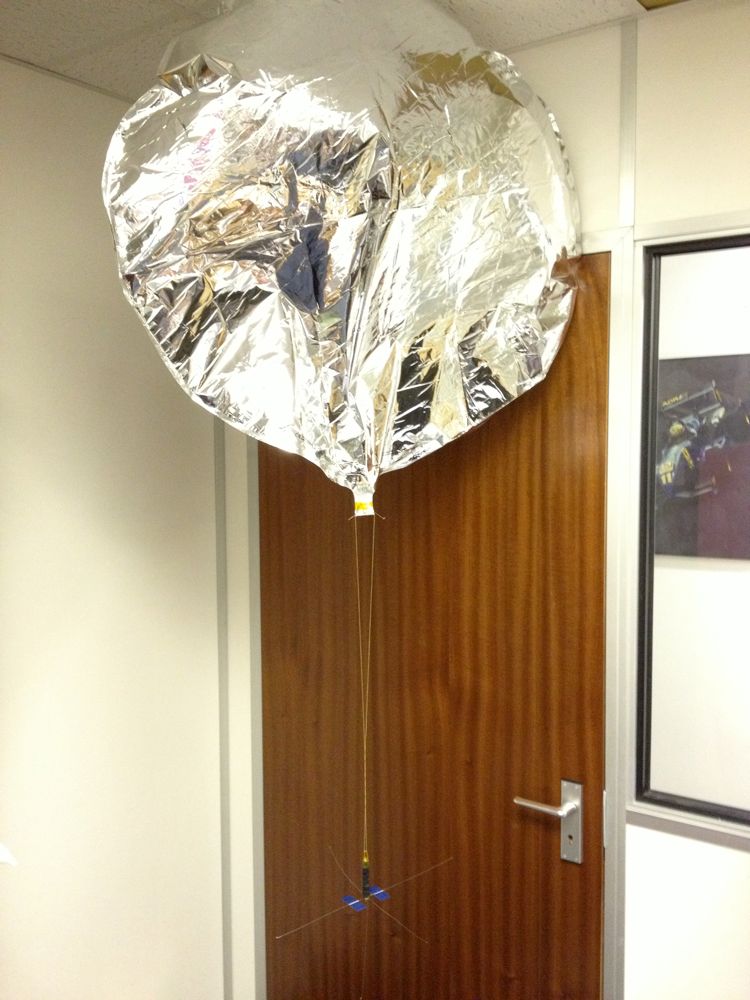
A long duration foil party balloon transmitting Contestia 8/250 telemetry data on 434.500 MHz USB was launched on Friday, April 18 from Silverstone in the UK by radio amateur Leo Bodnar M0XER. Its seven day journey has taken it to Iceland, Greenland across the Norwegian Sea and down into Finland.

According to the current projected course it may continue south into Russia and travel close to the Ukrainian border.

Depending on the altitude, the balloon could have a radio range of 300-500 km. See the current track of the balloon at http://spacenear.us/tracker/?filter=B-46

Typical 434 MHz solar powered payload - Image credit Leo Bodnar M0XER

Typical 434 MHz solar powered payload – Image credit Leo Bodnar M0XER

Balloon: 90cm Qualatex foil party balloon
Payload: 12 grams solar powered tracker

Telemetry: 434.500 MHz, USB, vertical polarisation, Contestia 8/250
Transmission contains two lines of telemetry every 4 minutes and lasts about 1 minute
Time between telemetry data is filled with beeps at 3 sec intervals.
Enable RxID (RSID) to automatically track the signal drift

Tracking link: http://spacenear.us/tracker/?filter=B-46
APRS backup: http://aprs.fi/#!call=a%2FM0XER-6

Leo Bodnar M0XER balloons
http://www.leobodnar.com/balloons/

You can see online real time tracks and frequencies of balloons at http://spacenear.us/tracker/

Typical pico balloon with tiny solar powered 434 MHz transmitter - Image credit Leo Bodnar M0XER

Typical pico balloon with tiny solar powered 434 MHz transmitter – Image credit Leo Bodnar M0XER

Download the dl-fldigi software from
http://ukhas.org.uk/projects:dl-fldigi

Listen to balloons online (when in range of south-east UK) from anywhere in the world with the SUWS 434 MHz WebSDR (select USB) https://amsat-uk.org/2013/12/28/websdr-for-434-and-1296-mhz/

Beginners Guide to Tracking using dl-fldigi http://ukhas.org.uk/guides:tracking_guide

Check the #highaltitude IRC channel for chat about launches. A web client is available at
http://webchat.freenode.net/?channels=highaltitude

To get up-to-date information on balloon flights subscribe to the UKHAS Mailing List by sending a blank email to this address: ukhas+subscribe@googlegroups.com