Radio hams help attempts to command NASA spacecraft

ISEE-3 - ICE Spacecraft - Image credit NASA

ISEE-3 – ICE Spacecraft – Image credit NASA

An IEEE article describes how volunteers, including many radio amateurs, are attempting command a 35-year-old NASA spacecraft, the International Sun-Earth Explorer 3 (ISEE-3).

Rachel Courtland interviews Dennis Wingo KD4ETA about the project and mentions the Bochum facility where AMSAT-DL members will be using their 20 metre dish antenna to help establish communications.

Software-defined radio peripherals built by Ettus Research (founded by Matt Ettus N2MJI) have been purchased, which can be used to implement modulator and demodulator programs that would once have had to be built in hardware.

Read the IEEE article at
http://spectrum.ieee.org/tech-talk/aerospace/satellites/space-hackers-prepare-to-reboot-35-year-old-spacecraft

The Watts Up With That website has a more detailed article on the project. The section about the AMSAT-DL Bochum facility mentions two of the team, Achim Vollhardt DH2VA and Mario Lorenz DL5MLO. The problems caused by ITAR are noted.

Read the Watts Up With That article ISEE-3 Reboot Project: Aiming for First Contact at
http://wattsupwiththat.com/2014/05/15/update-isee-3-reboot-project-aiming-for-first-contact/

Watch ISEE-3 Reboot Project – Recovering a 30 year old space probe

ISEE-3 / ICE Telecommunications Summary
http://mdkenny.customer.netspace.net.au/ISEE-3.pdf

Dennis Wingo KD4ETA blog http://denniswingo.wordpress.com/

Can radio amateurs command the ISEE-3 / ICE spacecraft ?
https://amsat-uk.org/2014/03/19/can-radio-amateurs-command-the-isee-3-ice-spacecraft/

Radio amateurs receive NASA ISEE-3 / ICE Spacecraft
https://amsat-uk.org/2014/03/09/radio-amateurs-receive-nasa-isee-3ice-spacecraft/

ITAR restrictions on US radio amateurs to be eased
https://amsat-uk.org/2014/05/19/itar-restrictions-to-be-eased/

ISEE-3/ICE on Facebook https://www.facebook.com/ISEE3returns
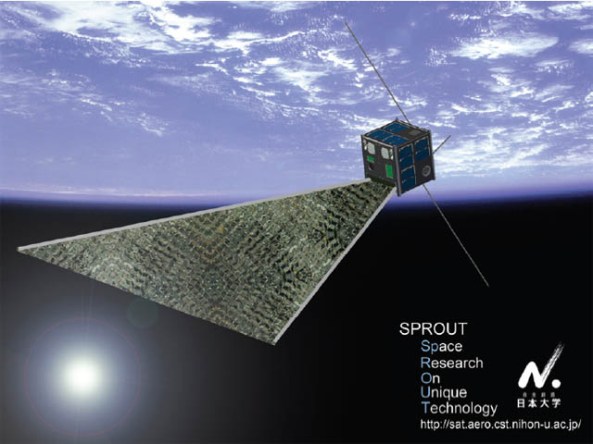
SPROUT Amateur Radio Slow Scan TV Satellite

SPROUT Amateur Radio SSTV Satellite

SPROUT, a 20 x 20 x 22 cm amateur radio nano-satellite with a mass of 7.1 kg, launched successfully with the L-band (1236.5 MHz/1257.5 MHz/1278.5 MHz) Synthetic Aperture Radar (SAR) satellite ALOS-2 on May 24, 2014 at 0305 UT. SPROUT is now in a 654 km, 97.9 degree inclination Sun Synchronous Orbit (SSO).

SPROUT Satellite - Credit Nihon-Univ. Miyazaki Laboratory

SPROUT Satellite – Credit Nihon-Univ. Miyazaki Laboratory

SPROUT (Space Research On Unique Technology) was built by students from Nihon University and its objectives are:

1. Operation of satellite by radio amateurs.

A FM Digitalker will enable the satellite to speak to amateurs around the world.

The Voice Message Box will record transmissions from radio amateurs and play them back.

Pre-loaded images from the Message Gallery can be transmitted using Slow Scan TV (SSTV).

Pictures of the Earth can be transmitted by SSTV and radio amateurs can receive it using free software such as MMSSTV. As part of the Earth mapping project the team ask radio amateurs to contribute pictures they have received from the satellite for display on the SPROUT website.

The satellite also has a packet radio Digipeater and Text Message Box function.

SPROUT in orbit2. Demonstration of the deployment of the combined membrane structure and verification of the design method of the structure SPROUT has a triangular membrane supported by two tubes like framework. They are folded and stored in the satellite before the launch. After the launch, the nitrogen gas is injected into the tubes in space, and they extend, so that the membrane deploys (called “combined membrane structure”).

3. Demonstration of attitude determination and control of a nanosatellite using the sun sensors, gyros, geomagnetic sensor and magnetic torquers.

It carries two UHF/VHF radio systems – one for Telemetry, Tracking & Control (TTC) using CW, 1200 bps AFSK and 9600 bps GMSK AX.25 packet and one for amateur operations using 1200 bps AFSK AX.25 packet.

SPROUT plans to launch from the Tanegashima Space Center into a 654 km Sun Synchronous Orbit (SSO) on May 24, 2014.

SPROUT 5 Days to Launch PictureCallsign: JQ1ZJQ
Size: 214x210x220 mm
Weight: 7.1 kg
Mode: 1200bps AFSK, 9600bps GMSK
CW downlink 437.525 MHz
FM packet downlink 437.525 MHz
Digi-peater uplink 437.600 MHz
Digi-talker downlink 437.600 MHz
SSTV downlink 437.600 MHz

SPROUT English website http://sat.aero.cst.nihon-u.ac.jp/sprout-e/

SPROUT Japanese website http://sat.aero.cst.nihon-u.ac.jp/sprout/

Nihon-Univ. Miyazaki Laboratory on Facebook
https://www.facebook.com/pages/Nihon-Univ-Miyazaki-Laboratory/406566642818860

Telemetry Software http://sat.aero.cst.nihon-u.ac.jp/sprout-e/2-Software-e.html

Telemetry format http://sat.aero.cst.nihon-u.ac.jp/sprout-e/2-Formats%20of%20telemetry-e.html

Keplerian elements (TLEs) from SPROUT launch data page
http://sat.aero.cst.nihon-u.ac.jp/sprout-e/2-Launch%20data-e.html

SPROUT
1 00000U 14001A 14144.15446759 .00000000 00000-0 00000-0 0 0013
2 00000 97.8740 241.6718 0035980 58.6810 194.6458 14.85960816 14

After launch TLE’s from the North American Aerospace Defence Command (NORAD) should also be available at http://celestrak.com/NORAD/elements/tle-new.txt

Adding new satellites to SatPC32, Gpredict and Nova
https://amsat-uk.org/2013/11/23/adding-new-satellites-to-satpc32/

Free Slow Scan TV (SSTV) software MMSSTV http://hamsoft.ca/pages/mmsstv.php

The JE9PEL website has information on other satellites on this launch
http://www.ne.jp/asahi/hamradio/je9pel/jaxalos2.htm

Read the Overview of the L-band SAR Onboard ALOS-2 here.

SPROUT satellite students at Nihon-Univ. Miyazaki Laboratory

SPROUT satellite students at Nihon-University Miyazaki Laboratory

Satellites at Amateur Radio Skills Workshop

Working the OSCAR Satellites - Graham Leggett G7JYD and Steve Hedgecock M0SHQ

Working the OSCAR Satellites – Graham Leggett G7JYD and Steve Hedgecock M0SHQ

Steve Hedgecock M0SHQ took along some rigs, antennas and software to the Chelmsford Amateur Radio Society (CARS) Skills Workshop held in Danbury, Essex on May 19.

He explained how to get started in listening to satellites, track them, and have contacts through them. Hopefully we’ll be seeing some new stations from Essex on the satellites in the near future.

Peter M0PXD and Christopher G0IPU running the construction and soldering workshop

Peter M0PXD and Christopher G0IPU running the construction and soldering workshop

The free Skills Workshops are held on the third Monday of each month and provide a great opportunity to chat, swap ideas, and get hands-on with something new. Find out more at http://www.hamskills.co.uk/

As well as the Skills Workshops the Chelmsford Amateur Radio Society run training courses for those wishing to get their amateur licence. To find out more speak to Clive G1EUC on
Tel: 01245-224577
Mob: 07860-418835
Email: training2014 at g0mwt.org.uk
Web: http://www.g0mwt.org.uk/training/

Follow CARS Training on Twitter @TrainWithCARS

What is Amateur Radio ? http://www.essexham.co.uk/what-is-amateur-radio

Watch a short overview of the Amateur Radio Skills Workshop, a new training initiative from the Chelmsford Amateur Radio Society (CARS)

How to work a FM satellite video https://amsat-uk.org/beginners/how-to-work-a-fm-satellite/

How to work a SSB satellite video https://amsat-uk.org/beginners/how-to-work-the-ssb-satellites/

RadCom article Getting started on satellites https://amsat-uk.org/beginners/radcom-getting-started-on-satellites/

New launch date for UKube-1

UKube-1 ready for launch

UKube-1 ready for launch

The CubeSat UKube-1 will be launched from Baikonur in Kazakhstan on a Russian Soyuz-2-1b Fregat-M rocket which has Meteor-M 2 as the primary payload. The new planned launch date for UKube-1 is July 8, 2014 with separation +9253 s Greenwich inertial (-1859.49, -3817.49, -5581.72) km (912.1, 6027.9, -4426.4) m.s-1 (TBC).

UKube-1 carries a set of AMSAT-UK FUNcube boards (FUNcube-2) providing a 435/145 MHz linear transponder and educational telemetry beacon.

Description of UKube-1 from Clyde Space:

UKube-1 is a 3U CubeSat has been designed and manufactured by Clyde Space at their high-tech facility on the West of Scotland Science Park in Glasgow. This CubeSat is one of the most advanced of its kind, the complexity of the spacecraft highlighted by the nature of the 6 independent, advanced payloads being flown by the mission. The UKube-1 mission is the pilot for a collaborative, national CubeSat programme bringing together UK industry and academia to fly educational packages, test new technologies and carry out new space research quickly and efficiently.

Payloads on UKube-1 include: the first GPS device aimed at measuring plasmaspheric space weather; a camera that will take images of the Earth, and test the effect of radiation on space hardware, using a new generation of imaging sensor; an experiment to demonstrate the feasibility of using cosmic radiation to improve the security of communications satellites and to flight test lower cost electronic systems; an advanced mission interface computer to enable serious number crunching on tiny spacecraft; a high rate S-Band transmitter and patch antenna; an outreach payload that allows school children to interact with the spacecraft.

UKube-1 communications subsystem:
• Telemetry downlink 145.840 MHz
• FUNcube subsystem beacon 145.915 MHz
• 400 mW inverting linear transponder for SSB and CW
– 435.080 -435.060 MHz Uplink
– 145.930 -145.950 MHz Downlink
• 2401.0 MHz S Band Downlink
• 437.425-437.525 MHz UKSEDS myPocketQub Downlink

The satellites on the Soyuz-2-1b Fregat-M launch are: Meteor-M 2, SkySat 2, TechDemoSat 1 (TDS 1), AISSat 2, Baumanets 2 [pulled from launch manifest], Relek, DX 1, Venta 1 [pulled from launch manifest], UKube 1.

Clyde Space http://www.clyde-space.com/

ITAR restrictions on US radio amateurs to be eased

ITARThe International Traffic in Arms Regulations (ITAR) inexplicably applies to amateur radio satellites. It threatens US radio hams with jail terms or six figure fines if they cooperate with amateurs outside the USA on satellite projects. Cooperation includes talking about or publishing on the web certain information regarding amateur radio satellite systems.

Satellite Today reports that after 15 years of restrictions and intense scrutiny, the United States Department of State is reclassifying satellites and several related components so they will no longer be treated as weapons. The changes affect Category 15 of the U.S. Munitions List (USML), which covers spacecraft and related articles, by shifting most commercial, civil and scientific satellites and accompanying equipment to the Department of Commerce’s Commerce Control List (CCL).

“The Department [of State] has committed to reviewing during the six months after the publication of this rule whether further amendments to the USML controls on civil and commercial remote sensing satellites are warranted, and seeks additional public comment on this matter,” according to a statement released by the Federal Register.

This rule is effective November 10, 2014, except for Sec. 121.1, Category XV(d), which is effective June 27, 2014. Interested parties may submit comments on paragraphs (a)(7) and (e)(11) of USML Category XV and ITAR Sec. 124.15 by June 27, 2014.

Read the Satellite Today article http://www.satellitetoday.com/regional/2014/05/16/new-us-satellite-export-reforms-gets-positive-response-from-industry/

Federal Register – Amendment to the International Traffic in Arms Regulations: Revision of U.S. Munitions List Category XV https://www.federalregister.gov/articles/2014/05/13/2014-10806/amendment-to-the-international-traffic-in-arms-regulations-revision-of-us-munitions-list-category-xv

Among the projects affected by ITAR has been the New Zealand Amateur Radio satellite KiwiSAT. A 2009 IARU Region 3 report highlights that ITAR requirements made AMSAT-NA direct its members to cease cooperation with AMSAT-ZL in the development of KiwiSAT. http://www.iaru-r3.org/14r3c/docs/046.doc

ITAR impact on the Eagle project https://web.archive.org/web/20140327205527/http://www.amsat.org/amsat-new/eagle/

The 2005 amateur radio P3E IHU project killed by ITAR http://www.amsat-dl.org/p3e/bericht-ihu3-0205-e.pdf

Export Control Reform initiative http://export.gov/%5C/ecr/index.asp

April 2012 ITAR – Section 1248 Report Released
https://amsat-uk.org/2012/04/22/itar-1248-report-released/

April 2012 ITAR and Amateur Radio – Progress Report
https://amsat-uk.org/2012/04/29/itar-and-amateur-radio-progress-report/

Read the Section 1248 Space Export Control Report
http://www.defense.gov/home/features/2011/0111_nsss/docs/1248_Report_Space_Export_Control.pdf

2011 ITAR submission by the Radio Amateur Satellite Corporation (AMSAT)
http://www.amsat.org/amsat-new/images/fck_images/AMSAT%20ITAR%20Comments%20Final.pdf

2009 AMSAT files CJ requests with US State Department
http://www.southgatearc.org/news/august2009/amsat_files_cj_requests.htm

ITAR in ARRL Executive Committee Minutes https://amsat-uk.org/2012/04/19/itar-in-arrl-executive-committee-minutes/

ITAR impact on satellite launches http://www.spacequest.com/Articles/SSC03-II-1%20SpaceQuest.pdf

In-Person Meeting for ARISS International

International Space Station - Image Credit NASA

International Space Station – Image Credit NASA

The ARRL report representatives of the Amateur Radio on the International Space Station (ARISS) International partners met in person last month for the first time in 2-1/2 years to reassess the program’s direction and to consider new objectives.

The European Space Agency (ESA) hosted the April 3-5 gathering at its European Space Research and Technology Centre (ESTEC) in The Netherlands. ARISS International Secretary-Treasurer Rosalie White, K1STO, represented the ARRL at the sessions. ARISS International Chair and AMSAT-NA Vice President for Human Spaceflight Programs Frank Bauer, KA3HDO, presided.

Former ESA astronaut Gerhard Thiele, DG1KIL, welcomed the representatives. Thiele, who heads ESA’s Human Spaceflight and Operations Strategic Planning and Outreach office, told the gathering that ESA recognizes the benefit to students of being able to communicate with the ISS crew directly via Amateur Radio, and that students learn a lot as a result of these ARISS contacts.

ARISS Amateur Radio on the International Space Station

ARISS Amateur Radio on the International Space Station

In a wide-ranging presentation, ARISS International Project Selection & Use Committee representative Lou McFadin, W5DID, addressed long-term equipment possibilities. Among other requirements, McFadin said, ARISS should have the ability to control its equipment from Earth, and he said that developing software-defined equipment would permit this. He also spoke of the need for an “override power switch,” as the astronauts need to shut down ARISS equipment during safety-critical events such as spacecraft dockings or spacewalks. Given the paucity of space aboard the ISS, ARISS also must minimize the amount of real estate its equipment occupies, McFadin said. He also noted that there is “little or no” ISS crew time to address ISS ham gear issues.

McFadin further discussed the advantages of installing a mobile VHF/UHF transceiver in the Columbus module that has higher power capabilities, similar to the Kenwood D-700 located in the Service Module. In recent months crew members have been using a 5 W Ericsson hand-held transceiver for school contacts, and signal levels have been lower than the team would prefer. McFadin suggested that a portable mobile system with a power output of 15 W or greater might improve this situation.

Read the full ARRL story at
http://www.arrl.org/news/ariss-international-partners-regroup-at-first-in-person-meeting-since-2011

ARISS ESTEC meeting minutes and committee reports http://www.ariss.org/meeting-minutes.html