ISEE-3 Presentation Video Now Available

ISEE-3 - ICE Spacecraft - Image credit NASA

ISEE-3 – ICE Spacecraft – Image credit NASA

Mario Lorenz DL5MLO and Achim Vollhardt DH2VA from AMSAT-DL Bochum gave a presentation on the ISEE-3 (ICE) spacecraft to the AMSAT-UK International Space Colloquium in Guildford, on July 26, 2014.

The video of the presentation which included a live demonstration of telemetry reception from the spacecraft can now be viewed on the web or downloaded to your PC. The presentation slides and a recording of ISEE-3 telemetry are also available.

The International Sun-Earth Explorer (ISEE-3) is a NASA spacecraft that was launched in 1978 to study Earth’s magnetosphere. It was repurposed and renamed the International Cometary Explorer (ICE) in 1983 to study two comets and has been in a heliocentric orbit since then, traveling just slightly faster than Earth. It’s finally catching up with Earth from behind with the closest approach expected in August, 2014.

Since NASA no longer has the capability to receive and command the spacecraft a group of amateurs, with NASA’s permission, decided to do it for themselves.

Bochum Amateur Radio Facility

Amateur Radio Facility at Bochum

On March 1-2, 2014 radio amateurs at the Bochum Amateur Radio Facility in Germany were able to detect the beacon signal from the spacecraft over a distance of 43 million km. After some changes to the ground equipment and aligning the receive antenna to the predicted position in the sky, the 2 GHz beacon signal could positively be identified due to its frequency, the position in the sky and the frequency shift due to the radial velocity (Doppler shift).

The 20m dish at Bochum was used to receive the signals. In 2003, AMSAT-DL converted this former industrial monument into a fully functional groundstation for deep space probes. Since 2009 the facility is being used by volunteers almost full time as ground receive station for data from the STEREO mission with its two spaceprobes monitoring the sun from different viewing angles.

In June Dennis Wingo KD4ETA and other volunteers succeeded in commanding the spacecraft using the Arecibo dish in Puerto Rico.

Links to the ISEE-3 presentation video, slides and a recording of the ISEE-3 telemetry signal are at
https://amsat-uk.org/colloquium/colloquium-2014/presentation-videos/

Watch 2014 ISEE-3 Reboot Trajectory by Mike Loucks


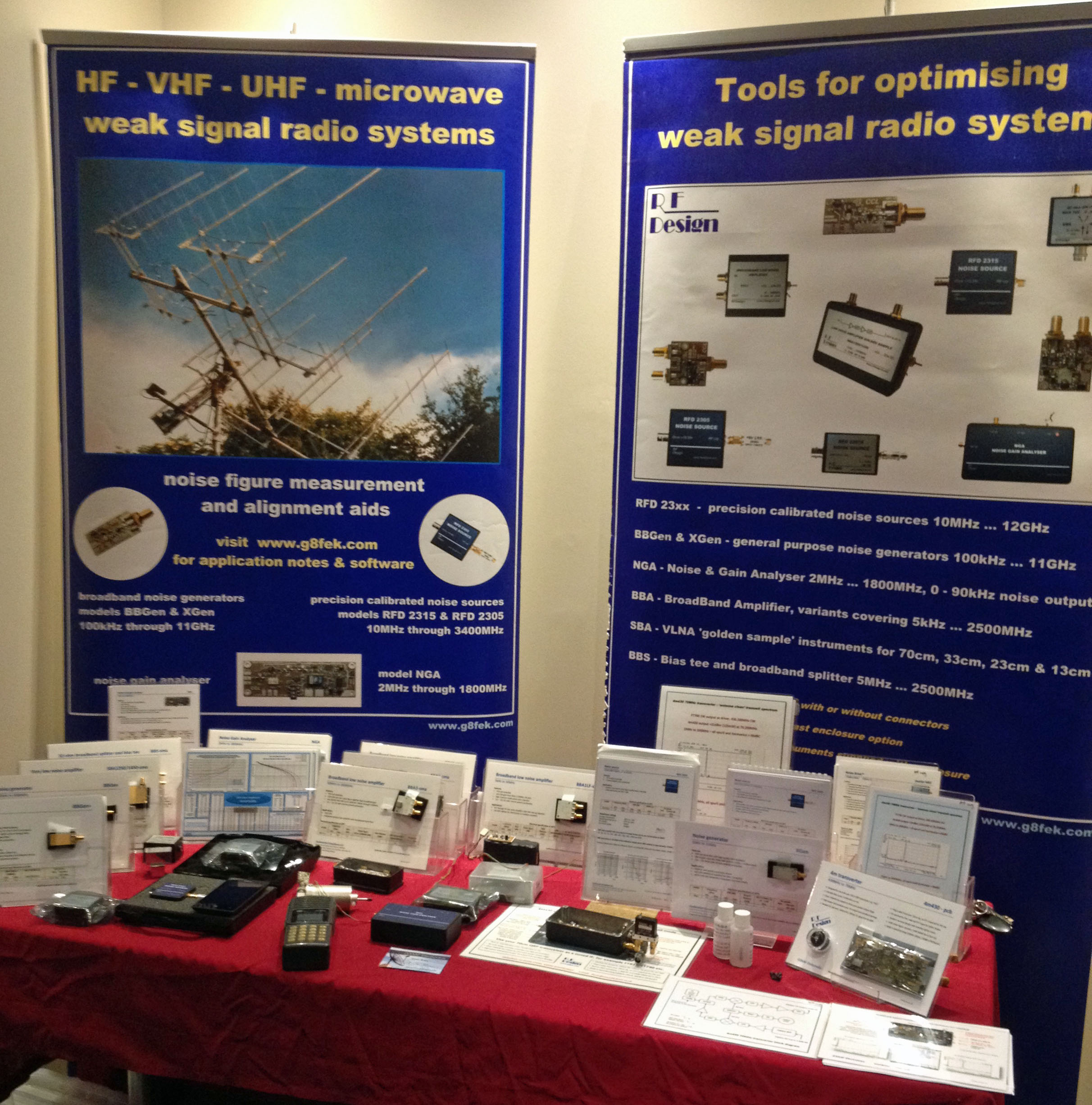
RF Design Stand at AMSAT-UK Colloquium

A delegate from the University of Surrey at the AMSAT-UK International Space Colloquium, Guildford

A delegate from the University of Surrey at the AMSAT-UK International Space Colloquium, Guildford

The RF Design stand of Kevin Avery G3AAF is a regular feature of the annual AMSAT-UK International Space Colloquium in Guildford and we were glad to see him again this year.

RF Design StandAs usual the stand was packed full of precision calibrated noise sources, low noise ampifiers, noise gain analysers and other equipment for frequencies up to 11 GHz.

The company also specialises in
● High power RF generation, e.g. CO2 laser plasma power supplies
● Solid state RF power amplifiers to 10kW from LF through UHF
● Short range wireless devices, e.g. Social Alarms

RF Design Amateur Radio and Radio Astronomy products http://www.g8fek.com/

RF Design http://www.rfdesignuk.com/

Videos of the presentations given at the AMSAT-UK International Space Colloquium can be seen at
https://amsat-uk.org/colloquium/colloquium-2014/presentation-videos/

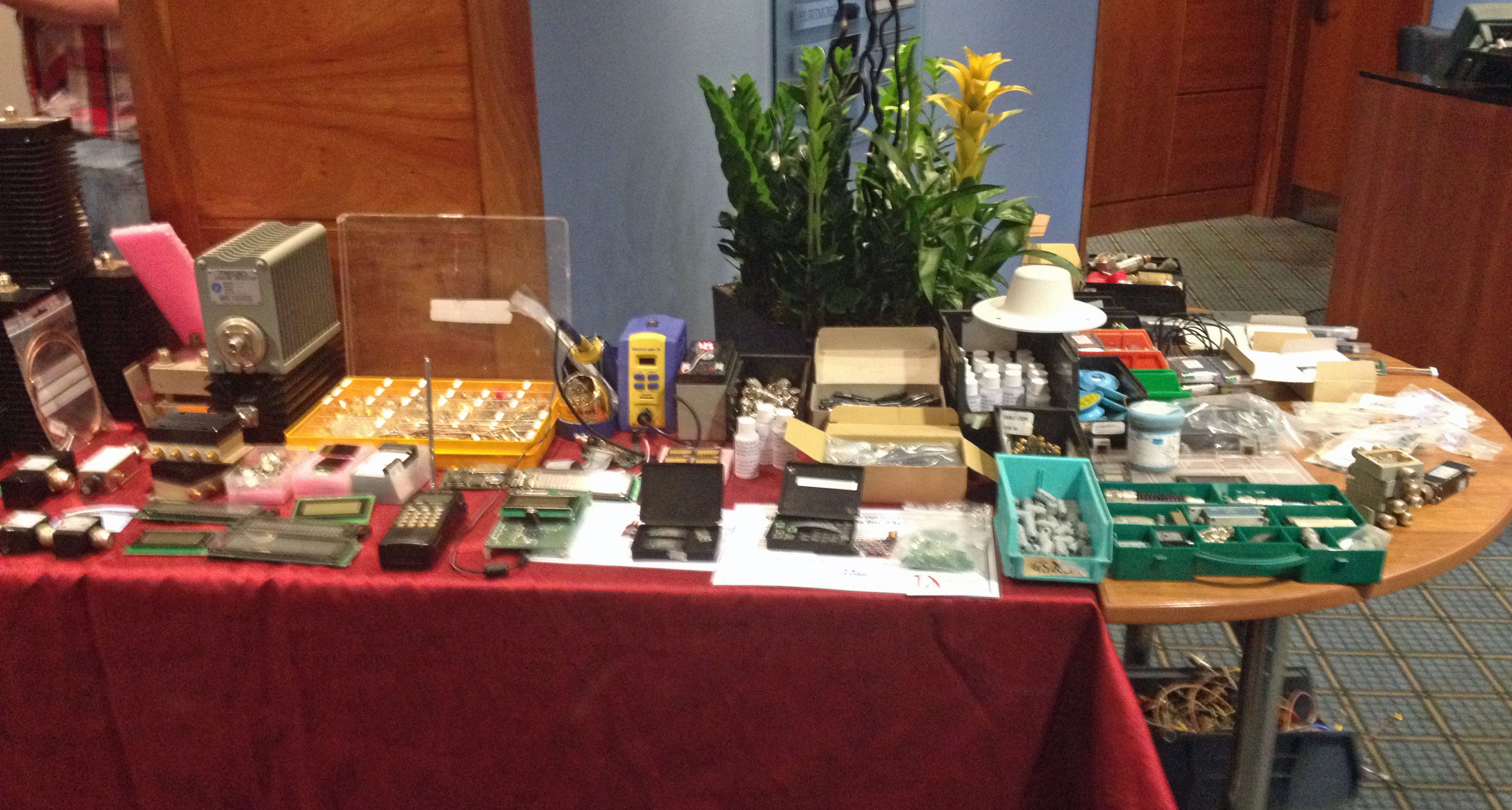
RF Design Table

G3YJO becomes Chair of Surrey Space Centre

Professor Sir Martin Sweeting G3YJO

Professor Sir Martin Sweeting G3YJO

Professor Sir Martin Sweeting G3YJO is to take up the position of Chair of Surrey Space centre (SSC), Professor Guglielmo Aglietti takes on the role of Director of the Centre.

“SSC has been steadily expanding its staff and activities and my new role as Chair will enable me better to help with the strategic research planning and external relations, as well as mentoring our staff and students – all of which is needed to take the Centre to even greater heights,” said Professor Sir Martin. “SSC grew from the original ‘UoSAT Unit’, a small research group I formed some 35 years ago as a PhD student. Its subsequent growth and international reputation established by the hard work of our excellent staff and students during these decades, alongside the remarkable success of Surrey Satellite Technology Ltd (SSTL), has been a source of great satisfaction to me and benefit to the University.”

“I am truly honoured to have been given the opportunity to lead the Surrey Space Centre, and I would like to thank Professor Sir Martin Sweeting and Professor Jonathan Seville for their trust in my capabilities, and all the colleagues in the Centre for their support,” added Professor Aglietti. “I believe that SSC staff is our greatest asset and I am very fortunate to work with such talented colleagues, who made the success of SSC, creating the largest and best known UK academic institution working in space engineering.  I believe that our partnership with SSTL and Airbus is best positioned to bridge the gap between academic research and industrial applications.  I am excited about working with my colleagues in my new position to ensure SSC’s continuous success.”

Professor Jonathan Seville, Dean of Surrey’s Faculty of Engineering and Physical Sciences, concluded, “I would like to take this opportunity to thank Martin for his many years of dedicated service as Director. SSC has shown substantial growth over the years with many notable successes under his leadership. Space continues to be a ‘flagship’ activity for the University. I look forward to working with Guglielmo in his new role and hearing of the continuing achievements of the Centre.”

Surrey Space Centre http://www.surrey.ac.uk/ssc/

UOSAT-1 https://amsat-uk.org/2011/10/12/30th-anniversary-of-uosat-1-oscar-9/

UOSAT-2 https://amsat-uk.org/2014/03/05/oscar-11-uosat-2-celebrates-30-years-in-orbit/