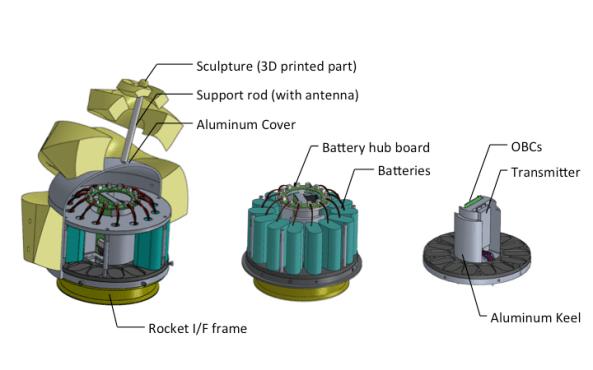
ARTSAT2:DESPATCH Internal Structure
Tama Art University Ground Station has decided to conclude attempts to receive the ARTSAT2:DESPATCH spacecraft, amateur radio callsign JQ1ZNN.
One month has past since Deep Space Sculpture “ARTSAT2:DESPATCH(FO-81)” was put into an Earth-escape orbit as a piggyback payload of H-IIA F26 launched at December 3, 2014 from Tanegashima Space Center, JAXA. It is estimated to have stopped sending radio waves since the battery of DESPATCH already ran out (We predicted that the battery will work for 27 days according to the running time of the transmitter).
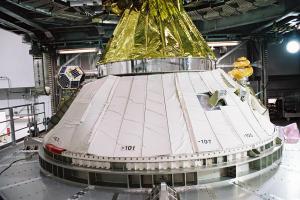
Shin’en2 on left – ARTSAT2:DESPATCH on right
Today January 3, 2015, the main control station, Tama Art University Ground Station, decided to conclude the operation of DESPATCH. Many people supported and cooperated us throughout the design and development of DESPATCH. In addition, many excellent many ham radio operator received and reported super weak radio waves of DESPATCH from deep space. To have this opportunity, I would like once again to thank all of them very much.
Reception reports of DESPATCH are summarized on the following page.
https://docs.google.com/spreadsheets/d/1WP-FzXHe8axAzNy44SGbKpJqIRKWHAcIP9vXnaHMb6g/edit#gid=0
Finally, we had two reception reports at 4.7 million kilo-meters from the Earth (more than 12 times of the distance to the Moon). They were far beyond what we expected. They are the the longest communication distance in the world between two amateur radio stations.
Orbital elements of DESPATCH is as follows (J2000 heliocentric ecliptic coordinates).
– Semi-major axis a : 1.003881127 [AU]
– Eccentricity e : 0.08741828512
– Inclination i : 6.796995362 [deg]
– Argument of perihelion w : 96.90057903 [deg]
– Longitude of the ascending node W : 250.5520871 [deg]
– Mean anomaly at epoch M : 101.6280436 [deg]
– Epoch : 2457023.50000 [JD]
(Time of perihelion : 2456919.7870655278675 [JD])
cf. Orbital elements of EARTH : http://nssdc.gsfc.nasa.gov/planetary/factsheet/earthfact.html
Celestial sphere position and orbital trajectory of DESPATCH can be checked anytime on the following web pages.
– Celestial Sphere http://artsat.jp/project/despatch/celestial
– Orbital Position http://artsat.jp/project/despatch/orbit
Transmission of the radio wave from DESPATCH has ended. However, the life of DESPATCH as a sculpture around the sun is almost eternal. We calculated the orbit (the distance from the Earth) of DESPATCH for 500 years from now.
http://artsat.jp/wp-content/uploads/2015/01/500years.png
http://artsat.jp/wp-content/uploads/2015/01/500years_large.png
DESPATCH will continue to orbit around the sun as an artificial asteroid. By examining the calculated results for the local minimum value of the distance between the Earth, DESPATCH will approaches to less than 1 million km from Earth after about 350 years. Possibly it will approach more closer to the Earth due to the interaction with unpredictable other celestial bodies.
We are glad if you think of DESPATCH as the most distant artwork in the world sometimes in the future.
ARTSAT project will continue to the future. We already started the conceptual design of next ARTSAT3. We kindly ask for your continuous support and cooperation for the project.
January 3, 2014
ARTSAT Project
Ham radio spacecraft launched into deep space
https://amsat-uk.org/2014/12/03/ham-radio-spacecraft-launched-into-deep-space/


 AMSAT-UK
You must be logged in to post a comment.