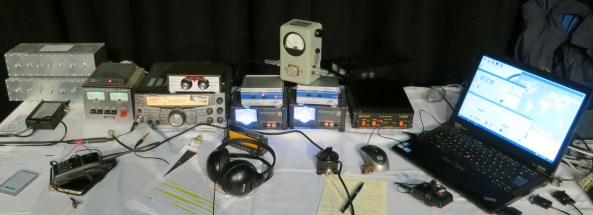
Amateur radio equipment used for ARISS Tim Peake GB1SS contacts – Credit Phil Crump M0DNY
On Saturday, March 5, 2016, at approximately 10:53 GMT, an ARISS contact is planned between astronaut Tim Peake GB1SS and Powys Secondary Schools GB4PCS, Mid Wales, United Kingdom.
The International Space Station (ISS) signal will be audible over the British Isles and Europe on 145.800 MHz FM and streamed live on the ARISS Principia website.

Tim Peake KG5BVI / GB1SS
School presentation:
Powys Combined Schools represent all secondary schools across the county of Powys in Wales. With students from over 90 primary schools and 12 secondary schools, we represent students from the age of 4 up to 18.
As Powys Combined Schools, we have a pool of some 7,700 students aged 11-18 and a similar number of 4-11 year olds in the primary schools.
Our goal is be to leverage our existing relationships with the primaries in each secondary catchment area to organise a county wide event over the months leading up to the ARISS contact. During which time workshops, projects and activities aimed around STEM subjects would be run.
Powys covers the historic counties of Montgomeryshire and Radnorshire, most of Brecknockshire (Breconshire), and a small part of Denbighshire — an area of 5,179 km² or 2,000 sq miles, making it the largest county in Wales by land area. Most of Powys is mountainous, with north-south transport being difficult.
The majority of the Powys population lives in villages and small towns. The largest towns are Newtown, Ystradgynlais, Brecon, and Welshpool. Powys has the lowest population density of all the principal areas of Wales.
Just under a third of the residents have Welsh linguistic skills: Welsh speakers are concentrated mainly in the rural areas both in and around Machynlleth, Llanfyllin and Llanrhaeadr-ym-Mochnant (where William Morgan first translated the whole Bible into Welsh in 1588) in Montgomeryshire (Welsh: Sir Drefaldwyn), and the industrial area of Ystradgynlais in the extreme south-west of Brecknockshire (Welsh: Sir Frycheiniog).

As part of his mission training Tim Peake KG5BVI / GB1SS learned how to use the ISS amateur radio equipment
Students will ask as many of the following questions as time allows.
1. Caitlin (aged 13): What training regime did you have to undertake in order to prepare for your mission to the space station?
2. Emily (aged 13): What is your favourite study that you carrying out to show what life is like in space?
3. Kelsey (aged 13): What objects in space can you see more clearly with your eyes in space?
4. Amelia (aged 13): Can you describe the automatic systems on board the ISS to keep you in your current orbit?
5. Callum (aged 11): What research are you currently working on?
6. Kit (aged 13): Do you ever feel sudden vertigo or claustrophobia whilst you are up in space?
7. Wyn (aged 14): Do you feel your senses are any different in space compared to being on the ground – for example is your sense of smell more acute?
8. Edward (aged 15): On the Principia website, it says you are looking into a range of research areas including ‘novel materials’. Can you describe a new material you are working on?
9. Amy (aged 14): Can you describe what is meant by ‘Fluid Physics’ and describe any experiments you are conducting using ‘Fluid Physics’?
10. Gwen (aged 18): On one of your video reports, we can see you watching the 6 Nations Rugby. How can you have a better picture in space compared to us here on earth?

Tim Peake GB1SS preparing for his space walk in January
11. Caitlin (aged 13): What inspires you to keep up the demanding physical exercise routines in space?
12. Emily (aged 13): How long does do you expect it to take you to acclimatise when you return to the earths surface?
13. Kelsey (aged 13): Of the objects you said that you can see with your eyes, what specific detail is better from space?
14. Amelia (aged 13): How do you assess your muscular strength in space?
15. Callum (aged 11): Can you describe how you get into and leave the ISS without losing any air?
16. Kit (aged 13): What is your favourite discovery you and the team have made during your time in space so far?
17. Wyn (aged 14): How long does it take to prepare for a spacewalk??
18. Edward (aged 15): Picking one ‘novel material’, can you describe how it would be used on earth?
19. Amy (aged 14): Of all the experiments you are carrying out on the human body, which one has given you the biggest surprise in terms of results?
ARISS offers an opportunity for students to experience the excitement of Amateur Radio by talking directly with crew members onboard the International Space Station. Teachers, parents and communities see, first hand, how Amateur Radio and crew members on ISS can energize youngsters’ interest in science, technology and learning.
73, Gaston Bertels, ON4WF
ARISS mentor
ARISS Principia site https://principia.ariss.org/
UK ARISS scheduled schools
https://amsat-uk.org/2016/02/03/all-uk-ariss-shortlisted-schools-are-now-scheduled/
What is Amateur Radio? http://www.essexham.co.uk/what-is-amateur-radio
Find an amateur radio training course near you https://thersgb.org/services/coursefinder/
A free booklet is available aimed at introducing newcomers to the hobby that can also be used as a handy reference while getting started, see
http://rsgb.org/main/get-started-in-amateur-radio/alex-discovers-amateur-radio-2/
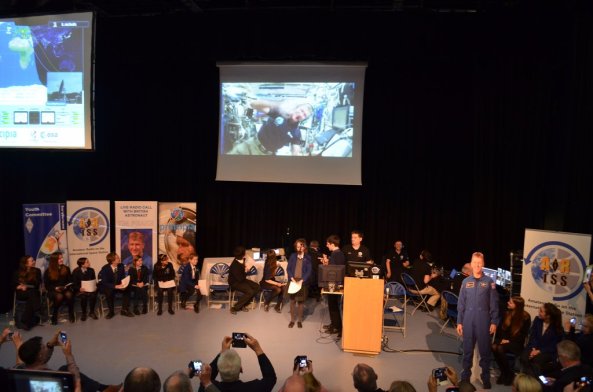
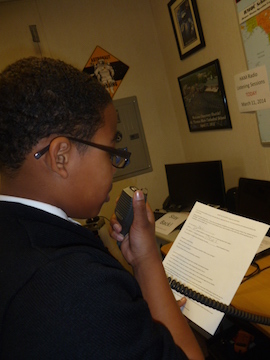
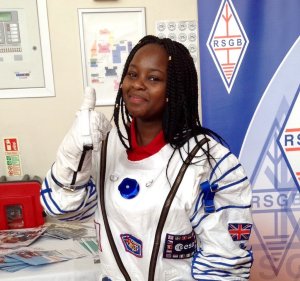 Radio amateur Tim Hare M6HTJ, a Year 10 pupil at CNS, led the space linkup. The pupils asked a range of questions from ‘what happens to the blood if you cut yourself in space’ to ‘what’s your favourite place to fly over’ to ‘what sort of experiments are you doing in space’? The 10 minute live link up was made possible by the Amateur Radio on the International Space Station (ARISS) team.
 AMSAT-UK
You must be logged in to post a comment.