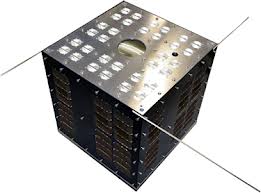
FUNcube-1’s Birthday

AO-73 (FUNcube-1) - Image credit Wouter Weggelaar PA3WEG

AO-73 (FUNcube-1) – Image credit Wouter Weggelaar PA3WEG

Hi Folks,

It seems amazing to us that FUNcube-1 – AO73, was launched nearly one year ago, in fact at 07:10 UTC on 21 Nov 2013. The very first signals were received by ZS1LS in South Africa at 07:37 UTC and he was even able to upload the resulting data to the Warehouse so the results could be seen immediately.

We are extremely happy to say that, since then, the satellite has been performing very satisfactorily, the battery voltage doesn’t drop below 8 volts, and becomes fully charged within about 7 – 10 minutes after re-entering sunlight from eclipse.

Howard Long G6LVB working AO-73 while Ciaran Morgan M0XTD captures the downlink passband data using a FUNcube Dongle Pro+ and Microsoft Surface Tablet

Howard Long G6LVB working AO-73 while Ciaran Morgan M0XTD captures the downlink passband data using a FUNcube Dongle Pro+ and Microsoft Surface Tablet

On Friday 21 Nov 2014, we will be celebrating the satellite’s first birthday. To mark the occasion, we will be activating the transponder earlier than normal – late on Thursday 20 Nov, so that it will be available for use during the whole of Friday. So please make as many contacts as possible through the transponder during Friday, FUNcube’s actual birthday. You are invited to make a note of any stations worked on this day, or any other comments on the FUNcube Forum. Please use the existing “FUNcube-1’s Birthday” topic, under the Welcome heading. The URL of the Forum is http://forum.funcube.org.uk/

Please also remember the ’73 on 73′ Award which is kindly being organised by Paul Stoetzer N8HM. See https://amsat-uk.org/funcube/73-on-73-award/ for more details.

Wouter Weggelaar PA3WEG talking about FUNcube-1 to students at Abbeys Primary School in Bletchley

Wouter Weggelaar PA3WEG talking about FUNcube-1 to students at Abbeys Primary School in Bletchley

We would like to take this opportunity of thanking all of our ‘users’, both those who download telemetry and forwarding it to the warehouse, and of course, all users of the transponder. This telemetry data is invaluable, both as an educational resource and to enable us to see how the spacecraft systems are performing and surviving. So far we have collected almost 400MB of unique data via stations from all around the world.

Of course we are hoping that the satellite continues to function nominally for several more years to come even though we may never reach AO7’s record!

73s AMSAT-UK and AMSAT-NL

First 73 on 73 Award issued to Wyatt Dirks AC0RA

First 73 on 73 Award issued to Wyatt Dirks AC0RA

The AMSAT-UK Flickr Group is at https://www.flickr.com/groups/amsatuk/
Please upload your pictures of amateur satellites, satellite ground stations, satellite demonstrations or any other satellite related event.

73 on 73 Award https://amsat-uk.org/funcube/73-on-73-award/

Data Warehouse – Telemetry Archive http://warehouse.funcube.org.uk/

Dashboard App – Telemetry Decoder http://funcube.org.uk/working-documents/funcube-telemetry-dashboard/

AMSAT-UK Introduce Electronic (PDF) Membership

AMSAT-UK_Bevelled_LogoAMSAT-UK is pleased to announce that we can now offer Electronic E-membership at a reduced rate.

Founded in 1975 AMSAT-UK is a voluntary organisation that supports the design and building of equipment for Amateur Radio Satellites.

AMSAT-UK initially produced a short bulletin called OSCAR News to give members advice on amateur satellite communications. Since those early days OSCAR News has grown in size and the print quality has improved beyond recognition. Today, OSCAR News is produced as a high-quality quarterly colour A4 magazine consisting of up to 40 pages of news, information and comment about amateur radio space communications.

The new E-membership will provide OSCAR News as a downloadable PDF file and members will have the freedom to read it on their Tablets or Smartphones anytime, anyplace, anywhere.

An additional advantage is that the PDF should be available for download up to 2 weeks before the paper copy is posted.

E-membership should be especially beneficial to Overseas members who have suffered from high postal charges and long delivery times.

The AMSAT-UK membership year runs from January 1 to December 31. Why not take the opportunity to renew your 2013 membership as an E-member.

Renew your AMSAT-UK membership as an E-member here http://shop.amsat.org.uk/shop/category_8/Existing-Members-Renewal.html

Join as a new E-member here http://shop.amsat.org.uk/shop/category_9/Join-Amsat-UK.html

E-members can download their copies of OSCAR News from http://www.amsatuk.me.uk/on

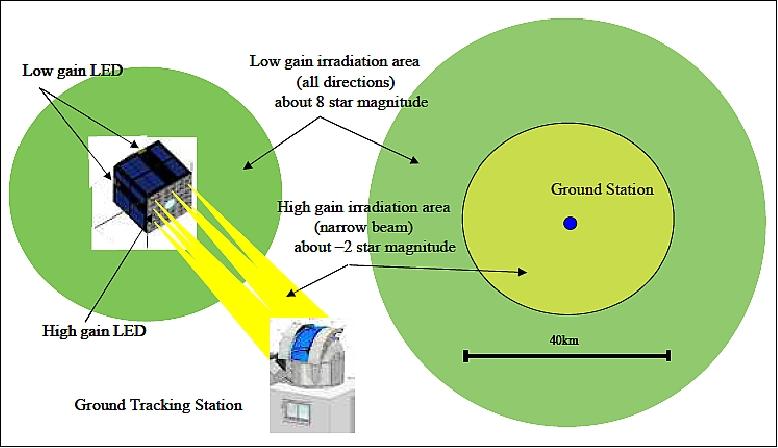
Article on LED Optical Morse Code Spacecraft ShindaiSat

Illustration of high-gain and low-gain LED illumination scenario at the ground station - Image credit Shinshu University

Illustration of high-gain and low-gain LED illumination scenario at the ground station – Image credit Shinshu University

An English language article about ShindaiSat is available at

https://directory.eoportal.org/web/eoportal/satellite-missions/s/shindaisat

ShindaiSatShindaiSat is a 20 kg spacecraft approx 300 by 300 by 350 mm which is planning to use bright LEDs for Space to Earth optical communication using Morse code. It also carries an optical lens system for receiving modulated LED light from the ground station.

There will be an AX.25 packet radio telemetry beacon and a low power CW beacon. Downlink frequencies of 437.305 and 437.485 MHz have been coordinated by the IARU Amateur Satellite Frequency Coordination Panel.

The article says “A launch of ShindaiSat as a secondary payload is manifested for mid-2014 on the primary GPM (Global Precipitation Measurement) mission of NASA and JAXA. JAXA is providing the launch on the H2A vehicle from the Tanegashima Space Center, Japan.

Orbit: Non-sun-synchronous circular orbit, altitude = 407 km, inclination = 65º.”

ShindaiSat website in Google English

JAMSAT 2013 Symposium in Tokyo

tokyo

JAMSAT announces their 2013 Symposium to be held in Tokyo on March 9  to March 10. The Symposium will be held at the National Museum of  Emerging Science and Innovation (Miraikan) – 7F Conference Room CR2. All amateur radio satellite operators are welcome to attend.

The Symposium schdule will be:

March 9 • 14:30 – 17:00 Papers and Technical Presentations • 17:30 – 19:30 Dinner Party

March 10 • 10:00 – 13:00 Papers and Technical Presentations

The list of technical topics includes: • Problem of 1.2GHz Band License • Interference with QZSS Satellite • FitSAT Report • JAMSAT Activities • Progress in Transponder and 38.4Kbps Transmitter • Noise Environment at 2.4GHz Band • Progress in Nippon University Cubesat “NEXUS” • Introduction to AMSAT-NA FOX-Project • SDR and Satellite Communication

Openings remain available for the addition of last minute presentations on topics pertaining to amateur radio in space. If you are interested in making a presentation please contact madoguchi@jamsat.or.jp or ja3gep@jamsat.or.jp

Information on the Museum meeting location can be accessed on-line: http://www.miraikan.jst.go.jp/en/

ANS, Mikio Mouri, JA3GEP of JAMSAT

Via http://www.southgatearc.org/index.htm

ARISS contact planned February 19, 2013 with school in Greece

The International Space Station

ARISS contact planned February 19, 2013 with school in Greece

An International Space Station school contact has been planned February 19 2013 with participants at 4th Dimotiko Scholeio Chaidariou, Chaidari (near Athens), Greece.             The event is scheduled to begin at approximately 14:06 UTC, which is 16:07 CEWT.

The contact will be a direct operated by J41ISS. Interested parties in Europe are invited to listen to dowlink signals on 145.800 MHz FM. The contact will be conducted in English.

The event will be webcast on several webstreaming servers: http://www.sv1eag.gr/ http://www.justin.tv/sv1eag#r=-rid-&s=em http://www.youtube.com/watch?v=6RFJbw5NeAc

School presentation:

Our school is located in Chaidari, a suburb in the north-west of Athens.             It was constructed in 1978, but it is now being renovated so as to be more energy efficient. It is a two-storey building with 16 classrooms, a Head office and a staff room. Continue reading

ShindaiSat to carry Optical LED Morse Code Beacon

ShindaiSatShindaiSat is a 20 kg spacecraft approx 300 by 300 by 350 mm which is planning to use bright LEDs for Space to Earth optical communication using Morse code.

There will be an AX.25 packet radio telemetry beacon and a low power CW beacon. Downlink frequencies of 437.305 and 437.485 MHz have been coordinated by the IARU Amateur Satellite Frequency Coordination Panel.

It is expected to launch into a 400km 65 degree orbit from Japan in 2013.

ShindaiSat website in Google English