Bath TOPCAT Project

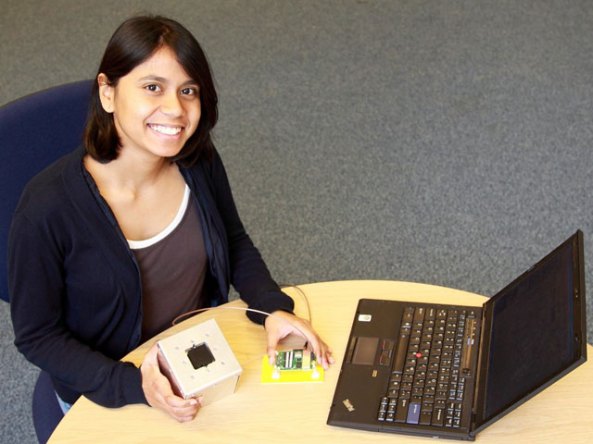
Talini holding a mockup of a cubesat (for testing antenna perfomance)

Talini holding a mockup of a cubesat (for testing antenna perfomance)

TOPCAT (TOPside ionosphere Computer Assisted Tomography) is a payload being developed at the University of Bath that will be launched on the UK’s first 3U CubeSat, UKube-1, next year.

Continue reading

ARISSat-1 BPSK Reception Challenge

ARISSat-1 was deployed from the ISS on August 3. It has a composite VHF downlink that will easily fit into the FUNcube Dongle (FCD) receive spectrum. The 145.920 MHz telemetry is 1000 bps BPSK and can, of course, also be received with a normal SSB 2 metre receiver.

The signal levels from ARISSat-1 should be similar to those we expect from the AMSAT-UK FUNcube-1 satellite (and also eventually  from UKube-1) and the AMSAT-UK team are keen to discover what will be the minimum and best type of antennas for schools to use with a FUNcube Dongle (FCD) Software Defined Radio (SDR). Therefore user experience with the ARISSat-1 signals will be very valuable in making this determination.

To encourage everyone to receive the 145.920 MHz BPSK ARISSat-1 telemetry signal AMSAT-UK are offering a FUN reward for listeners!

Continue reading

ARISSat-1 battery eclipse voltage decreasing

The ARISSat-1 Battery voltage is decreasing each eclipse period. It therefore is taking longer for the Battery to charge up to 32.5V to allow the switch from Low Power to High Power when the satellite enters an illumination period.

Kenneth Ransom, N5VHO has plotted the battery min/max for the last 8 days. We see that the battery voltage is decreasing at a faster rate than expected.  Kenneth’s graph can be found on the arissat1.org site under FAQ
http://www.arissat1.org/v3/index.php?option=com_content&view=section&layout=blog&id=13&Itemid=134

Take advantage of the High Power mode as much as possible over the next few days.

73 Gould, WA4SXM for the ARISSat-1/RadioSkaf-b team

ARISSat-1 Low Duty Cycle Mode

The new Amateur Radio satellite ARISSat-1 has been switching into low duty cycle mode even while in full sun which has suprised observers.

When the satellite is in darkness, in order to conserve battery power, it switches into a low duty cycle mode (also known as low power mode) where it transmits for 40 seconds and then shuts down for 2 minutes. On Thursday, August 11, a number of Radio Amateurs reported that ARISSat-1 was in  low duty cycle mode when the satellite appeared to be fully illuminated by the sun.

On the AMSAT bulletin board Tony AA2TX, ARISSat SDX software and hardware developer. provided an explanation:
Continue reading

FUNcube Dongle as a Radio Telescope?

A Radio Astronomy paper describes the use of the AMSAT-UK FUNcube Dongle Software Defined Radio as part of a Radio Telescope.

In the paper Dr David Morgan of the British Astronomical Association Radio Astronomy Group (BAA-RAG) describes how he used the FUNcube Dongle as the heart of a Radio Telescope operating on 1420 MHz.

He concludes that “A newly available SDR component has been shown to be very capable of acting as the heart of a simple and inexpensive three component radio telescope.”.

You can download the paper ‘Experiments with a Software Defined Radio Telescope’ by Dr David Morgan at
http://www.britastro.org/radio/projects/
An_SDR_Radio_Telescope.pdf

General Radio Astronomy Projects
http://www.britastro.org/radio/projects/otherproj.html

BAA-RAG Yahoo Group
http://groups.yahoo.com/group/baa-rag/

AMSAT-UK FUNcube Yahoo Group
http://groups.yahoo.com/group/FUNcube/


SSTV sent through ARISSat-1 transponder

SSTV sent through ARISSat-1 transponder

Henk PA3GUO has made the first successful transmission of a Slow Scan TV (SSTV) image through the ARISSat-1 linear transponder. His receiver was an AMSAT-UK FUNcube Dongle SDR

FUNcube Dongle pro

AMSAT-UK FUNcube Dongle Pro

Continue reading