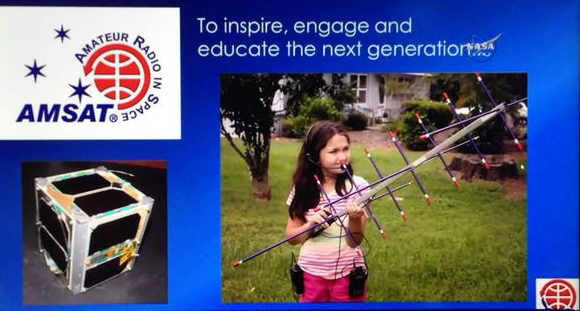
Fox-1A – To inspire, engage and educate the next generation
The amateur radio FM transponder CubeSat, AMSAT Fox-1A, was among 13 CubeSats flying as secondary payloads on the NROL-55 mission.
 The launch took place at 12:49:30 UT on Thursday, October 8 on a United Launch Alliance Atlas V rocket from Vandenberg Air Force Base in California.
Jan van Gills PE0SAT in the Netherlands reported receiving Fox-1A at 1724 UT and Masahiro Arai JN1GKZ received it at 1746 UT in Japan. Ken Eaton GW1FKY said “I am hearing Fox-1A here in Wales – UK on the pass 2029 hrs Zulu. The announcement – Fox One Speech Mode – is very loud and clear. Congratulations to all involved in the success of the launch activation and support for the project.”
Listen online to the signal from Fox-1A when it’s in range of London from anywhere in the world by using the SUWS WebSDR remote receiver. Select Frequency: 145980 kHz and Mode: FM. http://websdr.suws.org.uk
Fox-1A Real-time track and Orbital Predictions (click on Draw Footprint to show coverage area) http://www.n2yo.com/?s=40967
Fox-1A is a 1-Unit CubeSat carrying an FM repeater that will allow simple ground stations using an HT and an “Arrow” or “Elk” type antenna to make contacts using the satellite. Data Under Voice (DUV) is used to send 200 bps FSK telemetry data at the same time as FM audio. This is achieved by making use of sub-audible frequencies below 200 Hz. The FM voice transponder was activated during Friday, October 9.
Fox-1A frequencies, see Operating Guide to set up your rigs memory channels:
435.180 MHz FM Uplink 67 Hz CTCSS PL tone required
145.980 MHz FM Downlink
Note: If your rig has selectable FM filters use the wider filter for 5 kHz deviation 25 kHz channel spacing.
Download your free copy of the AMSAT Journal Fox-1A Launch special issue
FM transponder operating techniques http://www.dk3wn.info/p/?p=44412
On the AMSAT Bulletin Board Burns Fisher, W2BFJ provided this information prior to launch:
Initially the transponder will not be on and will not respond to uplinks. *Please do not attempt to uplink while we check out the satellite and commission it*. We will publicize when we have opened the transponder to general use. You should expect the checkout phase to last for a minimum of several days and possibly for several weeks.

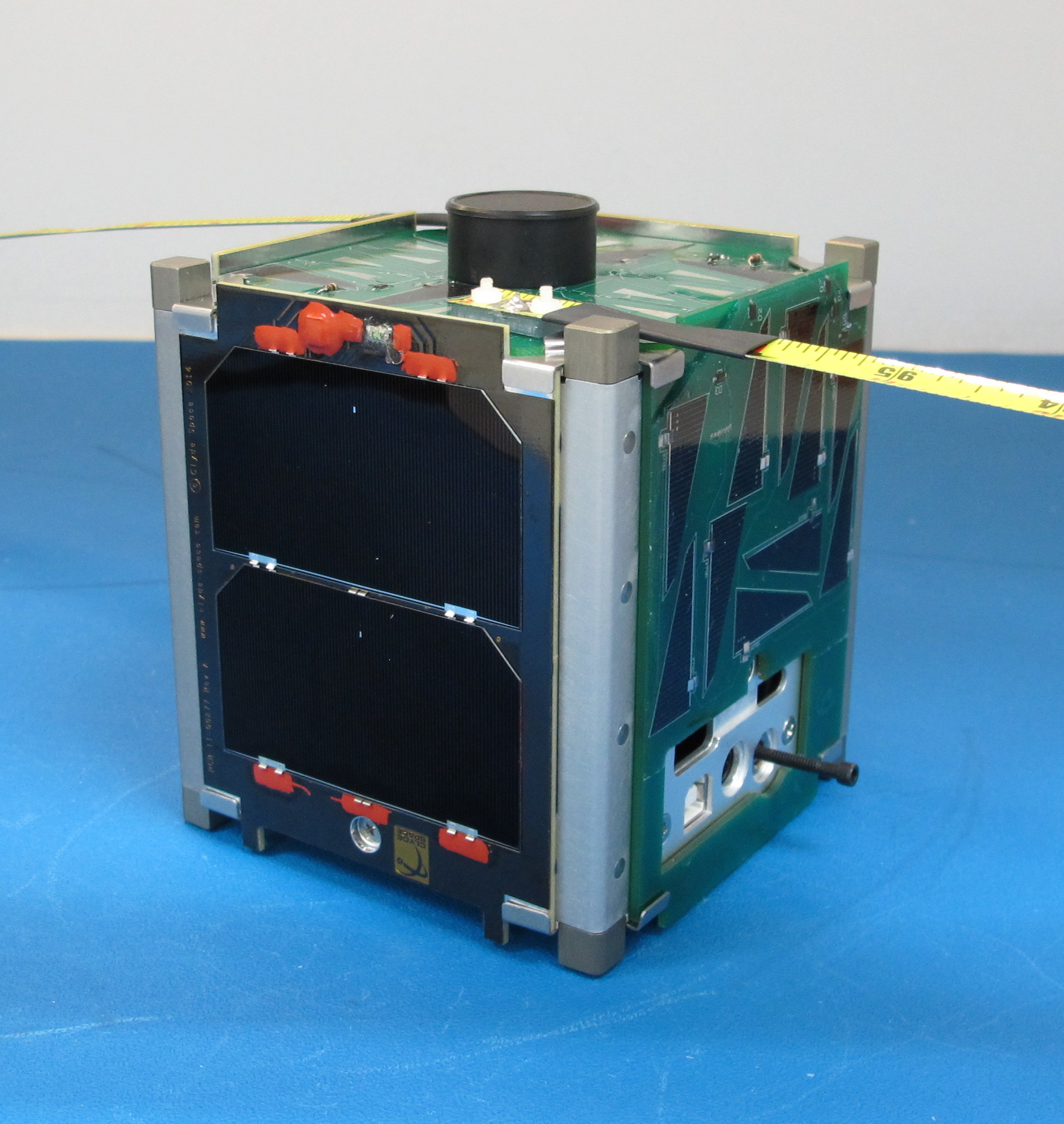
Fox-1A Flight Unit
During the initial checkout period and when the satellite is in range, every two minutes you will generally hear about 5 seconds of data followed by a few seconds of a voice ID (and possibly a second data packet). You may occasionally hear ‘data’ mode which Chris Thompson, G0KLA, has famously described as sounding like an old-fashioned telephone modem. If you should happen to hear what appear to be QSOs, please resist the temptation to join in before the commissioning period is over.
AMSAT-NA would love to have you collect and upload as much data as you can, and to give any other kind of report on the amsat-bb mailing list (which some of the Fox team will monitor) http://www.amsat.org/mailman/listinfo/amsat-bb
You can also report hearing or not hearing it on http://www.amsat.org/status/
You can upload data using the FoxTelem telemetry program that was recently released by Chris Thompson, G0KLA. (Check the “upload to server” box in the properties/preference page). More data will help us do the checkout faster! Remember if you hear the “telephone modem” sound, you must switch FoxTelem to high-speed mode manually. Similarly FoxTelem must be in low-speed mode at other times.
AMSAT-NA are planning a special award to the person who submits the first data from the satellite (by which we mean the earliest downlinked mission elapsed time), so get your rigs ready!
Information on the free Fox telemetry decoder software is at
https://amsat-uk.org/2015/09/23/fox-telemetry-decoder-software/
Note: Please make sure “upload to server” is enabled in decoder settings
Fox-1A Telemetry Leaderboard Statistics http://www.amsat.org/tlm/
Read the Fox Operating Guide at
http://www.amsat.org/wordpress/wp-content/uploads/2015/05/FoxOperatingGuide_May2015_Hi.pdf
BisonSat CubeSat
Among the other CubeSats on the same launch as Fox-1A were BisonSat and ARC1 which both carry amateur radio payloads.
BisonSat, the first satellite developed by Native American tribal college students. Using BisonSat’s 100-meter resolution camera the Salish Kootenai College students hope to acquire images of the Flathead Indian Reservation.
BisonSat (Nʷist Q́ʷiq́ʷay in the Salish language)
Beacon 437.375 MHz GMSK AX.25, 9600 bps, 60 sec interval
http://cubesat.skc.edu/
https://www.facebook.com/Bisonsat
https://www.youtube.com/watch?v=WeGvRhzRu2o
Colleges run by Native American tribes are graduating more students in STEM fields
http://scitation.aip.org/content/aip/magazine/physicstoday/news/10.1063/PT.4.2484
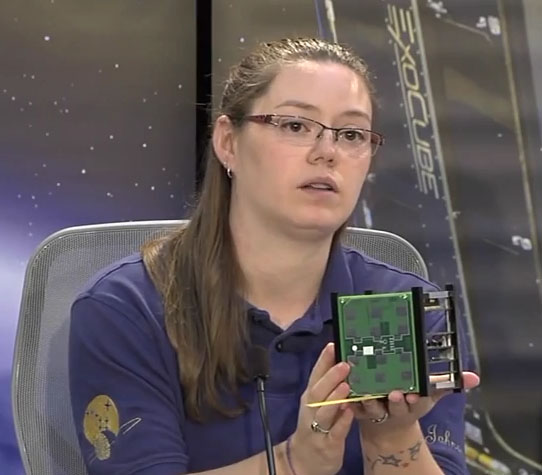
Morgan Johnson team lead for the ARC CubeSat
The Alaska Research CubeSat (ARC1) is a 1-Unit CubeSat designed and constructed entirely by engineering and science students from the University of Alaska Fairbanks (UAF).
ARC1 has four basic mission objectives:
• Provide authentic, interdisciplinary, hands-on student experiences in science and engineering through the design, development, and operation of a student small satellite mission
• Characterize the thermal and vibration environment inside the launch vehicle from ignition to orbit insertion
• Validate a novel low power Attitude Control and Determination System (ACDS)
• Validate a high bandwidth communication system by obtaining images of changing snow/ice coverage in arctic regions
ARC1 frequencies:
437.565 MHz CW beacon and 9600 bps FSK, AX.25, 10 sec interval. Initial message in ASCII switching later to satellite health telemetry
2440.5 MHz at 1 Mbps
https://ssep.community.uaf.edu/projects/alaska-research-cubesat-1/
Watch NASA TV at http://www.nasa.gov/nasatv
NROL-55 ELaNa XII CubeSat Launch – Status information
http://spaceflightnow.com/2015/10/07/av058-journal/
IRC channel to coordinate object identification
http://cubesat.calpoly.edu/index.php/collaborate/ground-operators
Payload information and the latest TLEs
http://cubesat.net/index.php/missions/upcoming-launches/155-nrol55-launch-alert
Fox-1A on NASA TV https://amsat-uk.org/2015/10/07/radio-amateurs-on-nasa-tv/


 AMSAT-UK
You must be logged in to post a comment.