Sarah Brightman Space Flight Training February 2015
Sarah Brightman announced Wednesday, May 13, 2015 that she is postponing her plans to launch aboard the upcoming Soyuz TMA-18M spaceflight mission expected for September.
Ms. Brightman said that for personal family reasons her intentions have had to change and she is postponing her cosmonaut training and flight plans at this time. She would like to express her extreme gratitude to Roscosmos, Energia, GCTC (Gagarin Cosmonaut Training Center), Star City, NASA and all the cosmonauts and astronauts, for their support during this exciting time in her life.
“Since 2012, Sarah has shared her story of a lifelong dream to fly to space. Her international fame as the world’s best-selling soprano has enabled her message to circle the globe, inspiring others to pursue their own dreams,” said Eric Anderson, Co-Founder and Chairman of Space Adventures, Ltd. “We’ve seen firsthand her dedication to every aspect of her spaceflight training and to date, has passed all of her training and medical tests. We applaud her determination and we’ll continue to support her as she pursues a future spaceflight opportunity.”
Danish Astronaut Andreas Mogensen KG5GCZ @Astro_Andreas tweeted
Sad to lose a fantastic crew mate. Best of luck, Sarah
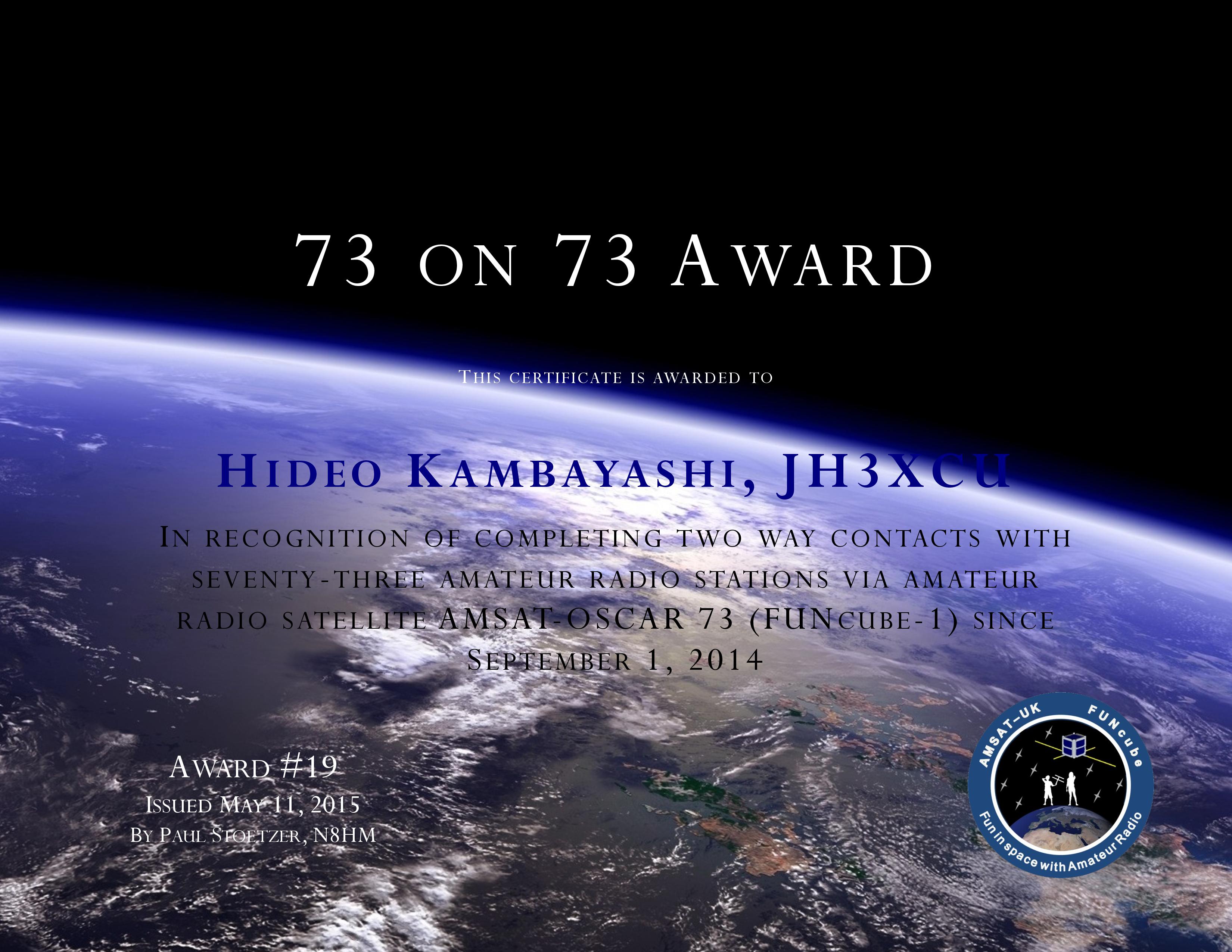
Congratulations to Hideo Kambayashi, JH3XCU, for working 73 different stations on AO-73 since September 1, 2014. Notably, he is the first to work all 73 different stations using CW.
AO-73 was launched on November 21, 2013 and is the first spacecraft to have a primary mission of educational outreach to schools and the smallest ever satellite to carry a linear (SSB/CW) transponder for radio amateurs.
On April 27, 2015 at 1901 GMT, Cuban radio amateur Hector Martinez W5CBF/CO6CBF achieved a 7537.8 km DX contact with UK amateur Peter Atkins G4DOL via FO-29.
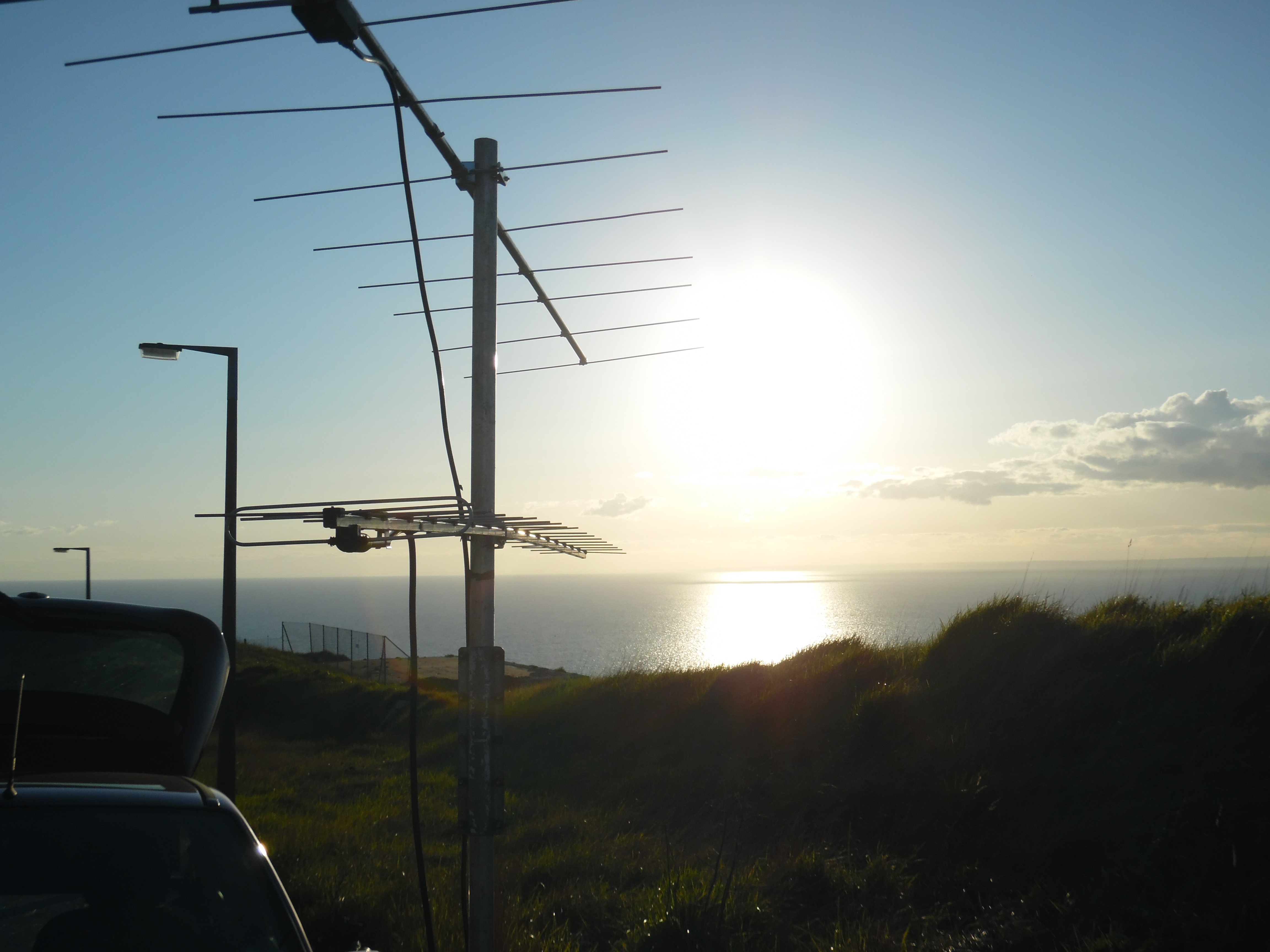
Antennas of Peter Atkins G4DOL near Weymouth
I am pleased to report that Peter G4DOL and I had another extreme QSO on FO-29. It is my furthest contact on the birds!
Back on October 2013, Peter and I had a very nice contact between EL92sd, Cienfuegos, Cuba and IO80so, Weymouth area, UK. It was a 7286 km contact and probably the first contact between UK and Cuba on FO-29!
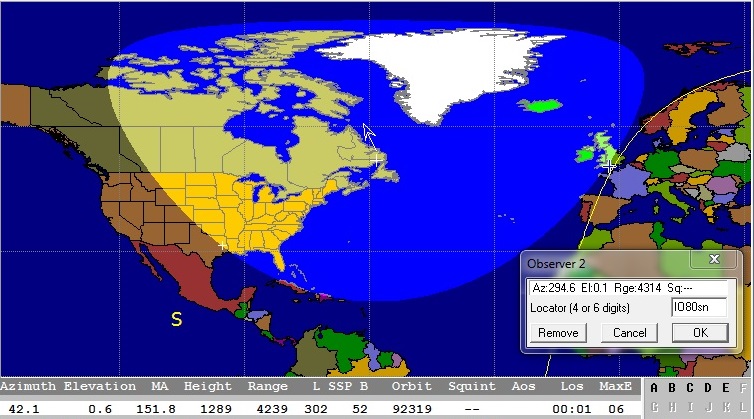
Peter and I desired to try again on FO-29, this time between EM21hs, Texas, US and his habitual spot in IO80so. We were able to complete a very nice CW contact on the 92319 orbit of FO-29. Peter had just 0.1 degree as maxim elevation while I had 0.8 during the 80 seconds mutual window.
As before, Peter did all the hard work by driving until his habitual spot at a cliff-top and setting up his “portable satellite station” (19 elements Yagi for 435 MHz and 10 elements Yagi for 145 MHz both with horizontal polarization). FO-29 was sounding really good on these orbits. It was a solid 559 satellite contact, we were very impressed.
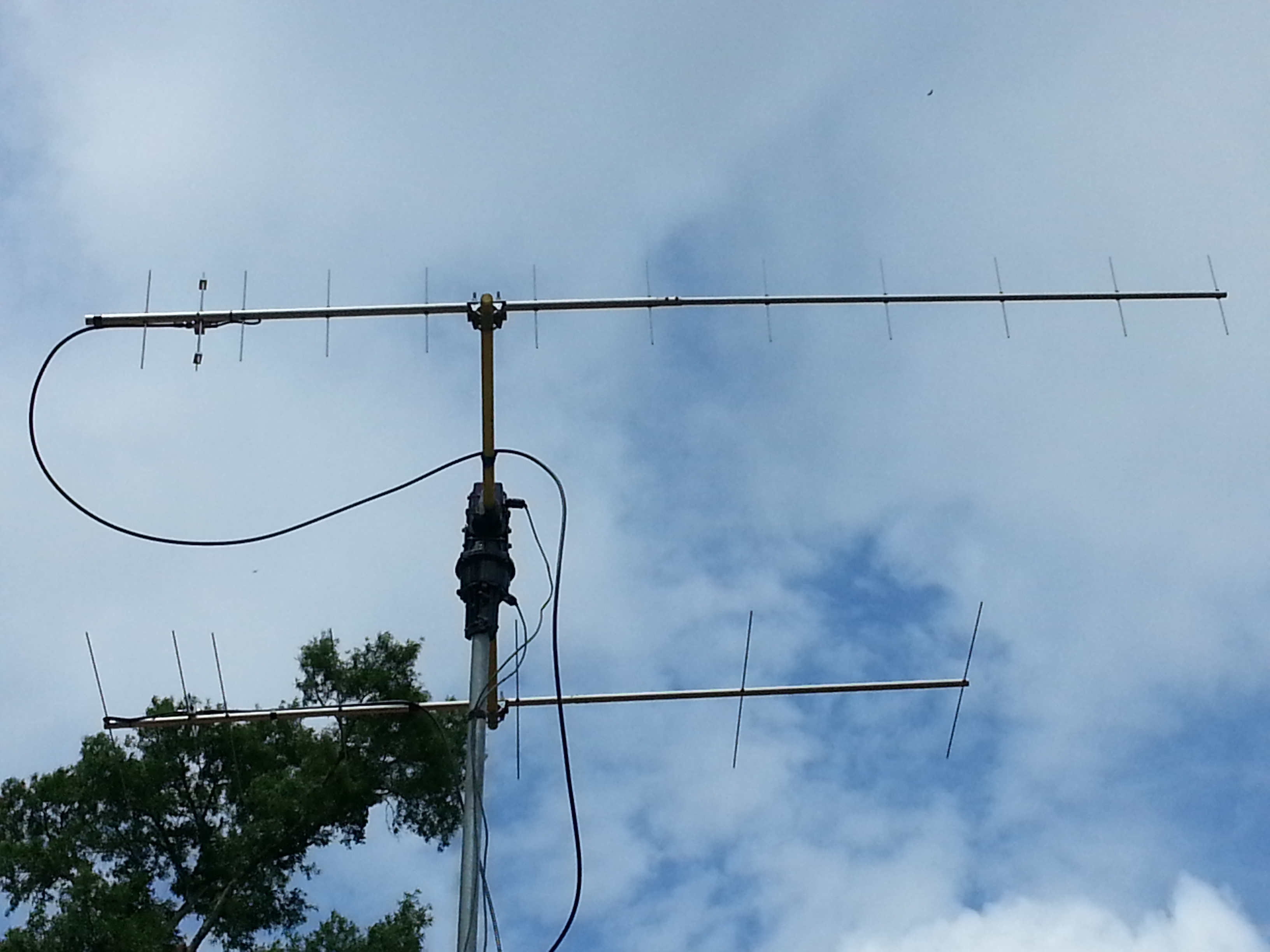
Antennas used by Hector Martinez W5CBF/CO6CBF in Texas
The distance between the stations was 7537.799 km (4683.77 mi). To my knowledge, the longest distance achieved on FO-29 until now had been 7,533.685 km between Frank, K4FEG and Erich, DK1TB http://www.qrz.com/db/k4feg
UPDATE 2015-05-08: K4KEG has now revised his distance to 7,538.685 km. This puts his contact with DK1TB just ahead of that of W5CBF and G4DOL.
It appears that an even longer distance is achievable. It has been reported that FO-29 has a “theoretical maximum range” of 7502 km, but I guess that at least 7600km is doable. We will try to break our own record!
This contact was possible thanks to the great feature implemented on SatPC32 V12.8b. There is an option of seeing the frequency you are at the satellite receiver at any time during a pass. It allows the operators to tune the right frequencies and attempt a contact without having to search for each other.
Thanks very much to Peter for his persistence, effort and all the fun!
73!
Hector, W5CBF/CO6CBF
Listen to a recording of the contact between W5CBF and G4DOL via FO-29
In 2012 St. Paul’s school student Sakshi Vagadia spoke to astronaut Sunita Williams KD5PLB as part of an ARISS school contact. Now, at 15, she has received her amateur radio licence VU3EXP.
Sakshi has just finished her 9th grade in St. Paul’s School, Rajkot and is the fourth member of her family to get an amateur licence. Her father is Rajesabhai Vagadia VU2EXP, her uncle Prakash Vagadia VU3PLJ and cousin Priyesa Vagadia VU3GLY.
Sunita Williams KD5PLB on the ISS
A year after speaking to Sunita Williams KD5PLB via the ARISS school contact Sakshi was able to meet her in person when Sunita visited the Government Science College (GSC) in Ahmedabad.
Sakshi did her training at the Gujarat Institute of Amateur Radio in Gandhinagar and took her amateur radio examination on February 25, 2013 received her pass result on April 2, 2013. It took the Government of India (WPC Wing) over two years to issue her amateur radio licence which she finally received on April 24, 2015.
It can be difficult to get an amateur radio licence in India. The archaic licensing system appears to have changed little since the 1940’s and is plagued with bureaucracy. After passing the exam it can take 12-24 months for Government officials to process the licence application. Among the information required on an Indian licence application are things such as height, eye colour, occupation and details of your Father, although not your Mother. There are even police checks on the suitability of an applicant. There are some parts of the country where Government simply refuses to issue any amateur radio licences.
Astronaut Samantha Cristoforetti IZ0UDF with ISS Ham Video Transmitter
Friday, May 1, 2015 the Ham Video transmitter on board the Columbus module of the International Space Station was powered on and started transmitting in “Blank Transmission” (BT) mode.
HamTV Antennas at ARISS Telebridge Station IK1SLD in Casale Monferrato, Italy
In this mode, the transmitter is operated without camera. The digital TV signal is fully formatted, but the content of the video is black and the content of the audio is at zero level. From a technical perspective, the BT signal is all that is needed for testing and fine tuning ground stations.
The European network of chained ground stations is presently nearly complete. Six ground stations span the continent in “X” formation. For each ascending pass over Europe, four stations provide about ten minutes of solid copy and the same is true for descending passes:
The chained ground stations are streaming the digital video to the BATC server (British Amateur Television Club). BATC set up a multiviewer page, accessible at:
The page shows all six streams from the chained ground stations. Each view can be maximized to full screen and the audio of each stream can be set to level or muted.
International Space Station – Image Credit NASA
Presently, active stations stream technical data provided by the software developed by Jean Pierre Courjaud F6DZP. Several data are most interesting to observe:
– the “constellations”, which visualize the QPSK (quaternary PSK) modulated signal
– the digital Signal/Noise ratio = MER (dB) (Modulation Error Ratio)
– the control LEDs that change from red to green on decoding the digital signal.
The Ham Video transmitter frequency is 2395 MHz and the symbol rate is 2.0 Ms/sec.
More information is available at:
The Ham Video transmitter will stay on as long as on board operations permit. When the ground stations will be operating reliably, the Ham Video transmitter will be used to enhance ARISS school contacts. Uplink will remain VHF audio only. This operational mode is dubbed ARISS Ham TV.
On Monday, May 4 at around 0830 UT it is intended to activate for one orbit the AMSAT-NL FUNcube-3 transponder on QB50p1 / EO-79.
TLEs are in the normal repositories, COSPAR 2014-033-R, Object# 40025. Real-time tracking at http://www.n2yo.com/satellite/?s=40025 (Click All Passes on Predictions)
We would like people to try the following frequencies if possible:
DOWNLINK: 145.960 MHz USB
UPLINK: Tune to match downlink +/- 435.065 MHz LSB
The transponder is linear inverting, nominally 30 kHz wide, and approximately 500 mW output.
If you find the transponder busy on those frequencies, feel free to move around and use the entire transponder passband.
AMSAT-UK FUNcube Mission Patch
The passband seems to have a “dip” in the middle which is bigger than expected, but we do welcome feedback about the usability. Also, please limit your uplink power, as it looks like this transponder is as sensitive as FUNcube-1. The spacecraft antenna is a monopole, so we would also be interested in signal fading reports.
The commissioning of the transponder done to date is very limited, three activations for 5, 10 and 8 minutes respectively. So your reports are greatly appreciated.
We do understand this is a very short notice, but hope that some of you will be able to participate. This was a take-it-or-leave-it opportunity offered by the ISIS engineers for our consideration, and we are again very grateful to ISIS and VKI for giving us this opportunity.
Please report contacts and signal reports to pa3weg@amsat.org
Wouter PA3WEG
FUNcube Team
QB50p1 EO-79 FUNcube-3 Transponder – Credit Mike Rupprecht DK3WN
You must be logged in to post a comment.