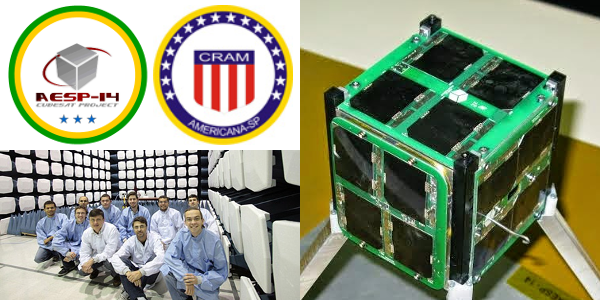
Video of AESP-14 CubeSat deployment from ISS

AESP-14 CubeSat

AESP-14 CubeSat

The Japanese Space Agency, JAXA, have released a video showing the deployment of the Brazilian amateur radio satellite AESP-14 from the International Space Station (ISS).

The AESP-14 is a 1U CubeSat developed by undergraduate and graduate engineering students at the Technology Institute of Aeronautics (ITA) in Brazil. The satellite’s primary mission is to test the various subsystems in the space environment.
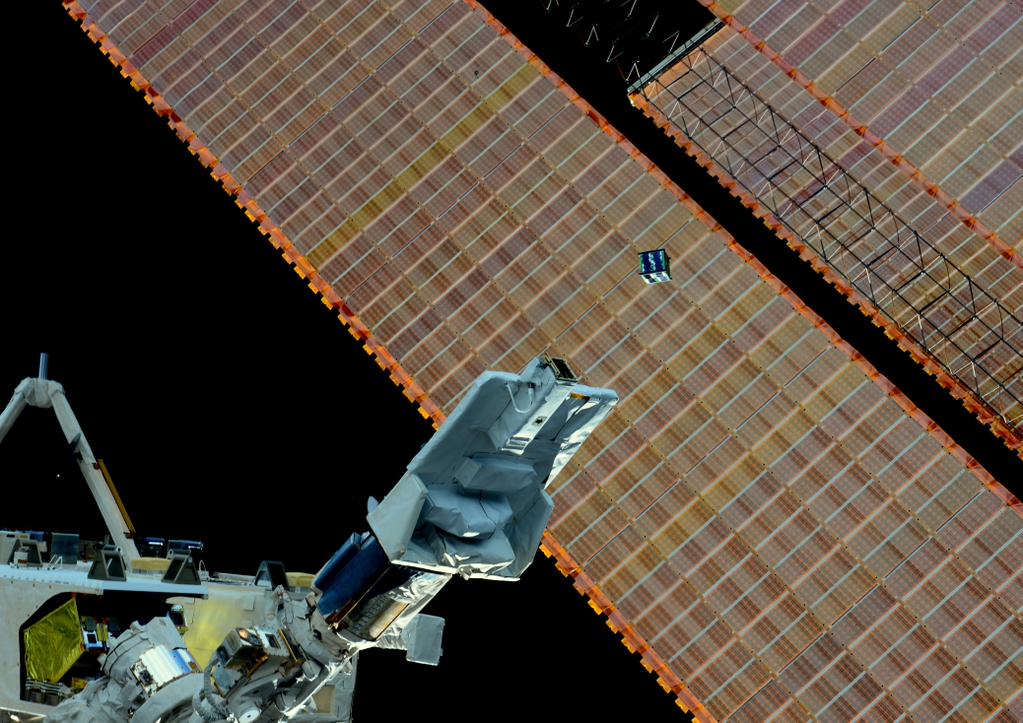
AESP-14 CubeSat released from ISS - Photo by Samantha Cristoforetti IZ0UDF

AESP-14 CubeSat released from ISS – Photo by Samantha Cristoforetti IZ0UDF

The satellite was sent to the ISS as cargo on the SpaceX Falcon 9 mission CRS-5. Launch had been scheduled for December 16, 2014 but was postponed three times and it wasn’t until January 10, 2015 that the launch eventually took place. AESP-14 then awaited deployment from the ISS by the JEM Small Satellite Orbital Deployer (J-SSOD) which is in the Japanese Experimental Module, Kibo.

The deployment took place around 1250 UT on Thursday, February 5. The AESP-14 telemetry beacon had a power output of 500 mW and used AX.25 with 9600 bps GMSK modulation (G3RUH standard) on 437.600 MHz. It should have started transmitting 30 minutes after deployment but as of March 30 nothing had been heard. It may be the battery did not survive several months without being recharged or the antenna may have failed to deploy.

Watch Deployment of AESP-14 Brazilian CubeSat

AESP-14 website http://www.aer.ita.br/~aesp14

Telemetry information sheet http://www.aer.ita.br/~aesp14/AESP-14Telemetry.pdf

AESP-14 CubeSat released from International Space Station http://www.spaceflight101.com/iss-expedition-42-updates-february-2015.html
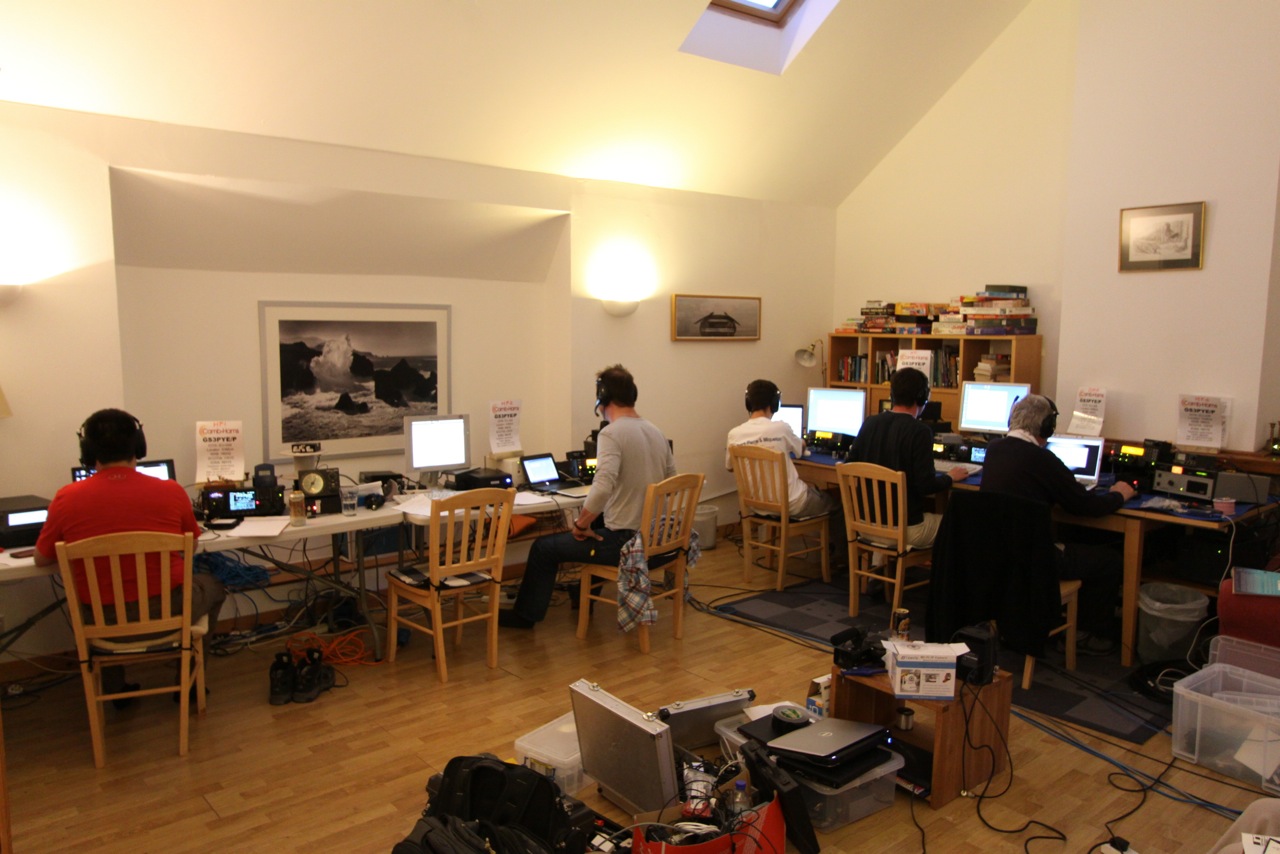
Satellite operation from Isle of Mull

Camb-Hams operating from the Isle of Mull in 2012

Camb-Hams operating from the Isle of Mull in 2012

Ten members of the Camb-Hams are returning to Grasspoint IO76EJ on Mull (IOTA EU-008) from May 15-21, 2015 as GS3PYE/P.

They will be QRV with multiple stations on HF on 3.5-28MHz SSB, CW, RTTY and PSK with dipoles and verticals and up to 400W if necessary.

VHF activity will be on 50MHz, 70MHz and 144MHz, all bands QRO with sizeable antennas.

VHF will be mainly QRV using JT6m or ISCAT on 50MHz, FSK441 on 70MHz and FSK441 and JT65b (for EME) on 144MHz, but SSB and CW is also possible, especially in any sporadic E propagation openings. Other modes by agreement.

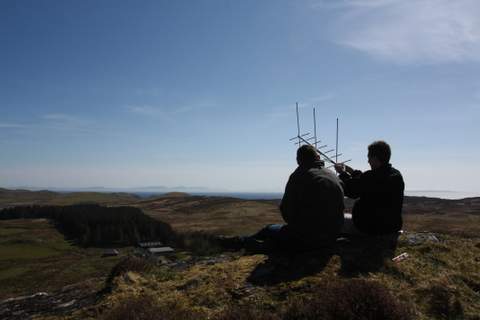
Hilltop satellite operation from Mull in 2012 with Peter 2E0SQL and Robert M0VFC - Image Credit Lawrence M0LCM

Hilltop satellite operation from Mull in 2012 with Peter 2E0SQL and Robert M0VFC – Image Credit Lawrence M0LCM

Satellite operations on 2m & 70cm will use an Icom IC-910 and X-Quad antennas mounted on a fully automatic AZ/EL tracking system. If internet connectivity allows, the VHF operators will monitor ON4KST Chat for terrestrial activity and N0UK JT65 chat for EME. You can submit your VHF sked requests online here: http://tiny.cc/gs3pyesked

The team will be QRV in the 80m CW CC event on the 21st and in the 144MHz contest on the 16th and 17th. They may do very short side trips to Iona and the Treshnish Islands and will announce these nearer the time on the website.

Please QSL only via OQRS on ClubLog for direct or bureau cards. Do not send any cards direct or via the bureau.

For the latest info see
http://dx.camb-hams.com/
http://twitter.com/g3pye
http://facebook.com/CambHams
http://youtube.com/CambHams

Astronaut issues challenge for UK students to “make that call”

Tim Peake KG5BVI, the first British ESA astronaut, has issued an invitation to UK school pupils to contact him via amateur radio whilst he is in space.

Tim will launch to the International Space Station (ISS) in November of this year and will spend 6 months working and living on the ISS. Thanks to a collaboration between Amateur Radio on the International Space Stations (ARISS), the UK Space Agency, the Radio Society of Great Britain (RSGB) and the European Space Agency (ESA), UK school pupils will be able to contact him whilst he is on board the ISS via a scheduled amateur radio link-up. Continue reading

FUNcube-1 Solar eclipse update

As expected, FUNcube-1 (AO-73) entered the shadow of the moon around 1000 UT on Friday, March 20, 2015.

Solar panel currents dropped to almost zeroThis is what happened to the solar panel currents, they dropped to almost zero.

This what we usually see from our Whole Orbit Data telemetry

This is what we usually see from our Whole Orbit Data telemetry. Normally the CubeSat is in the sun for 60 minutes and in eclipse for around 30 minutes…but not this morning!

FUNcube-1 (AO-73) Telemetry:
• Dashboard App http://funcube.org.uk/working-documents/funcube-telemetry-dashboard/
• Data Warehouse Archive http://warehouse.funcube.org.uk/
• Whole orbit data shows the effect http://warehouse.funcube.org.uk/wod.html?satelliteId=2

Southampton students to launch 434 MHz eclipse payload

Assembling SUSF payloads for solar eclipse launchThe University of Southampton Spaceflight Society will be launching for the solar eclipse on Friday, March 20, with two 434 MHz Slow Scan Digital Video (SSDV) balloon payloads.

The transmitters are as follows:

MAJORA – 434.211 MHz USB, 600 bps RTTY, 600 Hz Shift, 8n2 – (SSDV + no GPS)
OLAF – 434.149 MHz USB, 300 bps RTTY, 880 Hz Shift, 8n2 – (SSDV + GPS)
There may also be a backup tracker on 434.700 MHz USB.

The launch will take place from Pepperbox Hill near Salisbury, at 7am due to the NOTAM, so it will be sent up slowly, perhaps landing in France.

Live launch webstream: http://www.batc.tv/streams/m0dny
Prediction: http://predict.habhub.org/#!/uuid=eb10ee6e7030c615d2e0f49243add969e42465b0
Project page: http://susf.co.uk/launches/eclipse/
Eclipse summary page: http://ukhas.org.uk/news:balloon_launches

Thanks in advance to all those who will try to listen

Matt Brejza

The 434 MHz signals transmitted by High Altitude Balloons can have a range of up to 800 km. The path of the balloons can be tracked in real-time at http://spacenear.us/tracker/

Useful links for tracking, receiving and decoding the telemetry from 434 MHz balloons can be found at
https://amsat-uk.org/beginners/balloons/

Listen for 434 MHz balloon signals online using the SUWS WebSDR, further details at
https://amsat-uk.org/2014/08/15/suws-websdr-moves-to-new-site/

434 MHz balloon launch at BBC Stargazing event
https://amsat-uk.org/2015/03/16/434-mhz-balloon-launch-at-bbc-stargazing-event/

Ulster 434 MHz Solar Eclipse Balloon

Radio amateur Philip Heron MI0VIM reports on a Raspberry Pi balloon which will be launched for the eclipse and should be receivable across the British Isles.

All being well there will be a launch from Cookstown, N.Ireland on Friday, March 20 at about 0700 UT.

The plan is to have it rise high enough before the time of maximum solar eclipse, and maybe image the lunar shadow on the horizon. This will have a slow ascent rate and should hopefully float at about 36km, on a path which takes it south towards Dublin, before turning east to Wales and on towards Germany.

Callsign: EAGLE
Frequency: 434.250 MHz USB
Mode: RTTY 300 baud 8N2

The payload consists of a Raspberry Pi A+, camera and a Pi In The Sky module. It will be sending SSDV images throughout the flight.

The 434 MHz signals transmitted by High Altitude Balloons can have a range of up to 800 km. The path of the balloons can be tracked in real-time at http://spacenear.us/tracker/

Useful links for tracking, receiving and decoding the telemetry from 434 MHz balloons can be found at
https://amsat-uk.org/beginners/balloons/

Listen for 434 MHz balloon signals online using the SUWS WebSDR, further details at
https://amsat-uk.org/2014/08/15/suws-websdr-moves-to-new-site/

434 MHz balloon launch at BBC Stargazing event
https://amsat-uk.org/2015/03/16/434-mhz-balloon-launch-at-bbc-stargazing-event/