ISS 2395 MHz Digital Amateur TV Blank Transmission Test

Front panel of the HamTV transmitter

Front panel of the HamTV transmitter

The request to power up the Ham Video system was added to the crew task list on April 16.

That means, that crew is invited to activate Ham Video as a free time activity. No precise day/time for this activity is fixed.

Please monitor the 2395 MHz at 2.0 Ms/s frequency and tell everyone as soon as you observe it.

This will be a period of blank transmission for testing and calibration. Please make maximum use of it.

Read the HamTV overview by Gaston Bertels ON4WF http://tinyurl.com/HamTVoverview

Join the ISS HamTV Yahoo Group http://groups.yahoo.com/group/HamTV

ARISS-EU HamTV Bulletins http://www.ariss-eu.org/

HamTV on Facebook https://www.facebook.com/Hamtvproject

Video of ISS HamTV – Koichi Wakata KC5ZTA April 13, 2014
https://amsat-uk.org/2014/04/14/video-of-iss-hamtv-koichi-wakata-kc5zta-april-13-2014/

With a heavy heart – G3CWV – SK

Clive Wallis G3CWV

Clive Wallis G3CWV

It is with great sadness that I have to inform you that I have just learnt of the passing of our dear friend Clive Wallis, G3CWV on 27th March 2015.

Clive has been a very staunch supporter of AMSAT from the very early days. Many will recall his intense interest and loyalty in following UOSAT-2/UO-11. He maintained a very comprehensive web site with details of the spacecraft’s activities. He wrote many articles for Oscar News about his activities. He attended many AMSAT-UK Colloquia.

He was awarded the Louis Varney cup for 2015 by the RSGB, and although he knew of the award before his passing, the formal presentation is not until 25 April.

His funeral is to be held on Wednesday, 22 April 2015 at 3.00pm at Christchurch, Bedford Road, Hitchin, Herts, UK. I am sure that his family would appreciate the presence of any AMSAT members who are able to be there.

We send our condolences to his widow, Janet.

RIP, Clive.

73s
Jim Heck G3WGM
Hon Sec AMSAT-UK

For 17 years between 1996 and 2013 Clive produced monthly reports on OSCAR-11  (UoSAT-2).
The report archive is at http://www.g3cwv.co.uk/newsarch.htm

Clive’s OSCAR-11 page http://www.g3cwv.co.uk/oscar11.htm

In 1993 Clive Wallis G3CWV took over distribution of satellite related BBC software
https://amsat-uk.org/2011/12/11/bbc-micro-and-amsat-uk-software-library/

FUNcube-1 (AO-73) Transmitting Again

AO-73 (FUNcube-1) - Image credit Wouter Weggelaar PA3WEG

AO-73 (FUNcube-1) – Image credit Wouter Weggelaar PA3WEG

FUNcube-1 (AO-73) is again transmitting telemetry. A restart took place during the 0930 UT pass over Europe.

The CubeSat had stopped transmitting at around 2018 UT on Wednesday, April 15.

The team is still investigating the situation, but have concluded from earlier telemetry analysis that it was safe to switch back to nominal operations.

During the 0930 UT pass over The Netherlands, Wouter PA3WEG commanded it back to nominal mode with full automatic mode switching.

At this time, there is no reason to believe this event was dangerous to the spacecraft, all systems were nominal and the battery is nearly full.

Many thanks for all the reports that the team have received.

FUNcube-1 (AO-73) Telemetry:
• Dashboard App http://funcube.org.uk/working-documents/funcube-telemetry-dashboard/
• Data Warehouse Archive http://warehouse.funcube.org.uk/
• Whole orbit data shows the effect http://warehouse.funcube.org.uk/wod.html?satelliteId=2

ISS Ham Radio SSTV Video

On the weekend of April 11/12 Randy Hall K7AGE used his Arrow dual band J-Pole antenna, FT-817, Signalink USB interface and MMSSTV software to capture some great amateur radio Slow Scan Television (SSTV) images from the International Space Station (ISS).

Watch SSTV Images from the International Space Station

ISS Slow Scan TV Active on Weekend of April 11 https://amsat-uk.org/2015/03/31/iss-sstv/

Using WebSDRs Worldwide for the ISS https://amsat-uk.org/2015/04/14/using-websdrs-for-iss/

ISS SSTV in the UK Press https://amsat-uk.org/2015/04/15/iss-sstv-in-the-press/

ISS SSTV in the Press

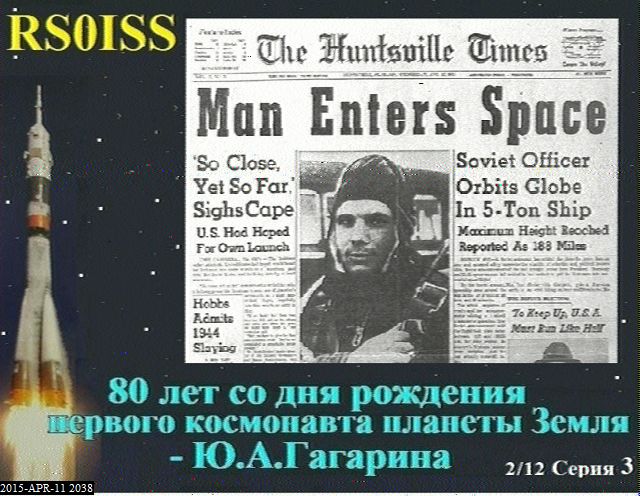
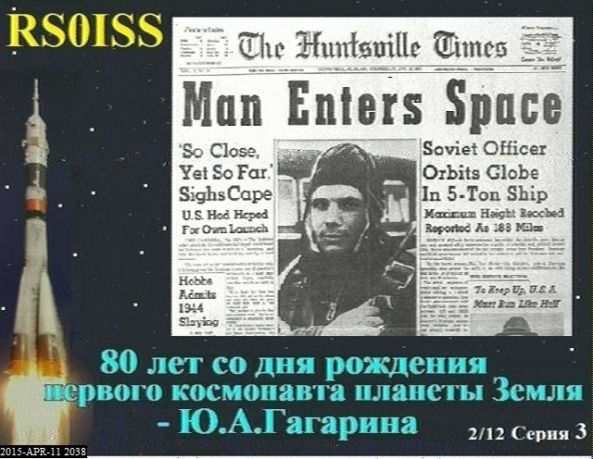
ISS SSTV Image 2 of 12 received by Andrew Garratt M0NRD April 11, 2015

ISS SSTV Image 2 of 12 received by Andrew Garratt M0NRD April 11, 2015

AMSAT-UK member Andrew Garratt M0NRD got some good publicity for Amateur Radio from the recent ISS Slow Scan Television transmissions.

The SSTV pictures were sent in celebration of Yuri Gagarin becoming the first human to reach space, on April 12, 1961. The Russian cosmonauts on board the station transmitted images from Gagarin’s life which were received by radio hams worldwide. Andrew said he hoped it would encourage more people to become interested in radio.

Read the full story at
https://web.archive.org/web/20160405015704/http://newarkadvertiser.co.uk/articles/news/A-message-from-space-picked-up-in-Newark

Local newspapers are generally only too glad to publish stories like this if someone takes the time to get in touch and tell them about it. Andrew made sure the newspaper was aware of his local clubs website URL and Facebook page enabling those reading the story to contact the club.

Follow M0NRD on Twitter http://twitter.com/nerdsville

ISS Slow Scan TV Active on Weekend of April 11 https://amsat-uk.org/2015/03/31/iss-sstv/

Note the ISS transmissions on 145.800 MHz FM use the 5 kHz deviation standard rather than the narrow 2.5 kHz used in Europe. If your transceiver has selectable FM filters try the wider filter.

The ISS Fan Club website will show you when the space station is in range http://www.issfanclub.com/

ISS SSTV information and links at https://amsat-uk.org/beginners/iss-sstv/

ARISS-SSTV Images http://ariss-sstv.blogspot.co.uk/

If you don’t have an amateur radio receiver you can still listen to the ISS by using an Online Radio, also known as a WebSDR. Select a Frequency of 145800.0 kHz and Mode FM:
• Farnham WebSDR when ISS is in range of London http://farnham-sdr.com/
• R4UAB WebSDR when ISS is over Russia

The RSGB produce a handy Media Guide and Template press release, see
http://rsgb.org/main/clubs/media-guide-for-affiliated-societies/

If you receive a full or partial picture from the Space Station your Local Newspaper may like to know http://www.southgatearc.org/news/2016/july/now-is-a-great-time-to-get-ham-radio-publicity.htm

Using WebSDRs Worldwide for the ISS

ISS SSTV and Packet Radio signals on the SUWS WebSDR

ISS SSTV and Packet Radio signals on the SUWS WebSDR

Martin Ehrenfried G8JNJ describes how he uses WebSDR’s to listen to ISS transmissions on 145.800 and 145.825 MHz. The SUWS SDR at Farnham can even receive the 143.625 MHz ISS comms channel.

We were treated to more Slow Scan Television (SSTV) pictures from the International Space Station (ISS) on the weekend of April 11/12.

During the Sunday evening passes a Cosmonaut suddenly decided to try some ad-hoc voice contacts between SSTV transmissions. Quite a few other stations were calling RS0ISS, but I didn’t hear any actual two-way exchanges. I made a very late, hurried and half-hearted attempt to call near the end of the pass, when my collinear antenna was most likely to be effective, but the ISS was very quickly out of range.

144 MHz G8JNJ prototype helix antenna used at SUWS WebSDR

144 MHz G8JNJ prototype helix antenna used at SUWS WebSDR

I was also monitoring the Russian VHF-2 comms frequency 143.625 MHz FM on the new extended 143 MHz band on the SUWS WebSDR in a second browser window, and heard a very short transmission from a Cosmonaut near the end of the UK pass. I suspect they were attempting to call Moscow as they started to come into range.

When the ISS dropped out on the SUWS WebSDR, I swapped over to the Russian http://sdr.22dx.ru/ WebSDR and heard some full contacts during a long pass over the Russian mainland.

With the exception of Asia (Bangkok SDR seems to be very deaf) it’s now possible to switch between WebSDR’s at different locations and catch just about all Amateur transmissions from the ISS. In fact it’s possible to set-up multiple browser tabs, one for each WebSDR and just leave them set on 145.800 MHz FM with squelch enabled, so that voice or SSTV traffic can be heard on each SDR in turn when the ISS passes into range.

These are two sound files captured on the WebSDR’s record function

SDR 22 DX recording


SUWS recording

Martin – G8JNJ
http://www.g8jnj.net/
http://www.tc2m.info/

WebSDRs which may be used to receive the ISS and some amateur satellites are:
United Kingdom Farnham IO91OF http://websdr.suws.org.uk/
Russia Ruzaevka LO24LA http://websdr.r4uab.ru/
Russia Belgorod http://websdr.radiotx.ru/
Eastern Russia Barnaul NO13TH http://sdr.22dx.ru/
Canada East coast http://ve2nnx.no-ip.org:8901/
USA West Coast http://eids.eecs.berkeley.edu:8080/
Brazil http://appr.org.br:8901/
Brazil http://sdrsp.dyndns.org:8901/
Brazil http://websdr.ddns.com.br:81/
Germany http://129.187.5.188:8901/
Germany http://websdr.ramge.de:8901/
Belgium http://websdr.khbo.be:8901/
Hungary http://www.websdr.hu/
Italy http://ik8ysw.ddns.net/
South Africa http://zr6aic.giga.co.za:8902/
Thailand Bangkok http://hs2jfw.noip.me/