The FUNcube team are pleased to announce that the Data Warehouse has received two million packets of telemetry data from ground stations around the world.
FUNcube-1 (AO-73) was launched on November 21, 2013 and since then radio amateurs and schools have been receiving the telemetry packets transmitted by the satellite and passing them to the AMSAT-UK Data Warehouse for analysis and storage.
There are normally several people uploading the same packet but for the 2 millionth it was an individual:
• Carlos Eavis, G3VHF
The Data Warehouse statistics as of 09:53 UT on March 15, 2015 were:
Number of registered users: 1529
Number of active users (data received in last two weeks): 193
Number of active users since launch: 818
Number of packets transmitted by satellite since deployment: 8312304 (2.13 GB)
Number of packets uploaded by users before de-duplication: 8539662(2.19 GB)
Number of packets stored in warehouse: 2000000 (512 MB)
Number of packets recovered & stored – Time – Coverage
• Realtime 2M – 115 days – 25%
• HiRes 3.9M – 1085 minutes – 19%
• WOD 0.56M – 385.78 days – 80%
As always, many thanks for all those individuals and groups who are sending data to the warehouse.
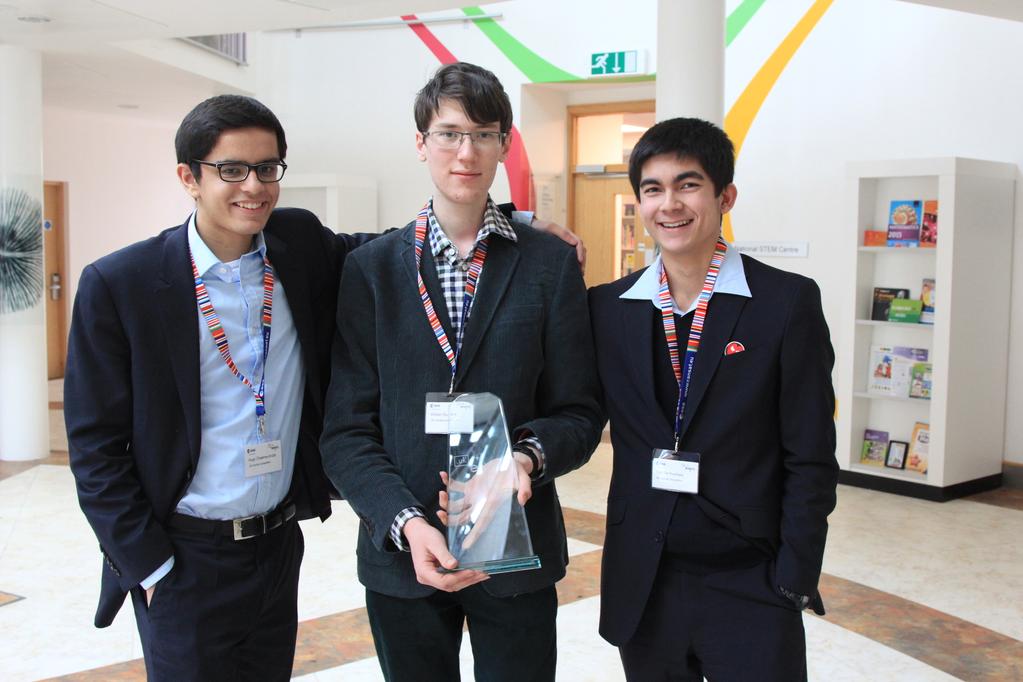
St Paul’s Team Impulse – UK CanSat 2015 Winners – Image Credit ESERO-UK
ESERO-UK, the UK space education office, based in York, has announced the winner of the UK round of the International CanSat competition .
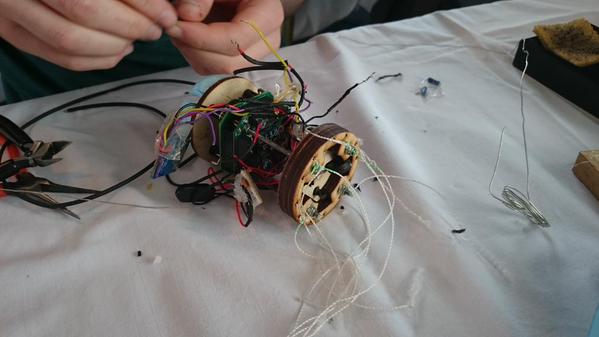
A CanSat is a student built simulated satellite with all the major subsystems including radio communications on 433/434 MHz and power fitting into a 350 ml soda can.
ESERO-UK organises the annual UK CanSat Competition for teams of secondary school students.
Winner of the Beginners’s category was the CANnoneers, from Tonbridge School in Kent. Runners up include: Spiritus, Putney High School, London; #getjezsrockettospace, from Allestree Woodlands School, Derby; Benenden CANSAT Avengers, from Benenden; Kent and Colossus, from St. Paul’s School, London.
“I highly recommend this wonderful opportunity to anyone who has the chance. Jump on it as it’s a unique opportunity to gain a lot of experience in a unique learning environment and will give a good amount of experience for anyone even considering a career in engineering! I enjoyed the experience and I’m sure the rest of my team did too.” Walter Tso, Outreach Manager and Electronics Assistant, CANnoneers.
Team Impulse, from St Paul’s School in London won the Advanced category of the competition. Runners up include: OSSO , from Oundle School, Northamptonshire; Heathrow Aeronautical Engineers, from Heathrow UTC, Greater London.
Team Impulse, from St Paul’s School in London, were announced overall winners of the 2015 CanSat competition and will go on to compete at the European CanSat Competition in Portugal.
“We are thrilled to be continuing the great British tradition of innovative engineering and are delighted to be representing St Paul’s and the UK at the CanSat final in Portugal.” Team Impulse, St Paul’s School.
Tom Lyons, ESERO Teacher Fellow said: “This year’s completion was a great success with all teams launching and recording data with their CanSats. We’re now looking forward to the 2016 competition and hoping to attract even more teams to get involved.”
8-year-old radio amateur Hope Lea KM4IPF made her first contact just 45 minutes after her callsign appeared in the FCC database. The contact with Arthur K4YYL, via the FO-29 satellite, took place on March 11, 2015 at 2100 UT.
Her elder sister Faith WA4BBC and brother Zechariah WX4TVJ got to work K4YYL as well. They had both gained their US Technician licenses (equiv UK Foundation) in February and upgraded to the US General (equiv UK Intermediate) a couple of weeks later.
Hope’s younger sister is studying for her licence.
Ofcom have announced that following representations they are restoring the 75.875-76.0 GHz Amateur and Amateur-Satellite allocation to Primary status in the new amateur radio licence which comes into effect on April 7, 2015.
The Ofcom licensing updates page says:
Following the recent notification sent to licensees of our proposal to vary the Amateur Radio Licence, Ofcom now publishes a Notice of Variation to the Amateur Radio licence.
Licensees who received a notification dated 30th January are not covered by this. Their licences will be the subject of a separate Notice, which we shall publish in the course of the next couple of weeks.
A number of changes have been made to the licence proposals originally announced December 5, 2014, these are detailed in Annex B.
It is understood that examinations will continue to be based on old licence terms until October 2015, since any exam changes are subject to a six month notice period.
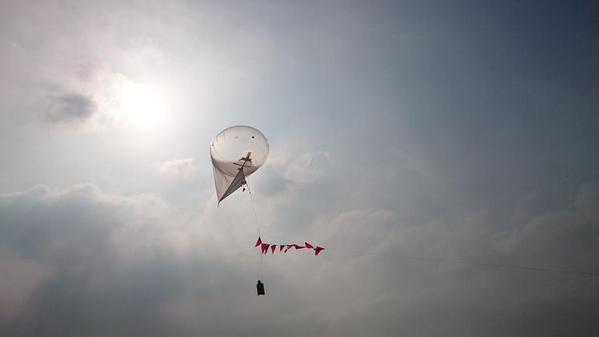
On Friday, March 13 eight school teams from across the UK competed in the National CanSat Competition held at the National STEM Centre in York.
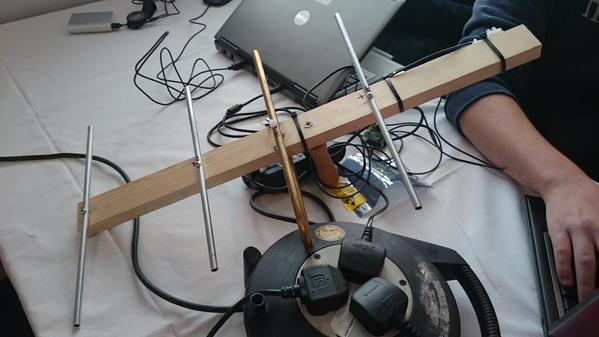
CanSat 434 MHz Tracking Antenna – Credit Ryan Laird
The CREST Gold Award accredited competition, now in its second year, involves students building a miniature simulation satellite, known as a CanSat, and launching it from 300 metres above an airfield.
The students had to build their own space experiments, fitting all the major subsystems including radio communications on 433/434 MHz and power into a 350 ml soda can.
They needed to write code to measure temperature, pressure and other chosen parameters on its journey parachuting to the ground. The winners of the competition will go on to the European finals, held in Portugal, in June.
Sarah Brightman Space Flight Training February 2015
Sarah Brightman hopes to launch to the International Space Station (ISS) for a 10 day mission in September 2015.
If the launch takes place as planned she would become the UK’s second astronaut, the first was Helen Sharman GB1MIR on May 18, 1991. Tim Peake KG5BVI is expected to launch in November 2015.
Sarah announced her planned flight on October 10, 2012 and commenced training in Russia’s Star City in January 2015.
She will fly to the ISS aboard Soyuz 44 (TMA-18M) and return on Soyuz 42 having spent 10 days on the ISS. With her on the flight will be Danish astronaut Andreas Mogensen KG5GCZ and Russian cosmonaut Sergei Volkov RU3DIS.
To celebrate her journey into space and recognise the combination of arts, science, technology, engineering and maths Sarah has teamed up with the Challenger Center to launch a programme for students all around the world. She says “Through my partnership with Challenger Center, I hope to inspire in children the same wonder and excitement for space exploration that I feel myself. As I prepare for my own space journey, I am proud to work with them to impart the sense of magic that has had me dreaming and looking up at the stars since I was a child.”
Prospective UK astronaut Tim Peake KG5BVI has sent this video message to Sarah
A flight to the ISS is understood to cost around $52 million, considerably more than the $20 million that Iranian-American engineer Anousheh Ansari paid for her mission to the ISS in 2006, highlighting the dramatic escalation in launch charges in recent years.
In 2012 in conjunction with Virgin Galactic, The Brightman STEM Scholarship program (science, technology, engineering, and mathematics) was launched to help young women in the US pursue STEM education across their four year college careers.
Her album, “Dreamchaser” was released on January 22, 2013. She said “I don’t think of myself as a dreamer. Rather, I am a dream chaser, I hope that I can encourage others to take inspiration from my journey both to chase down their own dreams and to help fulfill the important UNESCO mandate to promote peace and sustainable development on Earth and from space. I am determined that this journey can reach out to be a force for good, a catalyst for some of the dreams and aims of others that resonate with me.” She intends to become the first professional musician to sing from space.
The ISS has two amateur radio stations, one in the Russian Service module the other in the ESA Columbus module. It is not yet known if Sarah will make any amateur radio contacts during her mission.
In 1991 the first UK astronaut Helen Sharman was issued with a special callsign GB1MIR by the Radiocommunications Division of the Department of Trade and Industry (DTI). She was then able to contact radio amateurs on Earth during her stay on the MIR space station.
The RSGB has reported that the UK communications regulator Ofcom will make the callsign GB1SS available for issue to UK astronauts who wish to operate from the ISS.




 AMSAT-UK
You must be logged in to post a comment.