Radio hams will be at BBC Solar Eclipse event

Astronaut Paolo Nespoli IZ0JPA

Astronaut Paolo Nespoli IZ0JPA

Two radio amateurs, Dave Akerman M0RPI and Paolo Nespoli IZ0JPA, will be at the BBC Stargazing Live solar eclipse event at Leicester on March 20.

Dave Akerman M0RPI is well known for many High Altitude Balloon flights. These have carried the Rapsberry Pi computer board as part of the payload and produced spectacular pictures some of which were transmitted in the 434 MHz band using the amateur radio Slow Scan Digital Video (SSDV) mode.

Italian astronaut Paolo Nespoli IZ0JPA was on the October 2007 Shuttle STS-120 mission to the International Space Station. In 2010/11 he was flight engineer for ISS Expeditions 26 and 27 and installed amateur radio equipment in the Columbus module of the space station.

The Leicester Mercury newspaper reports the BBC is staging a spectacular show at the racecourse in Leicester to coincide with the solar eclipse on March 20.

It says Leicester was chosen by the BBC because it is home to the National Space Centre and Leicester University which are at the forefront of space exploration and were involved in the Beagle 2 mission to Mars in 2003.

Paolo Nespoli IZ0JPA said: “I’ve never been to Leicester and I’m really looking forward to visiting.”
“It will be great to interact with the kids and share my enthusiasm of space, science, maths and technology”.

The free event will be open from 9am until 3pm and from 6pm until 9pm on March 20.

Read the Leicester Mercury story at
http://www.leicestermercury.co.uk/BBC-live-event-Leicester-racecourse-mark-solar/story-26096057-detail/story.html

BBC Stargazing Live event details http://www.bbc.co.uk/stargazing

Information on the Solar Eclipse from Chelmsford Amateur Radio Society member Peter Meadows M0ZBU http://www.southgatearc.org/news/2015/march/partial_solar_eclipse_march_20.htm

Essex Partial Solar Eclipse Friday March 20, 2015
http://www.petermeadows.com/Essex_Partial_Solar_Eclipse_Mar15.pdf

RSGB respond to Ofcom UHF review

Ofcom-logo-col-tThe RSGB has responded to the Ofcom call for inputs to the strategic review of the 420-470 MHz spectrum.

The review includes the key Amateur 430-440 MHz and Amateur-Satellite 435-438 MHz allocations.

The consultation had been due to close on February 19 but was extended to February 26 to give more time for responses.

Read the RSGB response http://rsgb.org/main/files/2015/02/RSGB_UHF-Review_response.pdf

Ofcom: 420-470 MHz Consultation
http://www.southgatearc.org/news/2014/december/ofcom_420_470_mhz_consultation.htm

APRS balloon heads for UK

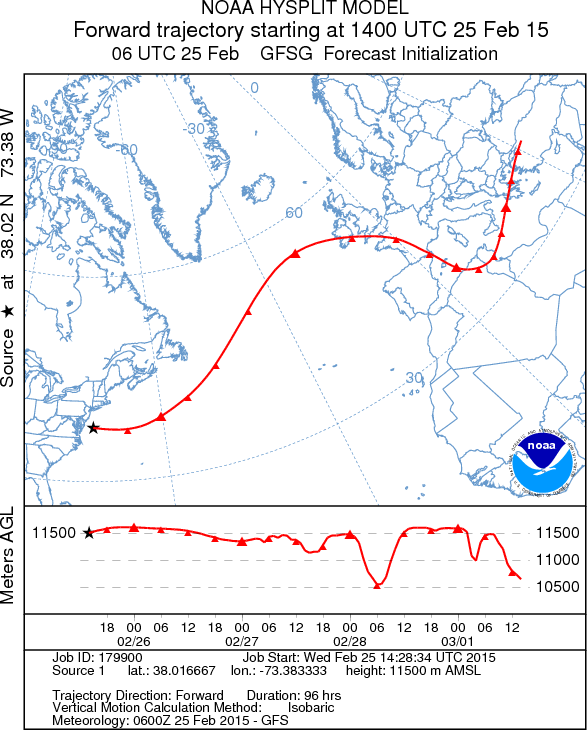
CNSP-22 Predicted Track for February 26 to March 1, 2015

CNSP-22 Predicted Track for February 26 to March 1, 2015

An amateur radio balloon CNSP-22, call sign K6RPT-11, is crossing the Atlantic at an altitude of 11,150 metres and should reach the British Isles on Friday, February 27.

The solar powered around-the-world high altitude balloon was released by the California Near Space Project team from San Jose on Monday, February 23 and is expected to reach the UK on Friday. The APRS beacon should have a radio range of up to 400 km.

The amateur radio APRS frequency is not standardized world-wide. The USA uses 144.390 MHz FM while the British Isles and Europe use 144.800 MHz. It is understood the balloon will change frequency to 144.800 MHz when it reaches this side of the Atlantic.

See the K6RPT-11 APRS track at
http://aprs.fi/#!mt=roadmap&z=11&call=a%2FK6RPT-11&timerange=86400&tail=86400

California Near Space Project
Web http://www.cnsp-inc.com/
Facebook https://www.facebook.com/pages/California-Near-Space-Project/255864787858630
Twitter http://twitter.com/k6rpt

APRS http://www.aprs.org/

APRS frequencies used around the world http://info.aprs.net/index.php?title=Frequencies

APRS-UK Yahoo Group https://groups.yahoo.com/group/APRSUK

ISS SSTV in a Brazilian School

Paulo PV8DX of AMSAT-BR turned the recent Slow Scan TV transmissions from the International Space Station (ISS) into an education outreach opportunity for amateur radio.

On Monday, February 23, 2015 at the Gonçalves Dias school he explained amateur radio to the students and demonstrated receiving an ISS SSTV picture on 145.800 MHz FM.

The ISS pass he received did not produce a strong signal and only part of the picture was captured but as can be seen from the video the students were enthusiastic and excited to be receiving a signal from space.

Paulo expressed the hope that the ISS will send images on school days more often.

Watch ISS – SSTV , By PV8DX

AMSAT-BR https://sites.google.com/site/amsatbr/

Information on receiving ISS SSTV https://amsat-uk.org/2015/02/11/more-iss-slow-scan-tv/

Space Station SSTV and Packet Radio via SUWS WebSDR

ISS SSTV and Packet Radio signals on the SUWS WebSDR

ISS SSTV and Packet Radio signals on the SUWS WebSDR

Martin Ehrenfried G8JNJ reports excellent SSTV and Packet Radio signals from the International Space Station (ISS) using the online SUWS WebSDR.

144 MHz prototype helix antenna

144 MHz prototype helix antenna

The omni-direction helix antennas at the WebSDR were designed with high elevation satellites in mind. Conventional antennas concentrate the radiation pattern towards the horizon resulting in weaker signals when a satellite is above 15 degrees elevation. Comparisons with other WebSDRs show the SUWS antennas provide a 6 to 10dB better signal to noise ratio on similar passes.

Martin says: “I had been experimenting with single turn ‘twisted halo’ design, and decided to try stacking them to see if I could achieve more gain. Modelling suggested that a stretched 3 turn helix with a helix circumference of approx 1/2 wave length and an overall length of 1/2 wave at 70cm, and fed with a gamma match at the centre would offer reasonable gain, an omni-directional pattern and mixed polarisation.”

You can use the free online SUWS Web Software Defined Radio from your PC or Laptop to receive the ISS and the many amateur radio satellites transmitting in the 144-146 MHz or 435-438 MHz bands. It also provides reception of High Altitude Balloons in the 434 MHz band and coverage of the microwave 10368-10370 MHz band.

The SUWS WebSDR is located at Farnham not far from London, 51.3 N 1.15 W, listen to it at http://websdr.suws.org.uk/

Full details of the antennas are available at http://g8jnj.webs.com/currentprojects.htm

Brazilian radio amateur uses SUWS WebSDR to receive ISS SSTV
https://amsat-uk.org/2014/09/06/iss-sstv-on-suws-websdr/

ISS SSTV image 9/12 received by Martin Ehrenfried G8JNJ using the SUWS WebSDR on Dec 18, 2014

ISS SSTV image 9/12 received by Martin Ehrenfried G8JNJ using the SUWS WebSDR on Dec 18, 2014

IARU-R1 VHF Newsletter Released

IARU_Region_1_logoIARU Region 1 has released issue 65 of the VHF-UHF-uW newsletter, it covers WRC-15 which could affect a number of amateur radio bands.

The newsletter says agenda items at the ITU World Radiocommunication Conference includes topics that affect amateurs in the 5MHz, 5GHz, 10GHz, 24GHz and 77GHz bands.

WRC-15 decides the agenda items for the next conference (WRC-19). IARU Region 1 has proposals in CEPT concerning these potential agenda items:
• 50 MHz Amateur-Satellite Service allocation
• 3.4 GHz harmonisation

There may be a need to raise the option of a new allocation such as 1300-1310 MHz in order to mitigate restrictions that are appearing in the existing 23cm band.

Read the newsletter here