Ham radio spacecraft launched into deep space

ARTSAT2-DESPATCH signal received

ARTSAT2-DESPATCH signal received

The amateur radio spacecraft Shin’en2 JG6YIG and ARTSAT2:DESPATCH JQ1ZNN were successfully launched on their journey to deep space at 04:22:04 UT on Wednesday, December 3, 2014 and signals from both spacecraft have been received.

ARTSAT2 DESPATCH  Deep Space Sculpture

ARTSAT2 DESPATCH Deep Space Sculpture

They were on the H-IIA Launch Vehicle No. 26 (H-IIA F26) which also carried the asteroid explorer “Hayabusa2”.

The two amateur radio spacecraft will have an elliptic orbit around the Sun and travel to a deep space orbit between Venus and Mars. The inclination will be almost zero, which means the spacecraft should stay in the Earth’s equatorial plane. The distance from the Sun will be between 0.7 and 1.3 AU. An Astronomical Unit (AU) is 149,597,871 km.

Shin'en 2

Shin’en 2

ARTSAT2:DESPATCH has a 7 watt CW transmitter on 437.325 MHz and is also the first 3D printed sculpture to be carried into deep space.

Shin’en2 has a CW beacon on 437.505 MHz (0.1 watt) and telemetry on 437.385 MHz (0.8 watt) using a mode which Seiji JH6RTO describes as similar to WSJT but not the same.

The Shin’en2 English language Ground Station page mentions WSJT but the equivalent Japanese language page does not.

The Shin’en2 site indicates there is also a F1D digital transponder with an uplink of 145.942 MHz with 435.270 MHz (0.4 watt) downlink.

Shin’en2 http://www.shin-en2.jp/index_E.html

Shin’en2 spacecraft prediction App
http://ji1izr.air-nifty.com/ham_satellite/2014/12/artsat2-despa-3.html

ARTSAT2:DESPATCH
Web http://despatch.artsat.jp/en/Main_Page
Facebook https://www.facebook.com/artsat
Twitter https://twitter.com/DESPATCH_ARTSAT

ARTSAT2:DESPATCH spacecraft prediction App
http://ji1izr.air-nifty.com/ham_satellite/in_english/index.html

Report reception of ARTSAT2DESPATCH at http://api.artsat.jp/report/

ARRL story 

Ham radio launches to deep space
https://amsat-uk.org/2014/11/19/ham-radio-launches-to-deep-space/

Japanese asteroid mission to carry amateur radio
https://amsat-uk.org/2014/09/01/japanese-asteroid-mission-to-carry-amateur-radio/

Shin'en2 on left - ARTSAT2:DESPATCH on right

Shin’en2 on left – ARTSAT2:DESPATCH on right

HAMSAT II – Dhruva Space and AMSAT India

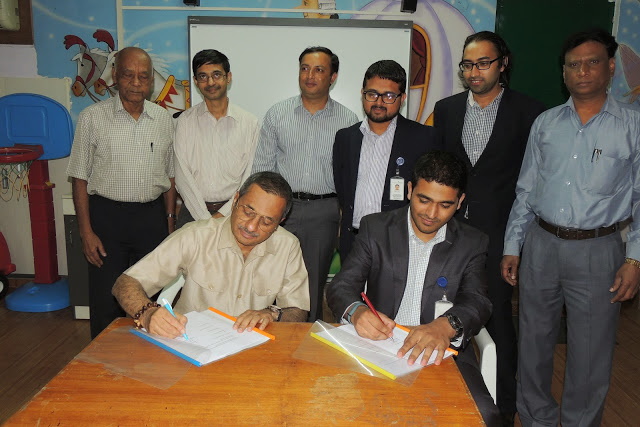
Signing of memorandum of understanding for HAMSAT II - Credit AMSAT India

Signing of memorandum of understanding for HAMSAT II – Credit AMSAT India

The Economic Times report Dhruva Space, a two-year-old start-up co-founded by space technologist and ham radio operator Sanjay Nekkanti VU3ISS/AB3OE, sealed a deal with AMSAT India on November 30, 2014 to develop HAMSAT II.

VUsat-OSCAR-52_HAMSAT

HAMSAT I – VO-52 – was a very popular amateur radio satellite

It will be the successor to HAMSAT VO-52 which went silent on July 11, 2014 due to the failure of the on-board lithium ion batteries. HAMSAT provided a valuable communications resource for the amateur radio community for over 9 years.

Dhruva’s satellites are expected to be launched on ISRO’s workhorse Polar Satellite Launch Vehicle (PSLV). Nekkanti said his team is working closely with the space organization for design approvals and testing of the satellite.

The AMSAT India Secretary Nitin Muttin, VU3TYG has released this statement:

We are pleased to announce that AMSAT India and Dhruva Space Pvt. Ltd. have signed a Memorandum of Understanding on November 30th 2014 to pursue the development of a follow up mission to HAMSAT launched in 2005 on-board the PSLV-C6. HAMSAT II is envisioned to fill the gap created by the recent end of life of HAMSAT and shall continue servicing the societal needs in disaster management, amateur/emergency radio communications and education.

Some of the contemplated payloads for HAMSAT II include:
• U/V Analog FM Transponder
• U/V Linear Transponder, 50 kHz
• APRS Digipeater
• Digitalker

Read The Economic Times article at
http://economictimes.indiatimes.com/articleshow/45354501.cms

AMSAT India http://amsatindia.org/

Thanks to Dinesh, AB3DC for the above information.

COSMOS-2491 RS-46

Dmitry Pashkov R4UAB reports that the COSMOS-2491 satellite carries RS-46 operating on 435.465 MHz and 435.565 MHz (+/- Doppler).

The satellite was launched on December 25, 2013 and is in a 1,515.8 km by 1,489.1 km 82.5 degree inclination orbit.

Watch COSMOS-2491/RS-46 (R4UAB)

Track COSMOS-2491 / RS-46 at http://www.n2yo.com/satellite/?s=39497

Listen for RS-46 online with the SUWS WebSDR located near London
https://amsat-uk.org/2014/08/15/suws-websdr-moves-to-new-site/

COSMOS-2499 Callsign RS-47 ! https://amsat-uk.org/2014/11/30/cosmos-2499-callsign-rs-47/

Dmitry Pashkov R4UAB
Web in Google English http://tinyurl.com/R4UAB-English
Twitter https://twitter.com/R4UAB

ARISS Officers for 2015-16

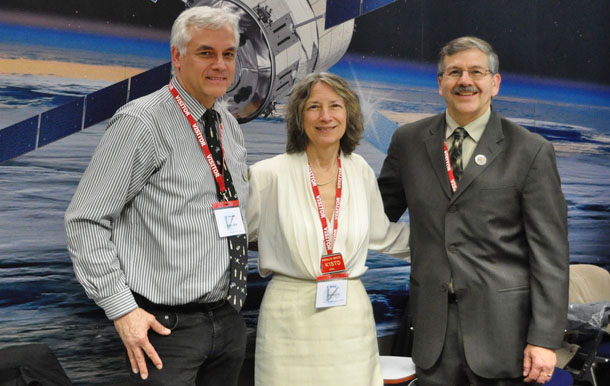
ARISS 2015-2016 Officers (L-R) ARISS Vice-Chair Oliver Amend, DG6BCE; ARISS Secretary-Treasurer Rosalie White, K1STO, and ARISS Chair Frank Bauer, KA3HDO

ARISS 2015-2016 Officers (L-R) ARISS Vice-Chair Oliver Amend, DG6BCE; ARISS Secretary-Treasurer Rosalie White, K1STO, and ARISS Chair Frank Bauer, KA3HDO – Credit ARISS

The ARRL report the Amateur Radio on the International Space Station (ARISS) organization is continuing to explore the possibility of establishing a network of ground stations to enable the use of the Ham TV video system during ARISS school contacts.

ARISS LogoMark Steiner, K3MS, updated the ARISS International team on the topic during its November meeting, conducted by teleconference. Kerry Banke, N6IZW, who works on ARISS hardware issues, reported that a document under development will describe just what is required to build a ground station.

He and ARISS International Project Selection & Use Committee representative Lou McFadin, W5DID, have successfully received Ham TV transmissions.

The officers elected for new 2-year terms starting on January 1, 2015 were ARISS Chair Frank Bauer, KA3HDO; ARISS Vice-Chair Oliver Amend, DG6BCE, and ARISS Secretary-Treasurer Rosalie White, K1STO.

Read the full ARRL story at
http://www.arrl.org/news/ariss-discusses-ham-tv-elects-new-international-officers

Read the minutes from the ARISS International November 18 meeting at
http://www.ariss.org/meeting-minutes/november-2014

Previous ARISS International meeting minutes http://www.ariss.org/meeting-minutes

COSMOS-2499 Callsign RS-47 !

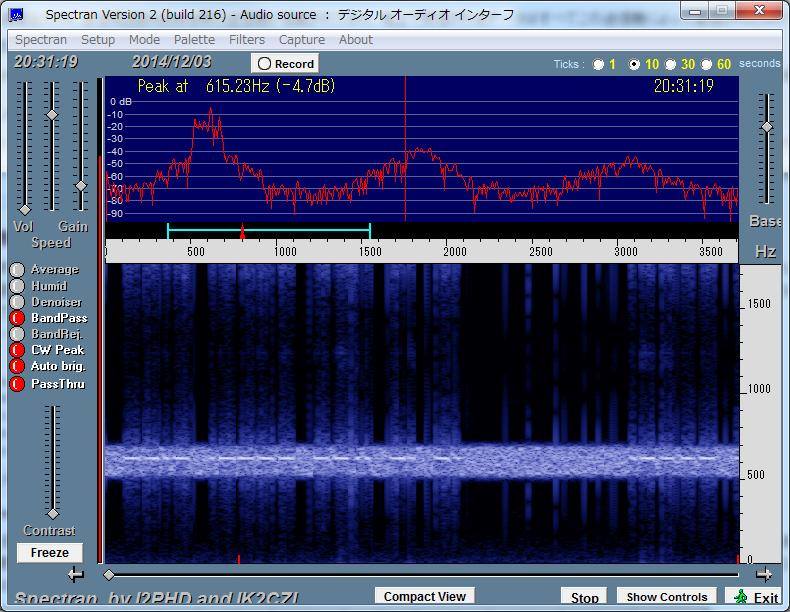
COSMOS-2499 signals received by Dmitry Pashkov R4UAB

COSMOS-2499 signals received by Dmitry Pashkov R4UAB

COSMOS-2499 (2014-028E) was launched on May 23, 2014 and is now in a 1,510.6 km by 1,158.8 km 82.4 degree orbit. Dmitry Pashkov R4UAB has received signals from the satellite on approximately 435.465 MHz and 435.565 MHz (+/- Doppler). On November 30 the satellite started identifying itself in Morse code on 435.465 MHz as RS-47.

Launch of Kosmos 2499There has been some mystery concerning the purpose of COSMOS-2499. In a post updated November 20, 2014 Anatoly Zak @RussianSpaceWeb wrote: Ground observations indicated that the mystery satellite had not exceeded 0.3 meters in size. Previously, two Rockot launches with trios of Rodnik/Strela-3M launches also carried Yubileiny (a.k.a. MiR) experimental satellites with a reported mass from 48 to 100 kilograms. As with the previous launch, observers were at a complete loss about the possible purpose of the satellite.

Cosmos-2499 has made a number or orbital changes since it was first launched. For further information see http://www.russianspaceweb.com/Cosmos-2499.html

Watch RS-47 / COSMOS 2499 / 2014-028E (R4UAB)

Track COSMOS-2499 / RS-47 at http://www.n2yo.com/?s=39765

Listen for RS-47 online with the SUWS WebSDR located near London
https://amsat-uk.org/2014/08/15/suws-websdr-moves-to-new-site/

RS-47 Telemetry data http://www.dk3wn.info/p/?p=52752

Dmitry Pashkov R4UAB describes receiving the 435.465 MHz and 435.565 MHz signals at http://tinyurl.com/R4UAB-COSMOS-2499

RAGazine now available for download

RAGazine Vol 2 Iss 2 front coverVolume 2 issue 2 of the free BAA-RAG radio astronomy publication RAGazine is now available for download.

In this edition:
– Meteor Scatter by Paul Hyde G4CSD
– VLF Report by John Cook G8EDG
– Update from the Hydrogen Line Group by Brian Coleman G4NNS and Gordon Dennis
– S7 and S8 14 Calibration Point Observations Brian Coleman G4NNS
– Airspy SDR Dongle by Tony Abbey G3OVH
– Choosing a Programming Language by Jeff Lashley 2E0ODF
– The rtl_power app by Jeff Lashley 2E0ODF
– Improving the accuracy of meteor data using the Scatterthon application by Victoria Penrice M6VXJ and Chris Jackson G7UPN/ZL2TPO
– European conference on Amateur Radio Astronomy by Paul Hyde G4CSD
– A Radio Astronomy Renaissance Man by Jeffrey M. Litchtman KI4GIY

RAGazine Vol 2 Iss 2 http://www.britastro.org/radio/ragazine/Ragazine_Vol2_iss2_11_2014.pdf

Download previous issues http://www.britastro.org/radio/downloads.html

Join the BAA-RAG Yahoo Group at http://groups.yahoo.com/group/baa-rag