SatNOGS Win Hackaday Prize

SatNOGS - Satellite Networked Open Ground Station

SatNOGS – Satellite Networked Open Ground Station

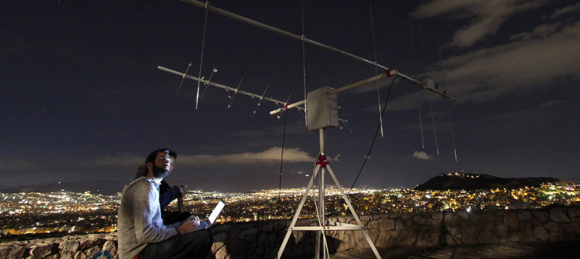
The open-source amateur satellite tracking project SatNOGS has won the Hackaday 1st prize and an amateur radio SDR won 3rd prize.

Six months ago Hackaday challenged their readers to realize the future of open, connected devices, The prize was a ticket to travel into space. The winners were announced at the Electronica trade show in Munich on November 13.

The SatNOGs project is a thrilling example of the benefits of a connected world. It opens up the use of satellite data to a much wider range of humanity by providing plans to build satellite tracking stations, and a protocol and framework to share the satellite data with those that cannot afford, or lack the skills to build their own tracking station. The hardware itself is based on readily available materials, commodity electronics, and just a bit of 3D printing.

Read the Hackaday article at
http://hackaday.com/2014/11/13/satnogs-wins-the-2014-hackaday-prize/

Ham Radio in Hackaday Prize Finals
https://amsat-uk.org/2014/11/08/ham-radio-in-hackaday-prize-finals/

SatNOGS – Satellite Networked Open Ground Station https://satnogs.org/

Chelmsford’s involvement in Rosetta

Computer generated image of Rosetta

Computer generated image of Rosetta

The UK Deputy Prime Minister congratulated one of the Chelmsford companies involved in developing key equipment for the successful Rosetta mission.

On Thursday, November 13 the Deputy PM @DPMoffice tweeted
Huge congratulations to @e2v in Chelmsford, who’ve been part of history on #Rosetta mission #spacehistory #RGF @spacegovuk

e2v developed the specialized sensors on which both Rosetta and Philae depend.

On Rosetta:
• OSIRIS – the high resolution imaging camera. It has a narrow field and wide field camera.
• NAVCAM – the navigation camera.
• VIRTIS (Visible and Infrared Thermal Imaging Spectrometer) – which maps and studies the nature of the solids and the temperature on the surface of the comet. It also identifies gases, characterizes the physical conditions of the comet and has helped to identify the best landing site (e2v’s devices are in the visible element of this instrument).

On Philae:
• ÇIVA (Comet nucleus Infrared and Visible Analyzer) – six identical micro-cameras take panoramic pictures of the surface of the comet. A spectrometer studies the composition, texture and albedo (reflectivity) of samples collected from the surface.
• ROLIS (Rosetta Lander Imaging System) – a CCD camera used to obtain high-resolution images during the descent of the lander and take stereo panoramic images of areas sampled by other instruments.

Read the e2v announcement at
http://www.e2v.com/news/scientists-ready-to-discover-the-origins-of-earth-with-help-from-high-performance-technology-company-e2v/

e2v was not the only Chelmsford company involved in Rosetta, the Intermediate Frequency Modem System (IFMS) was developed by BAE Systems Advanced Technology Centre in Great Baddow, Chelmsford, Essex
http://www.baesystems.com/article/BAES_175611/supporting-the-rosetta-mission

Watch IFMS: The Interplanetary Smartphone Supporting the Rosetta Mission

A number of radio amateurs work at both companies.

Radio amateurs have been listening to Rosetta’s signal on 8421.7869 MHz since January 2014 when it was 805 million km away from Earth, see
https://amsat-uk.org/2014/01/23/radio-amateurs-receive-rosetta-signals/

Chelmsford Amateur Radio Skills Night Monday November 17
http://www.southgatearc.org/news/2014/november/essex_amateur_radio_skills_night.htm

FUNcube-1’s Birthday

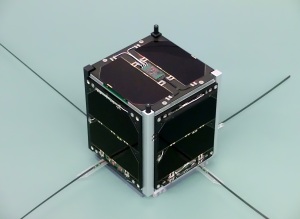
AO-73 (FUNcube-1) - Image credit Wouter Weggelaar PA3WEG

AO-73 (FUNcube-1) – Image credit Wouter Weggelaar PA3WEG

Hi Folks,

It seems amazing to us that FUNcube-1 – AO73, was launched nearly one year ago, in fact at 07:10 UTC on 21 Nov 2013. The very first signals were received by ZS1LS in South Africa at 07:37 UTC and he was even able to upload the resulting data to the Warehouse so the results could be seen immediately.

We are extremely happy to say that, since then, the satellite has been performing very satisfactorily, the battery voltage doesn’t drop below 8 volts, and becomes fully charged within about 7 – 10 minutes after re-entering sunlight from eclipse.
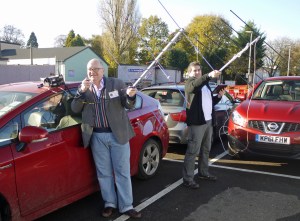
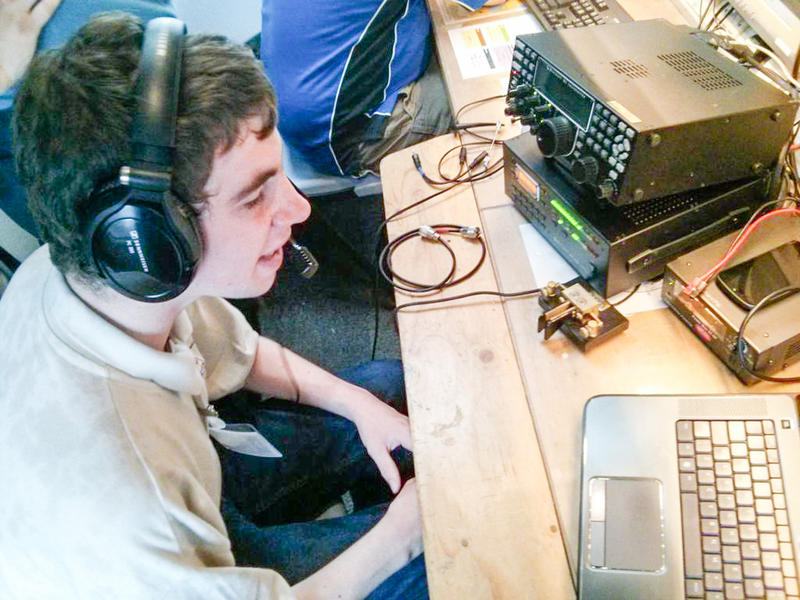
Howard Long G6LVB working AO-73 while Ciaran Morgan M0XTD captures the downlink passband data using a FUNcube Dongle Pro+ and Microsoft Surface Tablet

Howard Long G6LVB working AO-73 while Ciaran Morgan M0XTD captures the downlink passband data using a FUNcube Dongle Pro+ and Microsoft Surface Tablet

On Friday 21 Nov 2014, we will be celebrating the satellite’s first birthday. To mark the occasion, we will be activating the transponder earlier than normal – late on Thursday 20 Nov, so that it will be available for use during the whole of Friday. So please make as many contacts as possible through the transponder during Friday, FUNcube’s actual birthday. You are invited to make a note of any stations worked on this day, or any other comments on the FUNcube Forum. Please use the existing “FUNcube-1’s Birthday” topic, under the Welcome heading. The URL of the Forum is http://forum.funcube.org.uk/

Please also remember the ’73 on 73′ Award which is kindly being organised by Paul Stoetzer N8HM. See https://amsat-uk.org/funcube/73-on-73-award/ for more details.

Wouter Weggelaar PA3WEG talking about FUNcube-1 to students at Abbeys Primary School in Bletchley

Wouter Weggelaar PA3WEG talking about FUNcube-1 to students at Abbeys Primary School in Bletchley

We would like to take this opportunity of thanking all of our ‘users’, both those who download telemetry and forwarding it to the warehouse, and of course, all users of the transponder. This telemetry data is invaluable, both as an educational resource and to enable us to see how the spacecraft systems are performing and surviving. So far we have collected almost 400MB of unique data via stations from all around the world.

Of course we are hoping that the satellite continues to function nominally for several more years to come even though we may never reach AO7’s record!

73s AMSAT-UK and AMSAT-NL

First 73 on 73 Award issued to Wyatt Dirks AC0RA

First 73 on 73 Award issued to Wyatt Dirks AC0RA

The AMSAT-UK Flickr Group is at https://www.flickr.com/groups/amsatuk/
Please upload your pictures of amateur satellites, satellite ground stations, satellite demonstrations or any other satellite related event.

73 on 73 Award https://amsat-uk.org/funcube/73-on-73-award/

Data Warehouse – Telemetry Archive http://warehouse.funcube.org.uk/

Dashboard App – Telemetry Decoder http://funcube.org.uk/working-documents/funcube-telemetry-dashboard/
49.9 MHz Backscatter Radar 16 kW with 64 Antennas

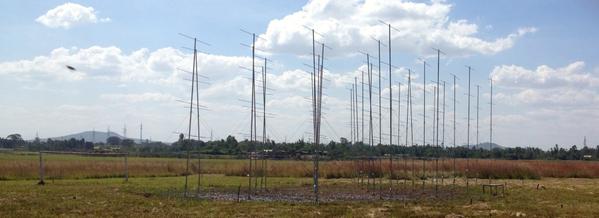
First 18 of the 49.9 MHz radar antennas pointing skywards

First 18 of the 49.9 MHz radar antennas pointing skywards

An impressive back-scatter radar on 49.9 MHz is currently being constructed in Ethiopia.

The Bahir Dar coherent backscatter radar is being assembled by researchers from the University of Oulu, Finland and Boston College, USA.

The radar will operate at 49.9 MHz with a 16 kW solid-state transmitter and 64 antennas. The sampling is based on a number of USRP X300-series boxes (the USRP was developed by Matt Ettus N2MJI).

Backscatter radar http://blog.sgo.fi/2014/11/bahir-dar-coherent-backscatter-radar.html

Lassi Roininen on Twitter https://twitter.com/LassiRoininen

Sodankylä Geophysical Observatory
https://www.facebook.com/pages/Sodankyl%C3%A4-Geophysical-Observatory/551697518290573

Predictions App for Deep Space Ham Radio Satellite

ARTSAT2 DESPATCH  Deep Space Sculpture

ARTSAT2 DESPATCH Deep Space Sculpture

Two amateur radio satellites ARTSAT2: DESPATCH (437.325 MHz CW) and Shin’en 2 (145/435 MHz linear transponder + 437 MHz WSJT) should be launched into deep space at the end of November.

Masahiro JI1IZR has announced that prediction software is available for ARTSAT2: DESPATCH:

One of the new deep space small satellites, “ARTSAT2: DESPATCH”, will be launched on the end of this month.

I developed a predict utilities that display the information got from the Web API data provided by the “ARTSAT” project team.

You can get the utilities and information from:
http://ji1izr.air-nifty.com/ham_satellite/in_english/index.html

You will also have the information of the satellite “ARTSAT2: DESAPTCH” from:
http://artsat.jp/en/project/despatch
http://pre.artsat.jp/wp-content/uploads/2014/07/despatch_abstract_en_ver1.0.1.pdf

I appreciate your notice for the project.

Thank you.

Masahiro Sanada JI1IZR

Art and Ham Radio in Deep Space https://amsat-uk.org/2013/11/03/art-and-ham-radio-in-deep-space/

Shin’en 2 has a linear transponder https://amsat-uk.org/2014/09/01/japanese-asteroid-mission-to-carry-amateur-radio/

4M – End of Mission

LX0OHB-4M amateur radio lunar payload - Credit LuxSpace

LX0OHB-4M amateur radio lunar payload – Credit LuxSpace

The JT65B amateur radio payload, which successfully completed a lunar flyby, has fallen silent after transmitting for 438 hours.

During the afternoon of November 10 the battery voltage dropped from 13.1V to 12.1V and continued falling. The last signal was received by Rein W6SZ at 01:35 UT on November 11 when the battery voltage had fallen to 8.4 volts.

Ghislain LX2RG posted the following to the Moon Net list:

Here at Luxspace, we have to thank you all for the reports, for the tracking, and we also hope that we provided you with the challenges you expected.

4M may possibly awaken from time to time if illumination becomes better.

We shall now endeavor to prepare the next one.

Manfred Memorial Moon Mission (4M) LX0OHB-4M http://moon.luxspace.lu/blog/

4M Lunar Payload https://amsat-uk.org/2014/10/15/4m-lunar-payload-integrated-keps-released/