40 Years of Tracking OSCAR-7

Satrack showing OSCAR 7 (AO-7)

Satrack showing OSCAR 7 (AO-7)

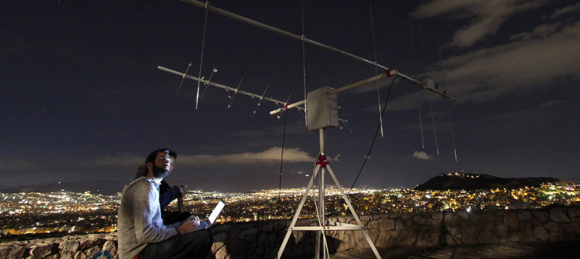
William Leijenaar PE1RAH shows how people tracked satellites in the time before PC’s and AMSAT Argentina show how it’s done today.

ARRL OSCAR LocatorIn the 1974 radio amateurs tracked OSCAR 7 (AO-7) using an OSCARLOCATOR that comprised a polar great circle map and overheads for each satellite.

40 years later OSCAR 7 is still operational when in sunlight and thanks to William Leijenaar PE1RAH you can now download the map and overheads to make your very own OSCARLOCATOR. Read his article at
http://www.qsl.net/pe1rah/oscarlator.htm

AMSAT Argentina has recently released the online satellite tracker Satrack, use it at http://amsat.org.ar/sat.htm

The PC version can be downloaded from http://amsat.org.ar/Satrack.htm

Special Event Station for 40th Anniversary of OSCAR 7 Launch
https://amsat-uk.org/2014/10/31/special-event-station-for-40th-anniversary-of-oscar-7-launch/

OSCAR 7 in Space

OSCAR 7 in Space


Ham Radio in Hackaday Prize Finals

SatNOGS - Satellite Networked Open Ground Station

SatNOGS – Satellite Networked Open Ground Station

Two of the five finalists for the Hackaday Prize involve amateur radio, the prize is a ticket to travel into space.

Six months ago Hackaday challenged their readers to realize the future of open, connected devices. They have now announced the five finalists vying for The Hackaday Prize.

The SatNOGS project involves a network of satellite ground stations, they are using crowdsourced data collection for something that is literally out of this world: listening to the ever-increasing number of amateur satellites orbiting the planet.
http://hackaday.com/2014/11/07/hackaday-prize-finalist-a-network-of-satellite-ground-stations/

PortableSDR is a completely stand-alone (no computer needed), compact, Portable Software Defined Transceiver. Originally designed for backpacking use by Ham Radio operators. It includes complete coverage up to about 30 MHz.
http://hackaday.com/2014/11/05/hackaday-prize-finalist-a-portablesdr/

The contest was open to entries from around the world with the exception of residents of Quebec, Italy, Cuba, Iran, Myanmar, North Korea, Sudan, Syria, or any jurisdiction where the Contest would be restricted or prohibited by law.

The winner of the Hackaday Prize for the best example of an open, connected device should be announced at the Electronica trade show in Munich on November 13.
http://hackaday.io/prize

Announcing the Five Finalists for The Hackaday Prize
http://hackaday.com/2014/10/13/announcing-the-five-finalists-for-the-hackaday-prize/

SatNOGS – Satellite Networked Open Ground Station https://satnogs.org/

Ex-Ofcom employee now ITU Deputy Secretary-General

Malcolm Johnson

Malcolm Johnson

Malcolm Johnson of the United Kingdom has been elected as the ITU’s new Deputy Secretary-General  at the 19th International Telecommunication Union (ITU) Plenipotentiary Conference in Busan, Korea.

Wiki records that he has represented UK in several international organizations, including the International Maritime Organization (IMO), Inmarsat, and the European Space Agency (ESA). He was employed at the Telecommunication Regulations Division of the European Commission between 1987 and 1992.

Later on, from 1992 to 2003, he was Director of the UK’s Radiocommunications Agency. In 2003, Johnson joined the UK Office of Communications (Ofcom) at its inception, he was International Coordinator with lead responsibility for UK in ITU and European Conference of Postal and Telecommunications Administrations (CEPT). He remained in this position until 2006.

Malcolm Johnson was elected Director of the Telecommunication Standardization Bureau (TSB) of the ITU Standardization Sector (ITU-T) by the ITU Plenipotentiary Conference 2006. He took office on January 1, 2007 and was re-elected at the ITU Plenipotentiary Conference 2010.

Beijing’s Houlin Zhao was elected Secretary-General of the ITU replacing radio amateur Dr. Hamadoun Touré HB9EHT. Houlin Zhao had served 8 years as Deputy Secretary-General.

Read the ARRL story at http://www.arrl.org/news/view/the-itu-elects-a-new-secretary-general

Wiki – Malcolm Johnson http://en.wikipedia.org/wiki/Malcolm_Johnson_%28administrator%29

Japanese Microsatellites Launched

Dnepr Launch November 21, 2013 - Credit ISC Kosmotras

A typical Dnepr launch – Credit ISC Kosmotras

On Thursday, November 6 at 07:35:49 UT a Dnepr rocket carrying the primary payload Asnaro-1 and four microsatellites was launched from Dombarovsky near Yasny. Kosmotras report all spacecraft have been inserted into their target orbits.

The four Japanese microsatellites are:
– ChubuSat-1 (Kinshachi-1) 437.485 MHz CW/AX.25 (Digipeater uplink 145.980 MHz)
– TSUBAME 437.250 MHz CW and 437.505 AX.25
– Hodoyoshi-1 467.674 MHz
– QSAT-EOS (Tsukushi) an AX.25 GMSK payload has been reported but the frequency is unknown.

Signals have been received from both ChubuSat-1 and TSUBAME.

The 50kg class ChubuSat-1 aims to
• Relay messages in amateur service (AX.25 packet radio Digipeater)
• Take pictures of particular site on Earth commanded from the Earth station with an optical camera and an Infra-red camera
• Try to take pictures of space debris commanded from the Earth station with above two cameras
It will have 3 axis stabilisation

Asnaro Mission PatchThe 30kg class TSUBAME aims to
• Demonstrate satellite bus technology for 30kg-class microsatellite and verification of COTS components such as micro-processors, memory and Li-ion batteries in the space environment
• Verify of Control Moment Gyros developed by the Laboratory for Space Systems
• Demonstrate of high-speed attitude manoeuvres technology using Control Moment Gyros. Some sensor data acquisition experiments will be conducted at the same time in order to demonstrate applications of CMGs
• Demonstrate of SRLL communication protocol developed by Tokyo Institute of Technology and high-speed GMSK data downlink
• Collect data through internet with the aid of radio amateurs all over the world

TSUBAME TLE http://www.dk3wn.info/p/?p=51785

Kosmotras announcement http://www.kosmotras.ru/en/news/155/

Satellite info and launch video http://russianspaceweb.com/dnepr_asnaro.html

ChubuSat-1 Slides http://www.frontier.phys.nagoya-u.ac.jp/chubusat/ChubuSat-20130311.pdf

UHF Satellite frequencies http://www.satellitenwelt.de/freqlisten/SatFreq-UHF.txt

IARU Satellite Frequency Coordination Panel Status Pages http://www.amsat.org.uk/iaru

UAE’s first CubeSat Nayif-1

EIAST-1280The Dubai based Emirates Institution for Advanced Science and Technology (EIAST), in partnership with American University of Sharjah (AUS) are developing the UAE’s first CubeSat Mission, Nayif-1, which they hope will be launched on a Falcon 9 by the end of 2015.

A report in Satellite Pro magazine says students will go through an intense systems design and testing training and will partake in the program as their Senior Engineering Design project and participate in the design, assembly, integration and testing of the CubeSat. Nayif-1 will carry out a 1U Communication Mission with development taking place in AUS, EIAST’s facilities and Delft in the Netherlands.

Read the Satellite Pro story at
http://www.satelliteprome.com/news/eiast-launches-uaes-first-cubesat-mission-nayif-1/

Khaleej Times with illustrative picture
http://www.khaleejtimes.com/kt-article-display-1.asp?xfile=data/nationgeneral/2014/November/nationgeneral_November45.xml&section=nationgeneral

Gulf News
http://gulfnews.com/news/gulf/uae/education/eiast-and-aus-launch-uae-s-first-cubesat-mission-1.1408034

EIST http://eiast.ae/en

IARU Region 1 Approve Youth Budget and Satellite Allocation

Lisa Leenders PA2LS

Lisa Leenders PA2LS

The minutes of the Final Plenary, 23rd IARU Region 1 General Conference have been released.

The Conference approved these Youth budgets:
a. Youth Projects – 25,000 Swiss Francs for the years 2015, 2016 and 2017
b. Youth Working Group – 2,000 Swiss Francs for the years 2015, 2016 and 2017
One Swiss Franc is roughly equivalent to £0.65, $1.04, €0.83.

It was agreed to set up a Youth Working Group which will be Chaired for three years by Lisa Leenders, PA2LS.

A new satellite Space-to-Earth (downlink) band from 144.000 – 144.025 MHz with a maximum signal bandwidth of 2.7 kHz was agreed. This allocation is now available in all three IARU regions.

Read the minutes at
http://rsgb.org/main/files/2013/05/VA14_IARU-R1_Conference-Plenary-minutes.pdf

Additional information is in annexes/minutes which are awaiting release, check
http://rsgb.org/main/about-us/committees/spectrum-forum/sf-iaru-matters/sf-iaru-r1-conference/