Join AMSAT-UK

AMSAT-UK_Bevelled_Logo

AMSAT-UK Logo

Founded in 1975 AMSAT-UK is a voluntary organisation that supports the design and building of equipment for amateur radio satellites.

AMSAT-UK initially produced a short bulletin called OSCAR News to give members advice on amateur satellite communications. Since those early days OSCAR News has grown in size and the print quality has improved beyond recognition. Today, OSCAR News is produced as a high-quality quarterly colour A4 magazine consisting of up to 40 pages of news, information and comment about amateur radio space communications.

The new lower-cost E-membership provides OSCAR News as a downloadable PDF file giving members the freedom to read it on their Tablets or Smartphones anytime, anyplace, anywhere.

An additional advantage is that the PDF should be available for download up to 2 weeks before the paper copy is posted.

AMSAT-UK FUNcube Mission Patch Rev4 20100609

AMSAT-UK FUNcube Mission Patch

The Membership year lasts for 12 months starting on January 1 each year.

If you join after July 31 of any particular year, then you will receive complimentary membership for the whole of the following year, i.e. join on November 12, 2013, and you have nothing more to pay until Dec 31, 2014.

Take out an Electronic membership here http://shop.amsat.org.uk/shop/category_9/Join-Amsat-UK.html

E-members can download their copies of OSCAR News from http://www.amsatuk.me.uk/on

A sample issue of OSCAR News can be downloaded here.

CNN report amateurs receive lunar rover radio signal

Jade Rabbit (Yutu) 8462.078 MHz signal received by Paul Marsh M0EYT February 12, 2014

Jade Rabbit (Yutu) 8462.078 MHz signal received by Paul Marsh M0EYT February 12, 2014

Beijing’s Jade Rabbit (Yutu) lunar rover had been thought to be dead but its radio signal on 8462.078 MHz was received by radio amateur Paul Marsh G7EYT / M0EYT on February 12, 2014.

In their story about Jade Rabbit’s return CNN mentions that the amateur @UHF_Satcom Twitter feed reported reception of the rover’s signal.

Jade Rabbit (Yutu) rover on the lunar surface imaged by the Chang'e 3 lander

Jade Rabbit (Yutu) rover on the lunar surface imaged by the Chang’e 3 lander

They say: “An amateur website dedicated to monitoring radio signals from space also reported on its Twitter account that it had detected “pretty good signals” from the device.”

Read the CNN story at
http://edition.cnn.com/2014/02/12/world/asia/jade-rabbit-resurrection/index.html

UHF-Satcom
Twitter https://twitter.com/uhf_satcom
Web http://www.uhf-satcom.com/
Yahoo https://groups.yahoo.com/group/amateur-DSN

Summary of all Chang’e 3 lunar signals received to date
http://www.uhf-satcom.com/amateurdsn/chang-e-3/

BBC News report Jade Rabbit ‘dead’ http://www.bbc.co.uk/news/world-asia-26166296

7202.381 MHz uplink signal to the Yutu lunar rover reflected off the Moon! X-band EME

7202.381 MHz uplink command signal to the Yutu lunar rover reflected off the Moon! X-band EME

FUNcube Data Warehouse Min-Max Values

FUNcube-1 (AO-73) - Image credit Wouter Weggelaar PA3WEG

FUNcube-1 (AO-73) – Image credit Wouter Weggelaar PA3WEG

Since deployment on November 21, 2013 of FUNcube-1 (AO-73) the FUNcube team have been capturing the minimum and maximum Realtime values for each channel when they have been uploaded by a ground station. This has given a good overview for the early operation and initial commissioning.

The team have now moved into a steady state of operation and need to check for long-term trends. To achieve this, they have changed the min-max data collection such that it resets every 7 days and we capture the values each time it does so. At reset you will see the reference date change on the page and the min/max values converge. They will diverge again within an orbit.

The team have considered a rolling 7 day period but that is quite a heavyweight process on the server as it has to be run each time we get an upload!

As always, many thanks to all those who are uploading data to the warehouse.

Any feedback to the forum as usual please: http://forum.funcube.org.uk

73 Dave, G4DPZ
FUNcube Team Member

Data Warehouse – Telemetry Archive http://warehouse.funcube.org.uk/

Dashboard App – Telemetry Decoder http://funcube.org.uk/working-documents/funcube-telemetry-dashboard/

FUNcube satellite talk at Sutton and Cheam

FUNcube-1 (AO-73) - Image credit Wouter Weggelaar PA3WEG

FUNcube-1 (AO-73) – Image credit Wouter Weggelaar PA3WEG

David Bowman G0MRF will be giving a presentation on the FUNcube satellite project to the Sutton & Cheam Amateur Radio Society on Thursday, February 20.

The FUNcube-1 CubeSat was launched on November 21, 2013 and provides a 435/145 MHz transponder for SSB and CW communications.

The meeting will be held in the Vice Presidents’ Lounge, Sutton United Football Club, The Borough Sports Ground
Gander Green Lane, Sutton, Surrey, SM1 2EY at 7:30pm for 8:00pm.

Map http://scrs.org.uk/location/

Sutton & Cheam Amateur Radio Society http://scrs.org.uk/

Watch the BBC News video about FUNcube

Brown University LED CubeSat

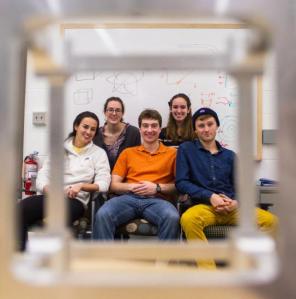
EQUiSat Students

EQUiSat Students

The EQUiSat CubeSat will have an LED beacon visible to the naked eye at night and will transmit data about its health and position.

EQUiSat, being built by a team of students at Brown University in Providence, Rhode Island, has been cleared for launch.

NASA has announced that EQUiSat is among 16 small satellites selected to fly on rockets to be launched over the three-year period beginning in 2015. EQUiSat has not been assigned to a particular rocket, but the announcement assures that the student-led project has a ticket to ride.

“It was pretty great to hear the news on Thursday,” said Hannah Varner, a senior engineering concentrator and one of the team’s leaders. “We’ve all been in disbelief for the last few days.”

The launch will be part of NASA’s CubeSats Launch Initiative. CubeSats are miniature spacecraft — four-inch cubes weighing around two pounds — that can be included as auxiliary payloads on rockets flown for other primary missions. The program’s purpose is to spur innovation in the design of relatively low-cost satellites and to get students interested in space technology. To get into the program, the Brown team submitted an application and made presentations to two review boards that judged the project’s technical feasibility and overall merit.

EQUiSat’s mission will be largely educational. The tiny satellite will carry a flashing LED beacon that will be visible to the naked eye as it passes through the night sky. In Providence, the beacon should be approximately as bright as the North Star, flashing every two minutes when in the night sky. EQUiSat will also broadcast via radio data on the health of its systems and its orientation relative to the Earth and sun. The signal will be available to anyone with a simple amateur radio receiver.

EQUiSat CubeSat

EQUiSat CubeSat

The idea is for EQUiSat to be a visible and audible ambassador from space to students and space enthusiasts on earth. The Brown team plans to combine the launch with a public outreach program. An app will help people track EQUiSat and know when it’s visible at their location. The team also plans to put together lessons that use EQUiSat to teach middle and high school students about satellites, orbital science, and space in general.

“Satellites have become so common but so few people know how important they are to everything we do,” Varner said. “They’re crucial to cell phones and TV and everything. So exposing a younger audience and a non-science audience to satellites was important for us.”

Another aspect of the mission is to show that space can be accessible to just about anyone with enough interest to try to get there.

“CubeSats are a really great architecture because, compared to other kinds of satellites, you can build them really quickly and get a launch comparatively easily,” said Emily Gilbert, a physics concentrator and an EQUiSat team leader. “They’re launched as secondary payloads so you don’t need to commission your own rocket for hundreds of millions of dollars. So it’s great for student groups without a lot of money and without a lot of time.”

EQUiSat will be inexpensive even by CubeSat standards. The students are building their satellite essentially from scratch, despite the fact that CubeSat parts — chassis, solar panels, and other components — can be purchased. Those parts aren’t cheap, and the build cost for most CubeSats is generally north of $30,000. But the EQUiSat team is working on a budget of around $13,000. Ultimately the students hope the design they develop for EQUiSat will lead to a CubeSat that can be built for $3,000 or less.

“We’re trying to prove that it’s possible to meet all of the specifications and all of the requirements without the very, very costly technology that is out there to build a satellite,” Varner said.
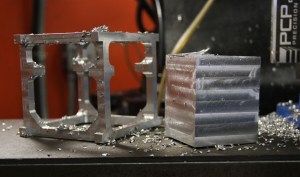
EQUiSat Structure

EQUiSat Structure

The students have worked for the last three years to design and build EQUiSat’s key systems. An attitude control system will align the satellite with Earth’s magnetic field to keep the LED pointed at a visible angle. A solar array will charge a set of lithium iron phosphate batteries, which will in turn power the LED and radio communications system. All of those systems will be carried on a chassis that can withstand the vibration of launch and the harsh vacuum of space. The team will spend the next year or so refining those systems and putting them all together on their tiny spacecraft.

The EQUiSat venture was launched in 2011 as part of an engineering design class taught by Rick Fleeter K8VK, adjunct professor of engineering. The project morphed into a student club in 2012 and now has around 30 student members. Fleeter, who founded a private satellite company before coming to Brown, oversees the club. But this is very much a student-owned project, he says.

“They’re just going on their own energy. I kind of got them pointed in the right direction, but it’s not like I have to encourage them or say, ‘Gee, guys, we ought to have a meeting.’ They just go.”

The original student founders were Kelsey MacMillan, Alexander Neff, Alexander Carrere, and Michael Monn KF7DEC, all members of the 2012 class. They passed the torch to the current group of leaders, including Varner, Gilbert, Kelly Hering, Tyler Del Sesto and Casey Meehan. All except Meehan are seniors, so they’ll need to pass the torch again. They’re quite confident that younger students will get EQUiSat into space.

“We have a really enthusiastic bunch coming up behind us,” Gilbert said. “We have a lot of faith in them.”

The team could get its launch call anytime starting next year through 2017.

Brown University Cubesat project https://mygroups.brown.edu/organization/CubeSat

Facebook https://www.facebook.com/browncubesat

$50SAT PocketQube Update

Yaesu handheld and $50SAT 1.5U PocketQube

Yaesu handheld and $50SAT 1.5U PocketQube

Michael Kirkhart KD8QBA provides this update on the $50SAT PocketQube which transmits on 437.505 MHz (+/-9 kHz Doppler shift).

The TLEs on the Dropbox have been updated to reflect the latest element set available from Celestrak. This probably is not necessary, as many (if not all) of you are probably pulling them down into your satellite prediction programs straight from Celestrak’s WWW site.

Construction of the replacement engineering model (engineering model 1 was promoted to flight model 1 and is what is in orbit) has been completed, and preliminary tests show it to be operating correctly. I posted a few photos of the build up on the Dropbox in the Pictures/Engineering-Model-2 folder. Final mass is 202.1 g, which is about 4 to 5 grams lighter than the flight model. This is in line with expectations, as it only has 1 fully populated solar panel, and the missing solar cells (18 of the 24 used on the flight model) would add about 4 to 5 g.

The RTTY reports file has been updated to include all telemetry posted/collected as of 2014-02-11. This file has nearly doubled in size from the last update, which was only 16 days ago. Thanks to everyone who has been feeding the data beast by posting their telemetry; please keep doing so. QSL cards for those who have been posting telemetry should start appear in your mailbox in the next few weeks (or sooner).

$50SAT Boards

$50SAT Boards

While it is still quite cold (and snowy) here in EN82, I have been going out with my FT-60 to listen for at least one pass per day. As the terminator continues to move north (not fast enough for some of us who would like to get past winter), I have noticed the point where the FM Morse beacon transitions to slow code speed (indicating it is now warm enough to turn on the solar power) has been occurring earlier in the pass. As soon as it warms up a bit, I will gather some telemetry just to see how much solar power is being generated.

I have a bit more analysis to do, but thanks to some telemetry captured by Kristaps, we believe the low temperature of $50SAT to be about -24 degrees C.

73
Michael Kirkhart KD8QBA
$50SAT team

$50SAT is one of the smallest amateur radio satellites ever launched at 5x5x7.5 cm and weighs only 210 grams. Transmitter power is just 100 mW on 437.505 MHz (+/-9 kHz Doppler shift) FM CW/RTTY. It uses the low cost Hope RFM22B single chip radio and PICaxe 40X2 processor.

$50SAT has been a collaborative education project between Professor Bob Twiggs, KE6QMD, Morehead State University and three other radio amateurs, Howie DeFelice, AB2S, Michael Kirkhart, KD8QBA, and Stuart Robinson, GW7HPW.

Further information in the $50SAT Dropbox https://www.dropbox.com/sh/l3919wtfiywk2gf/-HxyXNsIr8

There is a discussion group for $50SAT http://groups.yahoo.com/groups/50dollarsat/

50DollarSat http://www.50dollarsat.info/